TPG Telecom is using AI to intervene in circumstances that could be detrimental to user experience, with a view to maintaining high sentiment scores.
The telco’s chief technology officer Giovanni Chiarelli demonstrated the concept at the company’s investor day this week.
Amid a wider investor briefing that gave AI a central place in the carrier’s plans to improve business performance, Chiarelli said that the technology was among a narrowing list of options that remained available for the telco to improve its customer experience.
“As we’ve said before, our network is the strongest we’ve ever had, so in terms of further improvement on the customer experience ... only with AI adoption can we achieve a granularity that can give us the next the next boost,” Chiarelli said.
Chiarelli said that the carrier has developed three AI models for monitoring and measuring customer experience across mobile, fixed home broadband and enterprise.
The carrier has deployed an advanced data platform that has ingested a year’s worth of data from mobile devices using its network and “a good part of the fixed broadband” network as well, Chiarelli said.
Chiarelli did not provide detail on the type of generative AI that the carrier is using.
He said that the models have "learned to calculate the customer experience for what is as close as possible to the net promoter score (NPS) of the customer.
For mobile, this uses both direct network telemetry data and additional sources such as crowdsourced data from customers nearby, as well as complaints and churn events.
The aim, Chiarelli said, is to balance the individual experience with that of other people that are using and consuming network connectivity nearby.
The carrier has taken a similar approach to fixed broadband in homes. As a starting point, the system can automatically trigger router restarts to provide customers with an immediate lift in performance – an automation feature that Telstra has recently been vocal about in media reports.
However, TPG Telecom said that it aimed to go further with its AI-driven automation to generate sets of proactive responses that the carrier could take to prevent NPS scores slipping into “detractor” ranges.
In fixed residential, customer experience is dictated by NBN and TPG infrastructure, but also by customer premises equipment (CPE) type and placement.
“It’s regarding the router that you have, it is regarding the position of the router, it is regarding the wi-fi you have,” Chiarelli explained.
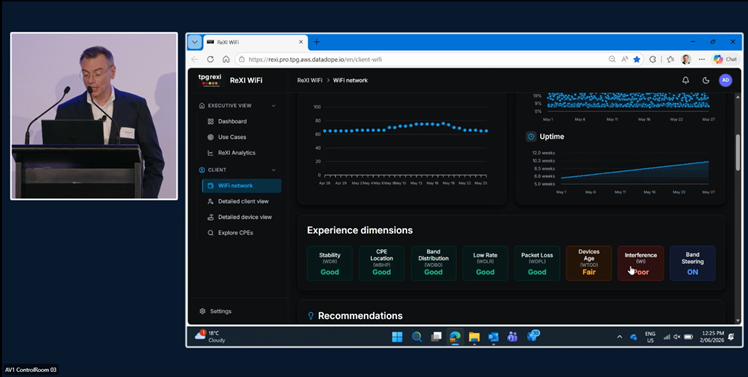
Demonstrating the system live, Chiarelli shared the dashboard of the based on an example of an anonymised NBN user with a neutral NPS.
The AI was able to pull data about devices on the customer’s home network, including the number of active devices, the most used, how old or new they were, and even their positions within the home.
These factors, said Chiarelli, were used to drive proactive customer communications. That could include suggesting where customers position home equipment or types of new equipment that could improve their experience, which Chiarelli said provided an opportunity for upsell.
Earlier in the day, attendees heard that competition in the NBN market was at its toughest due to flat growth in NBN Co’s overall subscriber base.
TPG Telecom said that NBN retailers were now only achieving subscriber growth by luring customers from rivals.
The carrier is aiming to deliver a $100 million in operating cost savings by FY2029.
A goal it is hoping to reach in part by lowering customer service costs and it expects automation to play an important role in getting there.



.jpg&h=140&w=231&c=1&s=0)


.jpg&h=140&w=231&c=1&s=0)


.png&w=120&c=1&s=0) HPE Networking Day Sydney
HPE Networking Day Sydney
 iTnews Resilience, Rewired Breakfast
 RIMPA Live Convention 2026
 iTnews Benchmark Security Awards 2026
 iTnews State of Security Breakfast Sydney


.jpg&h=271&w=480&c=1&s=1)