

Managing an organisation's financial technology stack in 2026 means keeping a close eye on trends shaping the market while ensuring business continuity and planning ahead to meet often unexpected events in an unsettled world that moves quickly.
A big picture view points to organisations still looking to move off manual financial tooling towards automated systems that can meet their growth needs and also handle more complex regulatory demands.
Some market trends to look out for in Australia this year include the 2027 deadline for ERP, which will see enterprise software provider SAP end mainstream support for the legacy platform which much of the big end of town runs on.
Payroll management meanwhile has become riskier thanks to Australia last year criminalising deliberate underpayments of wages, with severe penalties for individuals and organisations that do so.
Employers will need to deal with the important question whether their current systems can be made compliant, so as to avoid straying into "wage theft" territory where hefty penalties await.
Payday Super is another regulatory issue that came to the fore last year, when legislation was passed in November.
Employers have to pay super at the same time as wages from July 1 this year, to ensure that contributions reach funds within seven business days.
It's 2026, but organisations are still shedding spreadsheets and moving towards systems that automate commonly performed tasks quicker than what is possible with manual financial planning and analysis systems.
Having to do slow, painstaking data importing from multiple sources, along with reformatting ahead of processing and visualisation is still a reality that many organisations grapple with.
Speeding up that process means better decision making and much less time flying blind while charting the course for an enterprise.
Add to that a dollop of unavoidable artificial intelligence (AI) for automation and integration of data sources, a technology that promises greater efficiency and productivity but also carries risk that needs to be mitigated.
Either way the finance function of organisations is set for a busy time ahead, as they face technology shifts towards AI and automation, and tightened regulatory demands.
ERP users explore AI
Melbourne-based Acusensus is a technology company that designs and develops AI enabled road safety solutions for the global market.
Currently, Acusensus has 320 staff, and for its 2026 financial year forecasts revenue to exceed $83 million.
Acusensus had a long list to tick off when it moved off entry-level accounting tools and spreadsheets, to the Oracle NetSuite ERP system.
The company’s chief financial officer Anita Chow said Acusensus has a complex operating model with a mix of software, hardware and services.
These needed to be consolidated on a single system, to enable more automation as the company entered new markets, Chow added.
“NetSuite has helped us unify our finance, procurement, inventory and asset management processes to automate workflows, accelerate reporting, improve business partnering and streamline regulatory compliance as we expand,” Chow said.
Some of the wins with NetSuite for Acusensus include being able to close its books in just six days, something Chow said could take over two weeks in the past.
Being able to triple Acusensus’ invoice volume by using AI built into NetSuite, but without greatly increased headcount is another plus for Chow.
Acusensus is currently exploring what AI can do for the company, and Chow acknowledged that it is useful for getting more intelligence out of work, and to help with day to day tasks.
“It’s still early days for AI,” Chow said.
“We haven’t been able to eliminate work [with AI] but it adds value,” Chow said.
At the same time, AI can help level up inexperienced staff, she added.
Security is a concern with AI, and Chow pointed to governance as an important aspect to mitigate risk around the technology’s use.
Payroll leans on automation to manage growing complexity
Paying staff used to be yet another administrative chore for businesses but thanks to the recent tightening of regulatory obligations, getting remuneration right each and every time has become paramount.
Growing grocer chain Happy Apple in Melbourne grappled with how to support what has become a multi-site operation with several stores across the city, and staff expanding from 20 to 180.
That growth added to complexity for Happy Apple, with its existing system unable to keep pace with the expanding business.
Staff are paid under the General Retail Industry Award, and as Happy Apple grew, it became a complex and lengthy task to run payroll, with the job often taking seven to eight hours.
With young, casual-heavy employees, that work was an extensive task that payroll and accounts manager Philippa Gadsby at Happy Apple was faced with.
Automating as much of the work, including onboarding, rostering and pay using a single solution from Brisbane-based Tanda has cut that time down to about 20 minutes for Happy Apple.
As for being compliant with regulation, Gadsby said prior to the automated solution, it was her job to stay across the retail award, and to ensure that Happy Apple was compliant with all its staff members.
“This is a massive job that I would often have to outsource,” Gadsby said.
Now, the Tanda system checks Happy Apple’s compliance with the retail award; staff also have a mobile app to check rosters, view payslips and lodge unavailability.
Driving home the variable regulatory landscape for payroll, the Full Bench of the Fair Work Commission in March this year decided to remove junior rates under three awards, including the retail one that Happy Apple operates under.
To be phased in by December 1 2026, workers aged 18-20 with six months’ service should move to full adult rates.
PwC made the point that incorrect payroll configuration can result in serious consequences.
“Over many years, a small problem can end up with a big number attached, even if the majority of employees have been paid correctly,” PwC partner Stuart Shinfield said.
FP&A continues to shed the spreadsheet habit
The Queensland government’s Department of Transport and Main Roads (TMR) in December 2025 moved to SAP’s S/4HANA enterprise application suite, a shift that has opened up new possibilities and speeded up business processes.
One of the new items is a finance dashboard, which TMR’s manager of reporting, financial planning and analysis, Rory Armstrong said entailed moving off an older Tableau-based system, and a chain of spreadsheets, onto the SAP Analytics Cloud (SAC).
Under the old approach the finance team spent four to five days each month pulling data from the ERP, wrangling it and loading it into Tableau, and the figures were not visible until about the third day, Armstrong explained.
Now, the new dashboard runs overnight, and is roughly 90 percent populated when staff arrive, with underlying data flowing straight through from the ERP source rather than through spreadsheets.
The gain is not only speed but control, because once staff work in the system "you've got a single version of the truth, controlled information, and people are not slicing numbers to suit their own agendas," TMR’s deputy chief financial officer of digital transformation Paul Hesford said.
"We kicked this all off with some process mapping and some lean methodology work just to understand the current state, where the pain points are," Jennifer Allen, TMR’s deputy CFO of finance, said.
That sequence, fixing the process before choosing the technology, is what the department credits for a build of about five months, a two-month pilot followed by two to three months of work on a standard SAP data model with no customisation.
Overall, the project has been well received at TMR, with Allen saying the agency’s director general has been very complimentary.
“She loves it, was very excited around just the efficiency and now the capability that we're growing in the organisation to directly connect to the data tables and the fact that we can use AI just to remove that manual intervention,” Allen said.
“Also it improves the accuracy and removes that human error bit of miskeying a number or whatever for the variance commentary,” she added.
Another feature appreciated by TMR’s executive leadership team is that the dashboard can be utilised on their iPads.
“The executive being on iPads, they're able to bring this up on their iPad and it renders very, very well, very cleanly,” Allen said.
“They can actually bring it up and our CFO has been walking around town showing other CFOs, ‘look what I've got.’ on his iPad,” she said.
“So, you know, I'd say, so I think the proof's in the pudding that the CFO is incredibly proud of what we as a team have done; it's looking really, really good,” Allen said.
Allen said TMR has got some training to do and get those that aren't so digitally savvy more comfortable with using an online tool.
AI sits inside the dashboard in a deliberately bounded role, drafting a first pass of variance commentary in consistent language across divisions so staff can add the context a machine cannot, such as a weather event or trouble securing contractors.
TMR is looking to shift financial forecasting off spreadsheets, with Allen saying that function is 12 to 24 months away.
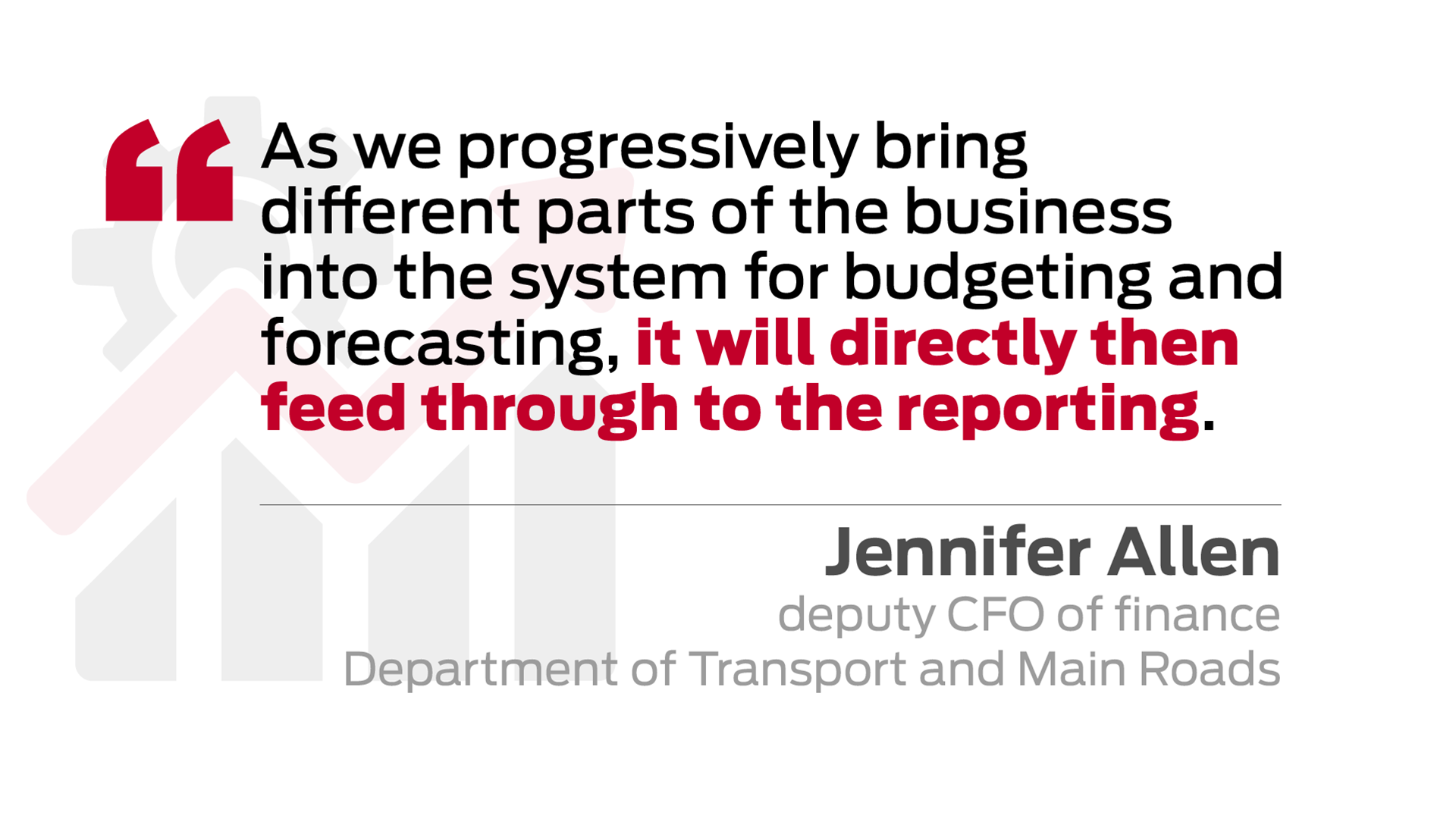
“As we progressively bring different parts of the business into the system for budgeting and forecasting, it will directly then feed through to the reporting,” she added.
A common thread across ERP, payroll and financial planning is the shift off spreadsheets and manual tools onto automated, connected systems, driven less by the technology itself than by growth, looming deadlines and a regulator with less patience than it once had.
Artificial intelligence sits on top of all of it, but it is still early days, despite exaggerated vendor claims.
An automated system built on a flawed process simply makes the same mistake faster, the advantage over the busy few years ahead will sit with the finance teams that do the unglamorous groundwork before they chase the AI.
State of Finance Tech Champion

Unmanaged SaaS is now a compounding liability. Can your governance keep up?
SaaS costs now demand continuous governance.
As SaaS pricing shifts from fixed licences to consumption-based models, unmanaged software is becoming a compounding financial and operational risk. Shadow IT, unused licences and AI-enabled tools can no longer be cleaned up at renewal or audit. Organisations need continuous governance, with IT, finance, procurement, security and business teams working from a shared view of usage, value and risk.