TPG Telecom and Optus are disputing Telstra’s claim it can deliver useable mobile services to consumers in areas where weaker signal strengths dominate as debate over how to map cellular coverage in Australia starts to heat up.
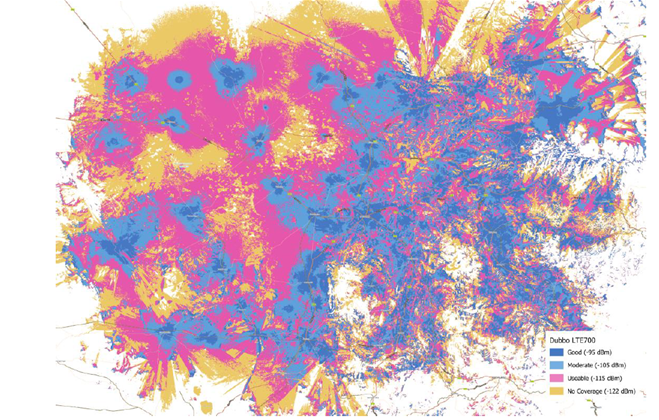
At the heart of the clash are contentious claims Telstra has put to the Australian Communications and Media Authority (ACMA) in response to its recently released draft of a new standard for mapping mobile coverage and service levels for consumers.
Communications minister Anika Wells last October directed the regulator to establish the new standard, which is based on mobile signal strengths. ACMA released its draft of the instrument for industry consultation in January.
ACMA’s preference under the draft standard currently proposes to declare areas with signal strengths lower than -115dBm as not having a useable service.
However, Telstra has told the regulator that it should be permitted to label areas with lower strengths, down to -122dBm, as having useable mobile service on its coverage maps.
Its rivals, TPG Telecom and Optus, disagree. They have contested Telstra’s claim and want the regulator to hold firm at its current proposed threshold which, if adopted, will dramatically cut back the area that Telstra will be able to claim its network reaches on its coverage maps.
"Coverage should mean your phone works"
TPG Telecom told iTnews that Telstra is pushing for a coverage mapping standard that would allow it to claim coverage in areas where consumers “probably” can’t place calls over its network.
“ACMA says coverage should mean your phone works. Telstra wants coverage to mean your phone might sometimes show a bar but probably can’t make a call.
“This is exactly the issue we exposed last year when Telstra was telling Australians their phone would work across 3 million square kilometres, a footprint that only holds together if you include vast areas where phones often don’t actually work.
“Only Telstra is fighting against this proposal for accurate maps because it exposes how much of its advertised coverage people can’t actually use,” a spokesperson for TPG Telecom said.
TPG Telecom, which sells mobile services in competition with Telstra via its Vodafone-branded network, has been contesting its rival’s coverage claims for close to a year.
It referred them to the Australian Competition and Consumer Commission (ACCC) for investigation last May.
“At Vodafone, we only show areas where we are confident our customers can reliably make calls,” the spokesperson added.
In its submission to ACMA on the mapping standard, it wrote that Telstra has “for many years” been using flawed methods to make its coverage claims.
It told the regulator that information Telstra and its mobile virtual network operator (MVNO) partners publish about the reach of their services is “confusing” consumers.
Putting Telstra's coverage claims to the test
TPG Telecom commissioned its own drive testing involving 20 locations where Telstra indicates on its website have “full coverage”.
It said that the tests showed that the probability of successfully placing calls over Telstra’s network in those locations using popular, modern makes of mobile handsets was “very unlikely”.
“Our test results showed that a typical user with a mobile phone is very unlikely to receive a usable mobile service in almost all of the area described by Telstra as ‘full coverage’.
“Importantly in some places within this area, the phone registered a signal but could not establish a voice call. In other places no signal was registered at all.
"This shows that although a carrier may have represented that a phone has signal at a particular dBm level, in practice, calls cannot be established at that level,” TPG Telecom wrote in its submission.
TPG Telecom also repeated arguments it put to the competition regulator that Telstra’s coverage claims only stand up in cases when consumers use signal boosting antennas.
“In or around December 2025, Telstra introduced even more confusion to users when it changed the description on its coverage maps from what used to be external antenna coverage to ‘full coverage’.
"Telstra now represent that an ordinary user with a smartphone can receive usable mobile coverage in areas where it is highly unlikely to receive any usable signal,” TPG Telecom stated in its submission.
TPG Telecom urged ACMA to adopt the -115dBm threshold, saying that it was what was “deemed acceptable” by the federal government’s National Audit of Mobile Coverage (NAMC) project.
The NAMC audit is a joint project by Accenture and Australia Post to test mobile signal strength and service coverage levels using a mix of drive testing and sensors placed at 77 regional post offices.
Telstra and Accenture are also currently partners in a joint venture aimed at accelerating the carrier’s adoption of AI across its business.
Telstra's marketing challenged
Telstra currently uses a lower threshold signal strength of -122dBm to define useable service in its coverage mapping.
If ACMA adopts the new and less forgiving signal threshold, it might create difficulties for Telstra.
The carrier has traditionally leaned heavily into marketing that emphasises the reach of its mobile coverage, particularly when it's advertising is directed at consumers who either live, work or regularly need to travel through regional areas.
Legal action between rivals over their competing mobile coverage claims are also not unheard of in the sector.
Furthermore, it’s not unreasonable to speculate that the new mapping standard will play a role in regulatory activity that might impact mobile network operators.
In its submission on the mapping standard, Telstra fiercely defended its preferred signal threshold for making coverage claims.
It told ACMA that, if the -115dBm threshold is adopted, it will immediately have to remove from view a million square kilometres of area currently marked as having service on its coverage map.
ACMA explains its threshold rationale
ACMA said the -115dBm threshold is based on coverage metrics adopted overseas, work by international telecommunications standards bodies and the federally-funded NAMC audit.
Extending from the threshold, ACMA wants the new coverage maps to include four labels: good coverage, moderate, useable and no coverage.
Areas where signal strengths exceed -95dBm would be considered to have good coverage, moderate coverage from -105dBm down to -115dBm, with a no coverage label to be applied to areas where intensity is lower.
Customer confusion
However, Telstra says ACMA’s approach will confuse customers. In some cases, it said, it might prompt them to make decisions about work, health and safety, and about telco service purchases, that are based on misleading information.
“It’s not an insignificant proportion of our customer base that currently relies on our coverage below the -115dBm threshold.
“Our concern is that, if there's not a way to represent it in some way in the new standard, we may need to find a different way to help our customers understand that it exists, because we know it works. We know they're using it today and we're not alone in that,” a spokesperson for Telstra told iTnews.
Rather than being in step with the federal government’s approach when classifying mobile service signal viability through the NAMC audit, Telstra argues ACMA’s labelling approach contradicts it.
The carrier has told ACMA that the NAMC labels signal strengths below -115dBm down to -122dBm, as a “modest” service, rather than “no coverage”.
“Further, the [NAMC] audit does not even regard this ‘modest’ coverage as the edge of coverage but includes another coverage tier called ‘limited’ coverage immediately below modest and above their ‘no service’ tier,” Telstra wrote in its submission.
“This distinction is central to the audit’s approach. The audit’s service-based tiers are designed to capture actual usability across all networks, recognising that performance varies but that usable service persists well below -115 dBm.
“The audit does not seek to account for operator specific variation. It acknowledges that different networks will perform differently within the same signal range yet still deliver functional outdoor mobility service,” it added.
In coverage in areas where signal strengths on Telstra’s network falls into ranges below -115dBm, around 1.5 million customers still manage to connect to its network each month, according to Telstra’s submission.
Furthermore, it said that customers in those areas are currently making voice calls on the network at a rate of about 700,000 per day, including around 57,000 triple zero calls placed annually.
It’s not clear, however, at how far below the -115dBm signal threshold mobile service remains viable for placing emergency calls.
Optus backs -115dBm
Still, Telstra’s other main rival in mobile service sector, Optus, like TPG Telecom, maintains that, at signal strengths weaker than -115dBm, mobile service isn’t reliable enough for an area to be declared capable of having one that is useable.
Optus told ACMA in its submission on the proposed standard that it considers the -115dBm threshold “probably the lowest value for reliable, useable customer experience”.
“Optus does not support a coverage threshold any lower than -115dBm as we believe this is the lowest level at which customer could achieve a reliable, useable service. While we acknowledge there may be occasional or fortuitous coverage at lower levels, this should not be reliably expected by consumers,” Optus wrote in its submission.
“Any values lower than that would likely overrepresent reliable coverage and experience [for] consumers, as any coverage below that level is likely to be fortuitous,” the carrier added.
Optus further argued that mobile network operators should only be allowed to vary from using the ACMA's recommended signal threshold to make more conservative claims about the size of their coverage on maps.
Allowing mobile network operators to draw up larger coverage areas based on lower thresholds, it said, would lead to an “inconsistent set of coverage categories”, depriving consumers of the ability to confidently compare mobile service reach across providers.
Telstra’s UOMO concerns
Telstra also raised concerns that the draft mapping standard might conflict with the federal government’s new laws requiring the big three mobile network operators to provide competitive mobile services to more Australians.
Known as the Universal Outdoor Mobile Obligation, or UOMO, the legislation, which parliament is yet to pass, requires Telstra, Optus and TPG Telecom – as designated carriers under the new laws – to offer contested outdoor mobile services over 5 million square kilometres of Australia's landmass.
The UOMO, however, relies heavily on recent and future developments in satellite telecommunications, including increasingly available of services provided through Low Earth Orbit craft (LEOsats), Direct-to-Device (D2D) technology, often referred to in the sector as Satellite-to-Mobile (STM).
While concerns linger about the maturity of commercial offerings for the technologies, they might one day vastly improve services for remote communities sparsely dotted across the Australian outback, especially for emergency services communications.
Telstra argues that making coverage maps show no terrestrial connectivity in areas where it claims it can provide a useable mobile service will create confusion in the future when the UOMO obligations kick in and carriers start turning to satellite to meet them.
“This [standard] will be misleading because satellite-to-mobile services will not [Telstra’s emphasis] activate where the terrestrial network is accessible.
“This risks confusing consumers regarding the delivery of Universal Outdoor Mobile [services]. A map showing 'no coverage' reasonably signals that terrestrial connectivity is not expected to work and, in the UOMO context, may also be interpreted as indicating satellite-to-mobile availability.
“At -115 dBm, neither assumption is correct,” the carrier argued.
Some agreement on labelling
Optus did find some common ground with Telstra on coverage labelling. Optus wants ACMA to remove its 'no coverage' classification from its proposed mapping standard, arguing, like Telstra, that it might cause confusion among consumers.
In its submission it wrote that “there may be some occasional or incidental coverage in these areas”, before adding that it was “not likely to be a reliable customer experience”.
Optus recommended that ACMA scrap its proposed approach to coverage labelling in favour of the Global System for Mobile Communications Association’s (GSMA).
Telstra also referenced the GSMA standard to support its position to permit the use of weaker signal thresholds when mapping its coverage.
The GSMA’s coverage classification system only contains two tiers: “strong/indoor” and “variable/outdoor”.
The “strong/outdoor” label, Optus said, should apply in areas where signal strength exceeds -105dBm and replace the ACMA’s proposed “good” and “moderate” tiers altogether. The “variable/outdoor” label would be used to describe areas where signal strengths were weaker than -105dBm and down to -120dBm.
Suggesting ways to describe the two labels for consumers, Optus said that, with an indoor experience, consumers could expect voice calls, SMS and data connections to be reliable.
Optus’ suggested description for the “outdoor” experience is substantially identical, but applies only where signal strengths are greater than its preferred threshold for viable service of -115dBm.
Telstra, in its submission, described the indoor classification as providing service commensurate with that needed for “fixed-like use cases”.
Both of Optus' descriptions contain caveats: in the case of the indoor category, it said that building types and densities impact connectivity; in the outdoor category it said “factors other than coverage” could influence customers’ ability to use a mobile network service.
TPG backs simpler, binary coverage labelling
TPG Telecom also wants ACMA to simplify its approach to coverage labels, saying that consumers “generally view coverage as binary”, preferring to be told which areas do and don’t have coverage.
It’s also recommending a labelling standard that only uses two definitions but not identical to those its rivals would prefer. It has told ACMA that coverage maps should be divided based on relatable consumer concepts of “good” and “useable” services.
However, it argues that the ACMA’s proposal to apply a “good” label in areas where signal strengths exceed -95dBm is too conservative.
In more specific terms, the challenger network operator wants areas where signal strengths exceed -105dBm to be classed as “Good outdoor”.
From there down to threshold signal intensity of -115dBm, it argues, areas should be labelled as “Useable outdoor”.
It wrote in its submission that its approach would allow nontechnical users to gain “a reasonable sense of the quality of the service at the point of making any purchase decisions.
“This will ensure the standard is relevant, timely and accurate,” it argued.
TPG Telecom also urged the ACMA to develop a new standard for measuring mobile coverage quality geared to motorists’ needs.
“TPG has heard from regional consumers that a key dissatisfaction is the lack of consistency between coverage maps and experiences when driving. To that end, TPG believes the ACMA should place an 'unmodified in-vehicle' coverage threshold on its development roadmap as there is a clear need for this information for consumers using mobile services in regional and rural areas,” it wrote.
Tick, tick, tick…
Both TPG Telecom and Optus want ACMA to engage in further discussions with the industry before going ahead with the new coverage mapping standard.
Under Wells’ direction, ACMA is required to complete the standard by the end of the month.
ACMA is also currently chasing a goal to have the new standard operating by June 30 this year.



.jpg&h=140&w=231&c=1&s=0)
.jpg&h=140&w=231&c=1&s=0)


.png&w=120&c=1&s=0) HPE Networking Day Sydney
HPE Networking Day Sydney
 iTnews Resilience, Rewired Breakfast
 RIMPA Live Convention 2026
 iTnews Benchmark Security Awards 2026
 iTnews State of Security Breakfast Sydney


.jpg&h=271&w=480&c=1&s=1)