That stubborn statistic, cited at the outset of a recent iTnews webinar hosted in partnership with Lumify Work, framed a broader and more uncomfortable truth: the issue isn’t technology. Instead, it’s execution.
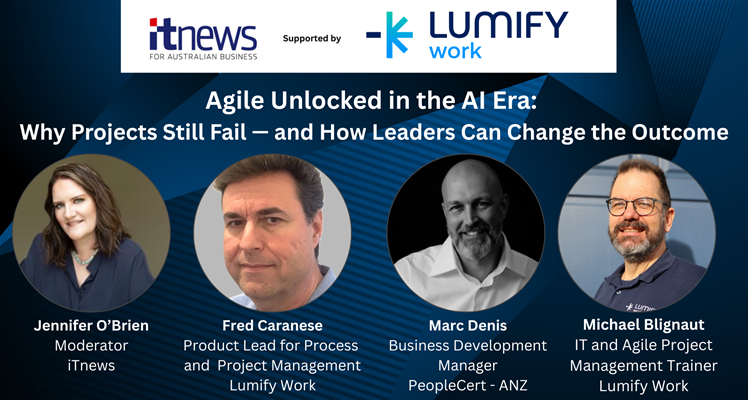
Across the discussion, key themes emerged consistently from practitioners and global experts alike: misalignment between leadership and teams; gaps in training and capability; overconfidence in frameworks; and a growing risk that AI is accelerating existing weaknesses rather than solving them.
“We’ve improved tools and frameworks, but outcomes haven’t improved. Mindset is everything,” according to Agile and Project Product Lead of Lumify Work, Fred Caranese.
Agile is designed to adapt, but execution often falls short
Agile is designed to help teams deliver value in smaller increments, respond to change quickly, and continuously improve based on feedback. But while the principles are well established, many organisations still struggle to apply them consistently in practice.
PeopleCert BDM and Partnership Manager ANZ, Marc Denis, says the challenge is not with Agile itself, but with how organisations translate its principles into day-to-day delivery.
“It’s not the framework that’s failing; it’s how organisations apply it,” he says, pointing to a persistent gap between theory and practice.
From a global perspective, Denis sees two recurring failure patterns. Some organisations rely on a handful of certified individuals and assume that capability will scale across the business. Others adopt frameworks successfully, only to lose understanding over time as teams evolve.
In both cases, the result is the same: the framework remains in place, but its underlying principles are either misunderstood or applied inconsistently.
“Frameworks are there,” Denis says. “It’s the certifications and the training that’s missing.”
Doing Agile vs being Agile
At the delivery level, the disconnect becomes even more visible.
Lumify Work trainer and practitioner, Michael Blignaut, who works directly with teams on the ground, describes a common pattern: organisations “doing” Agile without embedding the mindset behind it.
“Projects really go off track when organisations start confusing activity with progress,” he says.
In practice, that often looks like teams following ceremonies (stand-ups, retrospectives, sprint planning) without aligning those activities to outcomes.
The result is friction between delivery teams and the broader organisation, particularly when leadership expectations don’t match operational reality.
Blignaut describes one engagement where the disconnect was visible from the get go.
“The project manager would say, ‘yes, we’re doing it’… and the team would say, ‘no, we’re not’,” he says. “That disconnect just snowballed into everything they were struggling with.”
Leadership remains the critical failure point
While Agile is often framed as a team-level methodology, Caranese says failure typically originates higher up.
He points to a recurring leadership pattern: organisations commit to transformation, enable teams, and then step back too early.
“There’s a lack of ownership, unclear outcomes, weak reporting,” he says.
In particular, poor visibility into risk and value can derail projects long before issues are formally identified.
“Those systemic failures… tend to creep in and flow down, affecting everyone that’s involved,” he adds.
Agile can’t succeed as a team-level initiative alone. If anything, it requires alignment, understanding, and engagement at the organisational level, he says.
AI is accelerating outcomes, good and bad
Layered on top of these challenges is the rapid rise of AI in delivery environments.
While the technology is already delivering measurable gains, particularly in reducing administrative overhead, it’s far from a silver bullet.
“The real value is reducing that repetitive admin load,” Blignaut says, highlighting use cases such as drafting user stories, summarising meetings, and accelerating documentation.
But he also warns against over-reliance. “It’s not going to replace judgment; it’s going to give us more time to make better judgment.”
Denis agrees, highlighting a growing gap in how organisations manage AI risk from a governance perspective.
“The biggest issue at the moment is AI governance… nobody is really covering AI itself,” Denis says, warning that organisations are still catching up on how AI interacts with data and risk.
Without clear guardrails, even seemingly benign use cases, such as summarising meetings, can introduce data exposure risks.



.jpg&h=140&w=231&c=1&s=0)
.jpg&h=140&w=231&c=1&s=0)


 What’s Next?
 Cloud Resilience Summit
 iTnews Benchmark Security Awards 2026
 iTnews State of Security Breakfast Sydney
 iTnews Executive Retreat - Security Leaders Edition - VIC


.png&h=271&w=480&c=1&s=1)
.jpg&h=271&w=480&c=1&s=1)
.jpg&h=271&w=480&c=1&s=1)