Asahi Beverages is planning to reduce its reliance on market intelligence gathered by its 300-strong human sales teams in the field and AI appears set to play an important role.
The fast-moving consumer goods sector, in which the Melbourne-headquartered subsidiary of Asahi Group is major player in Australia and New Zealand, has traditionally relied on territory sales planning methods such as customer journey plans developed out annually.
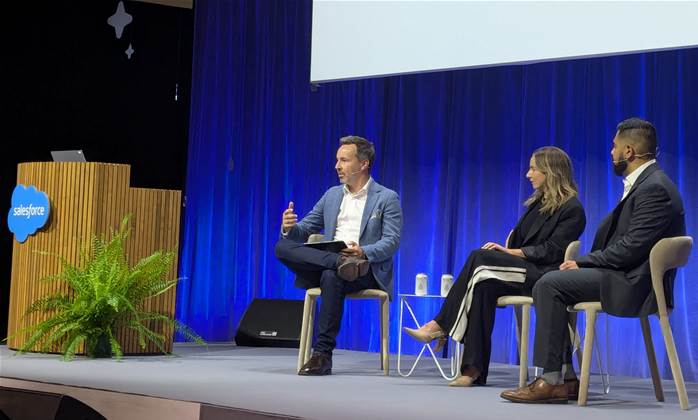
However, speaking at Salesforce’s Agentforce World Tour Sydney event, customer transformation chief Clara Kavanagh said Asahi Beverages was instead planning to use data analytics – potentially including AI-driven methods – to feed granular market intelligence to its sales reps in a more immediate way.
“What we're looking to move to is a far more dynamic model [that] territory planning will enable where we can actually use data in real time to understand consumer needs in particular territories and then deploy resources across the country, whether that be to serve in [new product development] or close gaps in our commercial plan depending on what the data is telling us," Kavanagh said.
“That moves us from relying really heavily on the expertise and experience of our reps and actually allows us to kind of partner expertise and experience with the data to create a better outcome for both our teams and our customers."
Asahi Beverages has, since at least last June, been working with Salesforce to wrestle a consistent view of its customers from what Kavanagh described as a “spaghetti of a technology architecture”.
Merger and acquisition activity over the last 20 years had left the company with the challenge of disentangling and simplifying a hodgepodge of sales and marketing technologies, including 60 relationship management systems and multiple ordering platforms.
While the work isn’t complete, with Asahi still moving its field service technicians onto its unified CRM, Kavanagh said that the simplification project was low-hanging fruit for getting a return quickly.
“We knew that in order to unlock investment we needed to get runs on the board quickly. Where we started was somewhere where we believed that we could deliver significant commercial value but with minimal technical complexity,” she said.
Asahi’s strategy appears to be in line with a broader industry trend which is seeing companies scramble to remove data complexity bottlenecks that could stop them taking advantage of recent developments in AI technology.
Typically, this involves moving data into large repositories or putting it behind a layer that makes it accessible in a consistent way so that AI, agentic or assistive, can process it.
Kavanagh said that AI would most definitely play a role in Asahi’s strategy, but said that it would only be deployed where there was a clear business problem for it to address.
“We're in the business of making marketing moving and selling beverages. We're not an AI business," Kavanagh said.
“However, AI is going to be a critical enabler of how we do business moving forward. And so, as we think about potential use cases, whether it's for analytics, advanced analytics AI and all the way through to agentic, it will focus on how we enable our teams to grow momentum and grow value.
“From my perspective, it's less about tech for tech's sake and more about identifying specific business problems and looking at where artificial intelligence can actually accelerate the outcomes that we want to achieve for our customers and our sales team."
Kavanagh didn’t reveal details of the beverage company’s plans for AI but said that it was watching developments at its rival and sometimes supplier, PepsiCo.
The US beverages has started embedding Salesforce’s Agentforce agentic AI into sales and marketing processes.
Serving the wider hospitality sector, which operates in social hours rather than regular business hours, Kavanagh said the technology had potential to “make customers feel heard” in cases when field beverage serving equipment technicians were unable to be onsite.
However, she said that the most promising feature of AI was the ability to democratise insights and information extracted from data that it usually only available to large licensed premise chain operators.
Instead, she said, it might be possible to provide the same level of strategic help to so called “mom and pop” retailers in its customer base.
“I spent a couple of years working with Endeavour Group, and the level of rigour and focus and insight that we can provide those customers because of the resource we dedicate is incredible,” Kavanagh.
Kavanagh said AI could allow Asahi to provide the same level of strategic knowledge to much smaller customers.
“[Take] the 30,000 or so customers we have across the country. How do we use technology to actually bring that data into each of those customers and help them to grow their businesses?
"I find that to be a super exciting prospect from this technology.”


.jpg&h=140&w=231&c=1&s=0)





 Personetics Executive Forum 2026 — Sydney
 Personetics Executive Forum 2026 — Auckland
 Can Testing Keep Up? Quality in the Age of Accelerating Delivery
.png&w=120&c=1&s=0) HPE Networking Day Sydney
HPE Networking Day Sydney
 iTnews Resilience, Rewired Breakfast