Telstra has taken aim at the federal government’s new mobile coverage mapping standard, saying that it could cause confusion and won’t reflect real-world experiences.
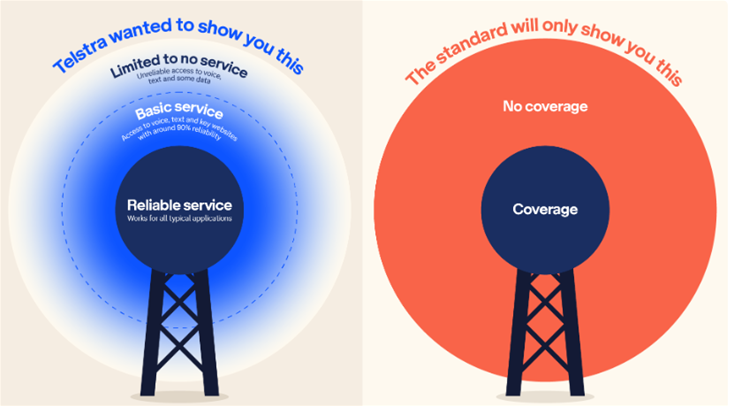
The Australian Communications and Media Authority (ACMA) today announced that it would to stick with its proposed draft standard to label areas with signal strengths lower than -115dBm as not having a useable service.
Carriers will now be required to label new coverage maps based on four service description levels: good coverage, moderate, useable and no coverage.
Areas where signal strengths exceed -95dBm will be considered to have good coverage, moderate coverage from -105dBm down to -115dBm, with a no coverage label to be applied to areas where signal intensity is lower.
With the new threshold in place, Telstra faces the prospect of immediately having to remove from view one million square kilometres of area currently marked as having service on its coverage map.
TPG, Optus back coverage definitions
Telstra’s rivals mobile network operators, TPG Telecom and Optus, support the incoming -115dBm signal strength threshold.
Optus argued that, in areas where signal strengths lower than the threshold dominated, service could not be considered reliable enough to be declared useable.
TPG Telecom also backed ACMA’s -115dBm threshold. It ran its own tests on Telstra’s network in areas the carrier claimed full coverage and found that consumers might receive a signal but would be unlikely to successfully place a call using a standard modern smartphone.
“ACMA says coverage should mean your phone works. Telstra wants coverage to mean your phone might sometimes show a bar but probably can’t make a call,” TPG Telecom said at the time.
Telstra's own testing
During the consultation process Telstra argued that it should be able to continue to use lower signal strength thresholds to draw up its coverage maps.
It cited network data it claims shows that 1.5 million customers each month connected to its mobile network in these intensity ranges, including placing 57,000 triple zero calls each year.
A Telstra spokesperson also emphasised that "nothing has changed about Telstra’s network. No sites have been switched off. No coverage has been removed."
The carrier stood by arguments it previously put to the regulator in an extensive blog post penned by its group executive global networks and technology, Shailin Sehgal earlier today.
Sehgal said that the new standard would see areas with strong usage patterns labelled as having no coverage.
He also revealed that Telstra’s own testing late 2025 showed that, at -122dBm, standard phones could load websites “within seconds”, start apps “without excessive delay” and make “clear” voice calls.
“Telstra supports a single, consistent standard that helps customers compare coverage across providers, but a standard that does not permit mobile network operators to show usable coverage could make it much harder for customers to access the information they need,” Sehgal wrote.
Seghal also said Telstra supported the regulator’s aim in good faith and offered a means of representing coverage that would have better reflected real-world mobile network performance.
“We also recognise that customers don’t want coverage maps that over promise or create a false sense of confidence. That’s not what we’ve advocated for,” Seghal said.
“When we saw the draft standard, we responded with a fact-led approach that would have kept maps comparable while clearly explaining what customers can expect at different coverage levels. It would have provided a transparent way to better reflect real world experience making the maps more useful for the many people who rely on them,” he added.
Where phones will work
ACMA Chair Nerida O’Loughlin today defended the regulator’s new coverage mapping standard.
“These new rules will ensure every carrier is giving the public a like-for-like comparison of service coverage in any location across Australia,” Ms O’Loughlin said.
TPG Telecom was also standing by its arguments it put to the regulator during the consultation period for developing the new standard.
“Consumers rely on coverage maps to understand whether their phone will actually work, particularly when travelling in regional areas. Clear, enforceable standards mean Australians can trust coverage claims.
“TPG Telecom supports the new coverage mapping rules which follow concerns we raised last year about Telstra’s overstated coverage,” a TPG Telecom spokesperson said.
“This reflects the real-world experience of everyday Australians, not what Telstra’s computer models predict, and reinforces long standing concerns raised by regional communities and local officials about inaccurate mobile coverage maps,” the spokesperson added.
Optus also welcomed the new coverage mapping standard.
“The new standard will give consumers and communities the ability to confidently compare mobile service reach across providers,” an Optus spokesperson said.
iTnews has contacted the Office of the Communications Minister for comment.
Carriers will be required to update their coverage maps every three months to reflect any ongoing changes to mobile network service delivery infrastructure.



.png&h=140&w=231&c=1&s=0)

.jpg&h=140&w=231&c=1&s=0)


.png&w=120&c=1&s=0) HPE Networking Day Sydney
HPE Networking Day Sydney
 iTnews Resilience, Rewired Breakfast
 RIMPA Live Convention 2026
 iTnews Benchmark Security Awards 2026
 iTnews State of Security Breakfast Sydney


.jpg&h=271&w=480&c=1&s=1)