Suncorp will have five AI agents handling various tasks or “sub-processes” in insurance claim processing as soon as the end of this month.
The insurer has long been a proponent of data science and AI technology, but its progress with making claims processing more automated - and, behind-the-scenes, agentic - means it is significantly more advanced than previously reported.
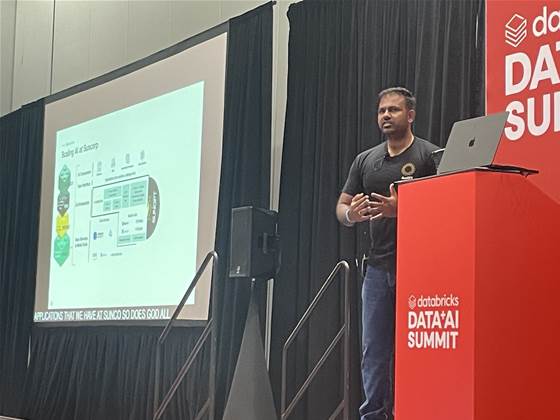
AI practice executive Kranthi Nekkalapu told the Databricks Data+AI Summit in San Francisco that claims process automation is a goal for the sector generally.
“Where we are right now is we are working through automating our claims processes using agents. Now, this is where everybody naturally wants to progress,” Nekkalapu said.
“Claims processes are inherently very complex, but at a high level, they are workflows.
“There are some set stages. You have an intake to start with. We triage or we assess the claim, and then we fulfill, taking lots of actions, and … ultimately settle [the claim].
“[In an agentic world] the workflow remains the same, but within that, there could be several tasks. These tasks themselves could be done by agents.”
Nekkalapu said that while claims process automation remains a “work-in-progress”, the first attempt at making the process more agentic will soon be in production.
“We haven't automated the full end-to-end process, but there are sub-processes within that which we are automating at the moment,” he said.
“The first set of ones, about five of them, are expected to go into production later this month.”
Nekkalapu displayed a “reference design” for the claims process as “an orchestrated, agentic business process”.
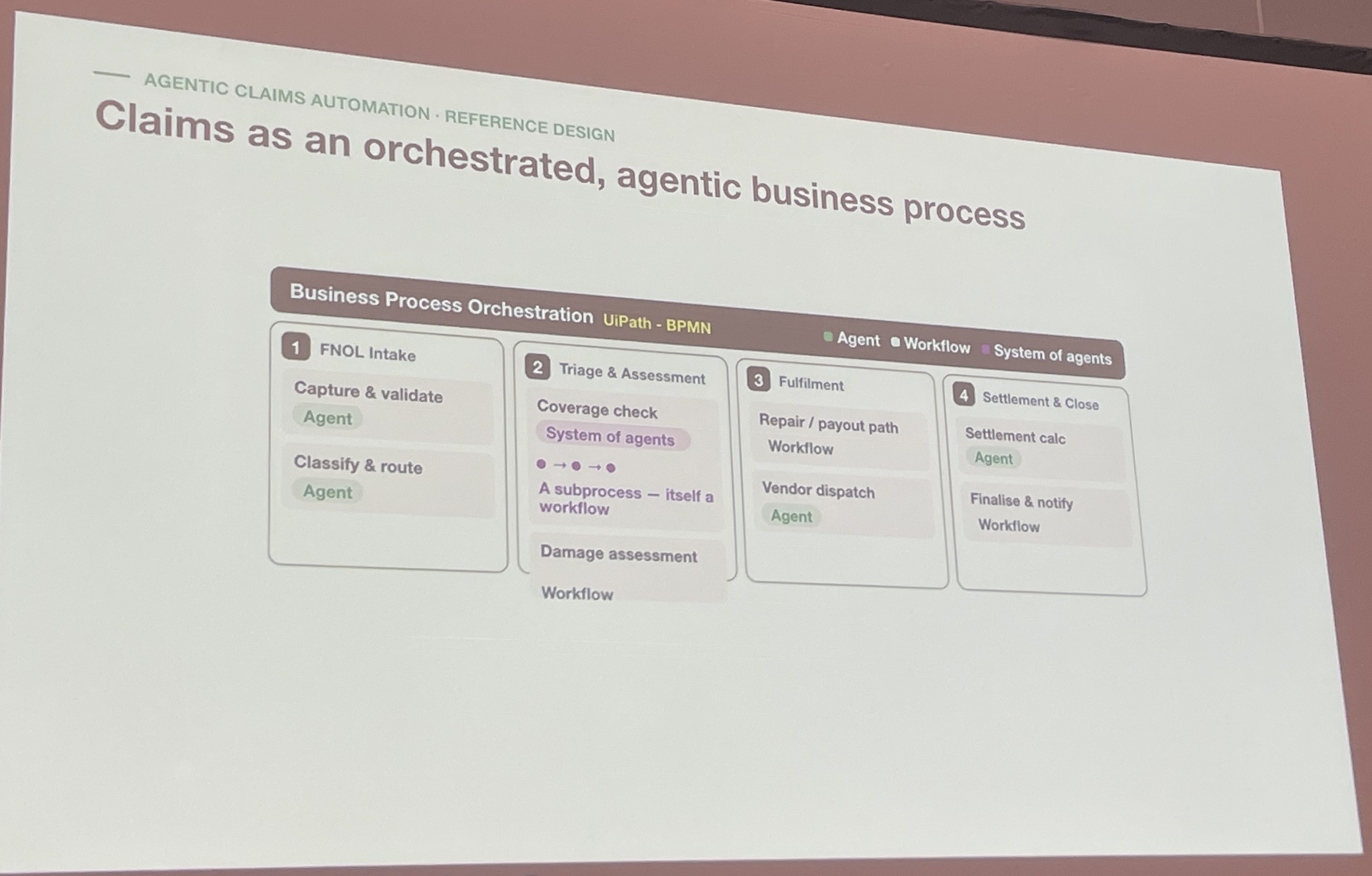
Two of the five agents work in the first stage of the claim being initiated - in insurance parlance, the FNOL or first notice of loss stage, where a customer reports an incident has occurred.
The agents are targeted at capturing and validating the report, and then classifying and routing it internally.
It appears at least one of these agents is voice-based.
“We have got voice agents which went into production very recently,” Nekkalapu said.
“They do the initial intake of the claim in some cases, and if it becomes more complex, then pass on to humans.
“There are multiple channels in which we intake claims.”
A “system of agents” is then specified to perform a “coverage check” as part of triage and assessment of the claim.
Agents are also to be used for “vendor dispatch” - presumably, engaging a party to conduct a repair - and to handle any settlement calculation.
In the reference design, the entire claims processing workflow is mapped out using business process model and notation (BPMN) and orchestrated with UiPath.
“So, at a high level, we are talking about … a BPMN workflow, [with] multiple tasks within that and each task could itself be done by an agent or a system of agents or workflows themselves,” Nekkalapu said.
With a number of agents in the claims process, Nekkalapu said that Suncorp had worked closely to ensure their work “is properly monitored”, governed and meets customer and operational expectations, as well as that of regulators.
“Observability is really, really key here,” he said.
“We may have a very fancy system, but if we do not have control over the risk, if we are not able to observe whether our controls are working or not, [then] it counts [for] nothing.
“There could be severe issues in the system and things may be broken or there may be some sort of attack on these agents by external parties. So how exactly are we going to monitor this?
“That is done through a central observability platform that we have built on Databricks.”
The observability platform is ingesting OpenTelemetry (OTel)-based data feeds from the various agents and technologies used in the claims processing workflow.
“We're bringing in traces by having an OTel collector on Databricks, so all the traces from agents and workflows across all those platforms will be sent to Databricks in real time,” he said.
Suncorp has also assembled “a controls library of about 100 different controls across different types of AI applications and for different types of risks.”
While parts of the claims process are becoming automated and agentic, humans remain involved, from where intake of a claim becomes too complex for an agent to handle, to reviewing claims that an agent determines should be rejected.
“We do want a human gate there, where all the rejected claims may have to go through a mandatory human review,” Nekkalapu said.
Claim coverage
Nekkalapu said that Suncorp is working on “complex agents” that can “determine whether a claim should be covered or not.”
It’s not clear if this is the “system of agents” referred to in the reference design or not.
“There could be a claim where there was a storm last night and a tree fell on the retaining wall, damaging a pipe that's running next to the wall, so that water seeped into a garage and damaged all the carpets and rugs in the garage,” he said.
“That is a contents insurance claim. But if you are looking at coverage, you need to identify what the loss cause is for that event, and based on that, you determine coverage.
“It could be the storm, it could be water leakage, or it could be the impact of the tree falling. It's not an easy problem [to solve]
“Our claims handlers spend a lot of time [on this], and it could be complex.”
He added: “We've developed a workflow with agents in there which can do all these jobs with 99 percent accuracy.”
Observing agentic performance
Nekkalapu added that the Databricks-based observability platform that Suncorp has built is intended to produce different views of agentic workflow performance for different types of internal users.
“We may have senior leadership and executives who are interested in how the whole program is running, so there are certain metrics that they want … and they would be able to get those insights through the dashboard,” he said.
“Our safety team wants to see whether [the application of risk] controls are effective or not.
“Business users want to see why a certain decision was made on the claim, and engineers want to see pretty much everything, but at the same time, they also want to debug it when something goes wrong, and it should not take very long.
“So, we built a dashboard and added [Databricks] Genie Code to that so that it can provide insights at different levels based on who is asking the question.”
Nekkalapu said that teams building agentic workflows within Suncorp would have access to the dashboard that “shows how the program is running, how a use case is running, how an agent is running with little different levels of detail”, and a chatbot to interrogate an observation of an issue.
“A chatbot could be the first level [of support] where they would ask questions, and they would get the answers and all the analysis in real time,” he said.
Ry Crozier attended the Databricks Data+AI Summit in San Francisco as a guest of Databricks.



.jpg&h=140&w=231&c=1&s=0)
.jpg&h=140&w=231&c=1&s=0)
.jpg&h=140&w=231&c=1&s=0)


 Personetics Executive Forum 2026 — Sydney
 Personetics Executive Forum 2026 — Auckland
 Can Testing Keep Up? Quality in the Age of Accelerating Delivery
.png&w=120&c=1&s=0) HPE Networking Day Sydney
HPE Networking Day Sydney
 iTnews Resilience, Rewired Breakfast