SpaceX has filed an application with the US Federal Communications Commission (FCC) for authority to launch and operate up to 100,000 third-generation Starlink satellites, the biggest such broadband constellation proposed so far.
The application proposes a new Gen3 system that would sit alongside the existing Gen1 and Gen2 Starlink constellations.
The Gen3 system is said to start launches in the second half of this year.
Independent tracking by astronomer Jonathan McDowell put the current Starlink constellation at 10,413 satellites in orbit and 10,397 working as of June 1 2026.
SpaceX proposes two closely stacked orbital shells in very-low Earth orbit, or VLEO, at nominal altitudes of 323 to 327.5 kilometres and 473 to 477.5 kilometres, for Gen3.
These are lower orbits than the original 550 km for the Gen1 Starlinks, and the 525, 530 and 535 km shells for Gen2.
Starship needed to fire heavy Gen3 Starlinks into orbit
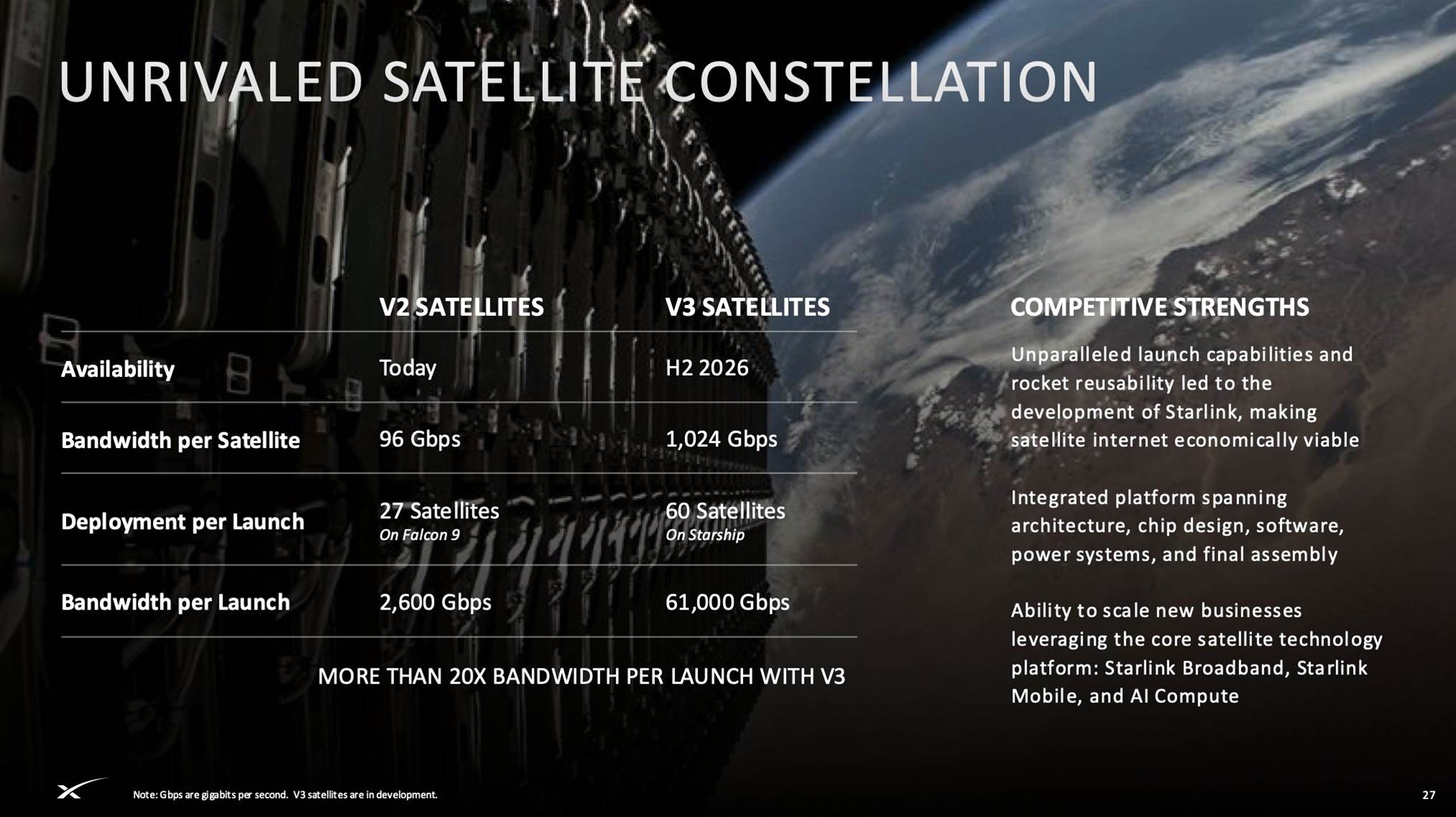
The Gen3 satellites have a mass range of 2000-2500 kg each, matching the full-size Gen2 V2 satellite that has sat on the books for Starship launch since 2022 but has not yet flown in numbers.
It is well above the roughly 800 kg of the Gen2 Mini currently flying on Falcon 9.
That extra bulk means Gen3 satellites can only be launched aboard the 124 metre SpaceX Starship, the company's reusable heavy-lift rocket that it is still developing, rather than its workhorse Falcon 9.
Starship is designed to carry about 60 Gen3-class satellites per flight, compared with 27 Starlinks on a typical Falcon 9 mission.
At that payload rate, over 1600 Starship launches would be required if the full constellation of Gen3 satellites is approved.
Gen3 will use Ku, Ka, V and E-band spectrum already granted for Gen2, and adds a push into largely untapped W- and D-band frequencies between 92 and 275 gigahertz (GHz) for backhaul capacity.
SpaceX argues that AI workloads need far more uplink capacity than today's networks provide, to move high-definition spatial and auditory data in real time.
Curiously, the FCC application for Gen3 makes no mention of the Direct To Cell service that Starlink has launched commercially, or its future mobile phone service.
Mega satellite Starmind constellation
While a 100,000 Gen3 satellites may seem like a massive constellation, it pales in comparison to SpaceX's Starmind, designed to be data centres in Earth orbit.
SpaceX filed an application in January for a Starmind constellation with up to a million satellites, in Earth orbit altitudes of 500 to 2000 km.
In the narrative for the FCC application, SpaceX said the million satellites operating as orbital data centres "is a first step towards becoming a Kardashev II-level civilisation".
This refers to a three-level scale proposed by Soviet astronomer Nikolai Kardashev, with level II being a civilisation that can harness the entire energy output of its home star.
As of writing, it is not clear how far advanced SpaceX's plans for Starmind are.



.jpg&h=140&w=231&c=1&s=0)
.jpg&h=140&w=231&c=1&s=0)
.jpg&h=140&w=231&c=1&s=0)
.jpg&h=140&w=231&c=1&s=0)


 iTnews Resilience, Rewired Breakfast
 RIMPA Live Convention 2026
 What’s Next?
 iTnews Benchmark Security Awards 2026
 iTnews State of Security Breakfast Sydney


.jpg&h=271&w=480&c=1&s=1)


.jpg&h=140&w=231&c=1&s=0)