WaterNSW is seeking to make more use of generative AI in its operations with application development and customer engagement its top priorities.
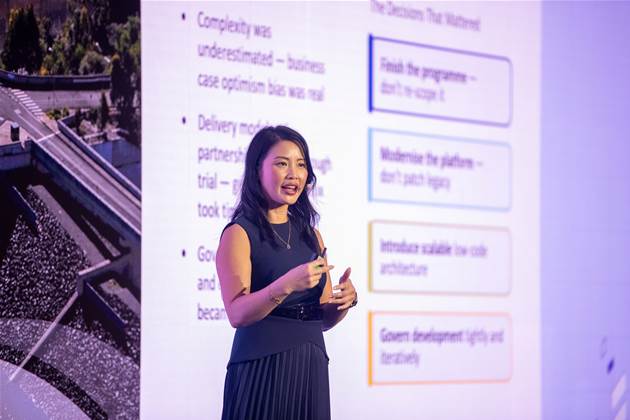
The water authority, which manages NSW' vast supplies of water in dams and other catchment infrastructure, has recently completed a major project to switch from predominately paper-based customer transactions to digital.
Speaking at a Pega Innovate event in Sydney, WaterNSW chief information officer and executive general manager of strategy and transformation Leeanne Chau said that, having completed the transformation, the next step is to use embed AI into the organisation to increase its digital agility.
WaterNSW is targeting two main areas for improvement using AI.
Chau said that the authority’s first priority is to speed up its application design and delivery.
It’s next priority, she said, is to use AI to improve its customer engagement – an apparent bid to increase take-up of its newly digitised client services.
Prompt-based engineering
The water authority appears to be joining the likes of NAB and others in adopting more prompt-based software engineering to speed up its application design.
Chau revealed that it is exploring the use of Pega GenAI Blueprint platform, a low-code, generative AI tool that can be used to build workflows and modernised applications.
Platforms like Pega Blueprint use AI to automate the process of modernising older software applications.
They analyse their code and interrogate other business documentation and policies, to recreate their workflows in more modern applications.
“We'll be looking to work faster through design and build using [Pega] Blueprint and really accelerate that process. It takes us months today to run through one of those prototyping phases and the constant iterations,” Chau said.
Virtual assistants
The second tranche of work coming down WaterNSW’s AI pipeline focuses on virtual assistants, Chau said.
She said the authority wants to use assistants to provide teams and customers with “instant accurate and, really importantly, consistent answers” given the heavily regulated and complex environment within which WaterNSW works.
Chau named Pega’s generative AI Knowledge Buddy as being among the systems the authority is exploring to meet the goal.
Internally, the agentic assistant is expected to help staff to accelerate the process of surfacing specific information from the authority's large institutional knowledge stores.
Outside the organisation, Chau she said that WaterNSW's customers, particularly farmers, were becoming increasingly reliant on digital means such as smartphones to conduct business and interact with the authority.
Accordingly, as a customer-facing measure, deploying agents taps into a wider trend that is seeing big organisations move away from traditional keyword-based search and toward having conversations with customers to boost engagement.
“We'll be looking to engage better through conversational AI, using natural simple language questions and then also being able to get them back in natural simple language as well,” Chau said.
More broadly, WaterNSW’s interest in AI would not be limited to seeking out tectonic operational shifts.
“We’re really excited about where this can go and, for us, AI is not just around the big transformational changes, but also the small incremental improvements that we can make along the way as well," Chau said.


.jpg&h=140&w=231&c=1&s=0)
.jpg&h=140&w=231&c=1&s=0)


.png&w=120&c=1&s=0) HPE Networking Day Sydney
HPE Networking Day Sydney
 iTnews Resilience, Rewired Breakfast
 RIMPA Live Convention 2026
 What’s Next?
 iTnews Benchmark Security Awards 2026




.jpg&h=140&w=231&c=1&s=0)