Telstra needs more LEO satellites to be deployed by its partner OneWeb to stem a sharp increase in backhaul-related mobile base station outages impacting remote communities and triple zero services.
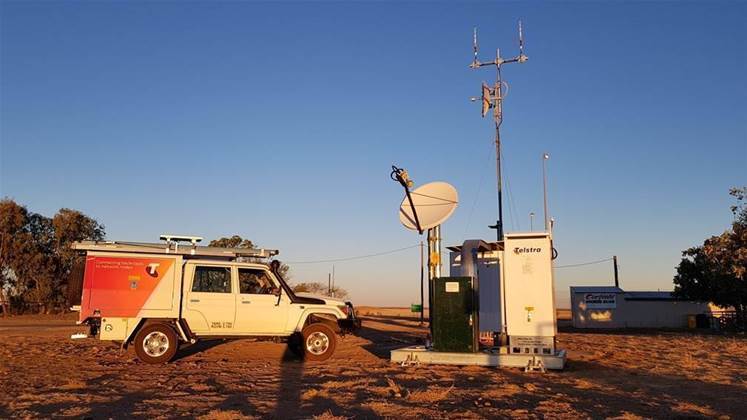
The telco leases capacity on the low earth orbiting craft to provide backhaul from small cell sites into its core network.
But its use of LEOsat-based backhaul has driven a significant - 43 percent - rise in the number of mobile tower outages causing “significant community impact”, from 3614 in 2024 to 5221 in 2025.
In the calendar years 2022 and 2023 the number of outages that Telstra recorded across the remote mobile network had remained relatively stable at 3067 and 3289 respectively.
A Telstra spokesperson told iTnews that the sharp increase in service disruptions was due to its increased reliance on the leased LEOsat fleet to provide backhaul connectivity to the sites.
The carrier said that its provider, Eutelsat OneWeb, is yet to deploy enough LEOsats for ubiquitous coverage.
That meant that the base stations were losing their ability to provide triple zero calls for periods of 10 to 15 minutes twice per day when they moved under coverage gaps and another satellite in the constellation was not immediately available to take over.
It’s understood that, on average, the gaps cause the small cell base stations to be unavailable for placing calls for around 30 to 35 minutes each day.
Telstra told iTnews that it hoped to eliminate the coverage gaps within the first half of this calendar year, but said that it is dependent on OneWeb's capacity to meet its orders and expand its constellation density.
“We are working with our LEO satellite provider to improve coverage through an increase in the number of satellites deployed. Since mid-2025, this has led to a significant reduction in outages,” Telstra’s spokesperson said.
It’s understood that LEO satellite availability in the southern hemisphere has grown more slowly than it has in the north due to landmass, market and population differences between the two zones.
OneWeb revealed overnight that it will buy 340 new satellites, but mainly just to maintain its existing coverage footprint, "progressively replacing early batches [of satellites] coming to end of operational life."
Telstra would not be drawn on whether or not any of the newly-purchased satellites would fill the coverage gaps over Australia.
Triple zero impact
Telstra’s disclosure [pdf] of LEOsat backhaul-related base station outages was made in response to questions put to it on notice during the triple zero inquiry late last year.
The committee asked the carrier to “advise the number of network and Triple Zero outages” between 2022 and 2025.
The base stations primarily serve very small communities in far remote locations such as indigenous settlements and roadhouses.
It’s not clear whether the brief but daily triple zero disruptions have led to fatalities or other outcomes that are cause for alarm in the remote communities that rely on them completely for emergency call services.
Telstra told iTnews that once connectivity to a cell was severed it had no way of monitoring it for failed triple zero calls.
"When a mobile base station is unable to connect to our core network – for example when there is a power outage, or a fibre connection to a tower is cut, or a small cell in a remote location loses satellite backhaul – we're unable to identify any attempts by customers to make calls,” a Telstra spokesperson said.
It also said it was not aware of any cases in which individuals in distress had been left unable to reach first responders due to the LEO satellite coverage issue.
"We're not aware of any example of a customer being unable to contact triple zero at a time when a small cell supported by satellite backhaul has lost connectivity," the spokesperson added.
To smaller extent, it’s understood that the closure of the 3G network has also impacted triple zero service availability in remote areas. When the 3G and 4G networks were operating in tandem they were capable of providing each other with redundancy.
Telstra did not disclose to the committee how many of its mobile base stations are impacted by the short outages, only the total number outages that occur across them in a given timeframe.
Having no visibility into its rivals’ service availability, Telstra focused its response on areas where it was known to be the only mobile service provider as these were the only locations where it could reliably report that triple zero service would be impacted. Where dual or multiple services were available, triple zero could be provided using camp on capabilities of networks and handsets.
Also, in cases where, fixed networks operated alongside the small cells, either via the NBN or other means, triple zero service calls would remain possible, such as by using wi-fi calling.
Since June 30 2025, carriers have been required to comply with new rules requiring them to update customers and government stakeholders of “significant local outages” on their networks.
Announced by the Australian Communications Media Authority and supported by federal legislation introduced last April, the rules extend the regime that was already in place for reporting major outages.
Those rules define a significant local outage as one that impacts more than 1000 services and is expected to persist for longer than six hours in regional areas. In the case of remote areas, the threshold is lower at 250 services with expected outage duration at only three hours.
For the purpose of responding to the inquiry, Telstra defined community impact as being significant to a more stringent standard, setting the bar at 10 minutes or longer.
The carrier said had also taken other steps to fortify its triple zero service availability in response to the issues with its small cell site connectivity, particularly in areas deemed “at-risk”.
It said that it had upgraded 1000 payphones with free wi-fi and stronger power backup, and expanded its use of rapid-deployment Starlink satellite kits for its teams across the country to 200.
It’s also participating in co-investment programs with government to make networks relied on for disaster relief more resilient.
That includes deploying more than 190 auxiliary power upgrades and 110 trailer-mounted, high-powered generators under the federally-supported Strengthening Telecommunications Against Natural Disasters and Mobile Network Hardening Program.



.jpg&h=140&w=231&c=1&s=0)

.jpg&h=140&w=231&c=1&s=0)


.png&w=100&c=1&s=0)
 Sydney Cloud & Datacenter Convention 2026
 iTnews Executive Retreat - Security Leaders Edition
 Can Testing Keep Up? Quality in the Age of Accelerating Delivery
 iTnews Resilience, Rewired Breakfast
 RIMPA Live Convention 2026