Iron ore producer Fortescue has revealed that it’s currently in the midst of an AI transformation ingesting decades of historical data into models, letting it move away from relying on human judgement.
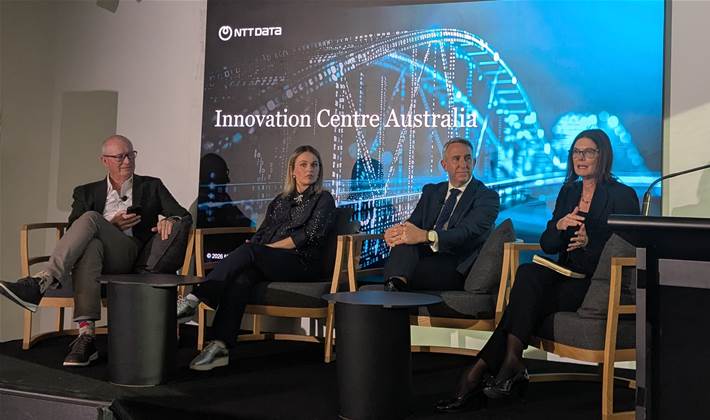
Global CISO Vanessa Van Beek said that the transformation, which has been under way for about three to four years, is impacting a broad swathe of Fortsecue’s operations.
Speaking at the launch NTT Data’s new innovation centre in Sydney, Van Beek said that the company was now relying on AI to for everything from its mining and drilling operations to its energy production management and corporate functions.
Van Beek said that, with a large amount of company equipment already having autonomous capability, Fortescue has now deployed an intelligence layer that helps it with a range of decisions.
For example, she said, AI was helping it to decide where it should drill and which equipment it should use in the process, optimal ore mix for yield, how to schedule its vessels and where it might run into equipment constraints.
“Traditionally that's required a lot of human judgement and expertise. We can put all that data – 25 years of data – into a model and we can actually have more refined decisions and intelligence that's resulting in safety outcomes, greater productivity, more yield – which you'll see that in our annual results – and you'll also see it in the quality of the yield that we're producing now. We have less waste and it's more sustainable.
"We're also linking that with some of our sustainable operations for wind and also solar to make sure we're producing just the right amount of energy for the for the demand we have at any particular point in time.
“AI is really in the heart of our integrated operations as well as some of our corporate functions in the organisation as well,” Van Beek said.
While Fortescue’s AI transformation may only be in its third or fourth year, it’s accelerating an evolution that started further back in time when the company began to expand roboticisation of its physical operations, particularly its autonomous haulage trucks.
In 2017 Fortescue Metals Group – as it was then known – began a long-awaited expansion of autonomous trucks at its Cloudbreak and Christmas Creek mines, converting around 100 vehicles for robotic haulage.
However, Van Beek said the period coincided with a broader company push to use technology to solve safety problems related to deploying workers in some of Australia’s hottest and most remote regions.
“We started the journey of autonomous operations probably about that time, but I think we've always been thinking about [how we can] unlock the value of the data … how can we use AI to see things we haven't seen before and to do predictive maintenance around tyres and [other] maintenance.
“How do we use AI computer vision to, instead of alerting or [sounding] an alarm [if] someone's in an unsafe area, how do we actually shut down part of a mine to save a life?
“We're actually applying AI to those things we haven't been able to see before, because now we have a new lens on some of these problems,” she said.
Closer to home for the company’s most senior information security leader, Van Beek said that she expected the technology to play a powerful in hardening Fortescue’s cyber defences.
“I'm really hopeful for what AI will do for the mining industry. I'm also very hopeful for what it potentially, I can also do for cyber security.
"I'm expecting a lot more power in our vulnerability management and our capability to address vulnerabilities, and also to produce secure code.
“I'm expecting a lot more intelligence right across how we put all of our security tooling together and have those tools work together from a defence point of view,” she said.
However, when asked about a recent incident which saw an OpenAI agent break out of its test environment and conduct a breach cyber security at AI model and tool repository, Hugging Face, Van Beek hinted that humans rather than the technology might have been the problem.
“What should have been put into the prompt engineering? You know, ‘stay in the sandbox first’ maybe? Maybe we'll be designing that into all of our prompts.
“Things will happen and I think we learn as things happen as an industry. We pause and reflect and then we redesign knowing what's possible,” she said.
Regardless, Van Beek saw a tight correlation between take-up of AI and developments in cyber security.
“I think my underlying message is that AI adoption and cyber security, those two are really intertwined like a braid and to accelerate the car you need the brakes. You really do need to have these disciplinary teams working together to solve those problems both inside the organisation and within the ecosystem,” she said.
Fortescue was contacted for additional comment on this story but did not respond in time for publication.



.jpg&h=140&w=231&c=1&s=0)
.png&h=140&w=231&c=1&s=0)
.jpg&h=140&w=231&c=1&s=0)
.jpg&h=140&w=231&c=1&s=0)


 What’s Next?
 Cloud Resilience Summit
 iTnews Benchmark Security Awards 2026
 iTnews State of Security Breakfast Sydney
 iTnews Executive Retreat - Security Leaders Edition - VIC