Customer relationship management (CRM) systems and customer data platforms (CDPs) have driven billions of dollars in marketing technology spending, but the tools themselves have never really been the point. It has always been about the data.
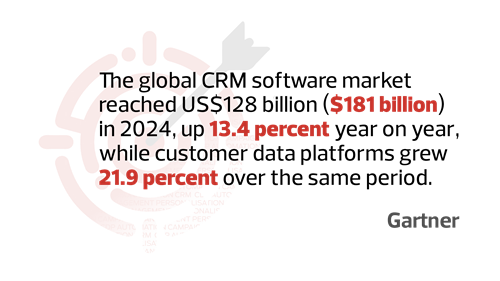
The scale of investment in these tools has been substantial. Gartner estimates the global CRM software market reached US$128 billion ($181 billion) in 2024, up 13.4 percent year on year, while customer data platforms grew 21.9 percent over the same period.
While neither category is disappearing, customer data is increasingly moving into a more distributed architecture, with greater emphasis on a governed data layer that can support intelligence and action across the enterprise.
But for many organisations, the promise of unified customer data remains only partly realised.
The CDP Institute’s 2025 member survey found 68 percent of respondents had deployed a CDP and 57 percent had established a unified customer database. Yet only 64 percent of deployed CDPs were delivering significant value.
From customer platforms to data layers
According to Gartner vice president analyst Ben Bloom, the capabilities of CDPs were increasingly becoming a part of a broader enterprise data architecture.
“We wrote in 2025 that the customer data platform is being forced to evolve from a packaged standalone software-as-a-service application into a layer that is embedded in an organisation’s enterprise data platform,” Bloom said.
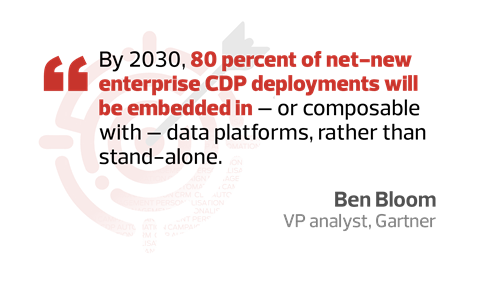
“By 2030, 80 percent of net-new enterprise CDP deployments will be embedded in – or composable with – data platforms, rather than stand-alone.”
Gartner also expected that 80 percent of CMOs who renewed CDP contracts through 2027 would opt for single-year or pay-as-you-go terms, and by 2030, technologies such as data lakehouses and data fabric would become mainstays of martech strategy. This reflected a broader move towards enterprise data infrastructure as the foundation for customer-facing technology.
Bloom said the shifts also extended to questions of who owned customer data decisions, as CDP functionality became more relevant to technology peers.
“Stop duplicating identity – move it to the warehouse – and accelerate plans to work with CIOs and data and analytics leaders to make the customer data platform an enterprise data decision,” he said.
According to IBRS analyst and advisor Dr Joseph Sweeney, while the CDP itself may not disappear, the category itself could, as customer data capabilities become distributed across suites, data platforms, and cloud data warehouses.
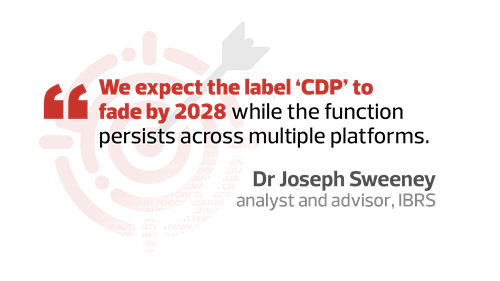
“We expect the label ‘CDP’ to fade by 2028 while the function persists across multiple platforms,” he said.
A data quality challenge
CDPs aren’t the component of the customer data stack undergoing change, as the role of CRM is also evolving.
Gartner forecast the CRM marketing software market would grow from US$26.5 billion ($37.4 billion) to US$46 billion ($65 billion) by 2028, representing a five-year compound annual growth rate of 14.4 percent.
However, its role would change to become a more dynamic source of customer intelligence.
Sweeney said one of the clearest signs of that shift was the improvement in the quality of CRM data itself, thanks to inputs such as AI transcription, conversational client data capture, and automated enrichment.
“Customers report tenfold improvements in CRM accuracy,” Sweeney said.
But improvements in data capture do not resolve the more fundamental challenge of defining a single authoritative customer profile.
Sweeney said that while the unified customer view could work for organisations with relatively clean data and fewer systems, the picture became much more complicated in large enterprises dealing with fragmented identities, overlapping customer records, and jurisdiction-specific consent requirements.
“Aggressive identity resolution creates compliance exposure and conservative resolution recreates silos,” he said.
Customer data management was therefore becoming as much a governance challenge as an integration problem, as organisations struggled to determine which identities should be connected and under what rules, and who was responsible for making those decisions.
The increasingly enterprise-wide nature of customer data also places greater emphasis on collaboration between marketing and technology leaders. Bloom said only 18 percent of organisations currently demonstrated co-leadership in managing their technology stack, but those that did were twice as likely to exceed their business performance targets.
From customer data to marketing judgement
However, better customer data could only go so far. Former Flybuys senior marketer Georgie Packer said the value of martech ultimately depended on how effectively marketers interpreted and acted on the information it produced.
“Data is very good at showing you what has happened, but more often than not, it rarely tells you why,” Packer said.
“That still comes down to marketer expertise and intuition, which is built from years of experience.”
For Packer, the role of technology was therefore to sharpen rather than replace that judgement. In the context of CRM and CDPs, that meant distinguishing the customer signals that mattered from the growing volume of information that was simply easy to capture and measure.
“Martech should sharpen a marketer’s intuition, not substitute for it,” she said. “The most high-performing marketers I know treat these informative dashboards as a starting point for a conversation, and not as the final word.”
For marketers, the question is shifting from which platform owns the customer record to how customer data is governed and made useful across the enterprise.
Whatever happens to the categories, the objective remains the same - turning trusted customer data into intelligence the organisation can act on.
Case Study: REA Group
REA Group is using a common data and engagement architecture to transfer learnings and practices from its B2C marketing operation to its B2B customers.
The creation of a Lifecycle Marketing Centre of Excellence in 2019 has enabled REA Group to bring together its consumer and customer lifecycle marketing teams together under a common operating model using best-of-breed customer data and engagement tools.
According to executive manager for lifecycle engagement, Suzie Scicluna, this has allowed REA Group to take the lessons it has learned through engaging more than 12 million monthly visitors and adapt them to the needs of real estate professionals who use REA Group’s Ignite marketplace.
“We could see that they (professionals) weren't always utilising all of the value of their products and services that we were providing,” Scicluna said.
“So we knew we could use the personalisation playbook for our consumer business and apply it to our customers to really simplify their experience and get more value from Ignite.”
“We are constantly finding that what works on one side of the marketplace can be really successful on the other side as well.”
One example is how REA Group supports agents during a property sales campaign. These can run for four to six weeks and contain a number of moments where agents can take action to improve a listing’s exposure, such as through using its Listing Bump option.
Using the shared data and engagement architecture, REA Group can monitor listing-level data to identify specific properties where Listing Bump has not yet been used and then contact the agent and take them directly to the place in Ignite where they can act.
“It is a good illustration of the approach because it is helping the agents in their existing workflow and making it easy to act with the tools they already have,” Scicluna said.
The result has been a 250 percent uplift in agents using Listing Bump.
“It shows our strategic approach, in moving away from broad campaign education messages to actually shaping touchpoints and experiences, using intent, behaviour, and context,” she said.
“We are seeing a massive uplift in engagement and outcomes compared to more generic feature announcements.”
Scicluna said many of the lifecycle marketing techniques developed for consumers could be transferred almost directly into a B2B context.
“A classic B2C abandoned cart journey uses the same basic thinking as helping an agent who started a really important task but had to go and do something else and dropped out – so bringing them back to complete that task,” Scicluna said.
The model is underpinned by an architecture built around specialised platforms, with Tealium providing customer data platform functionality and Braze used for customer engagement.
Scicluna said Tealium helped capture real-time contextual signals which could be used to determine when and how a customer should be engaged, while Braze was applied across channels including email, push notifications, in-app messages, web dialogues, and inbox notifications.
“Our strategy has been a deliberate best-in-class strategy,” Scicluna said.
“We use each of our tools for a specific job – we don't make one platform do everything.
“The combination is really powerful, because it connects the identity with the real-time behaviour and allows us to put the right message in front of the right users. It allows us to go from generic communication to something that is timely, relevant, and genuinely useful.”
While REA Group’s B2B operation still had fewer signals available than its more mature consumer operation, Scicluna said the benefit of the Centre of Excellence model was that the company did not have to rebuild its approach from scratch, as teams had a mechanism for sharing testing methodologies, data frameworks, and processes.
“We have been really maturing a lot of our data and technology and process frameworks, and we are finding that has allowed us to scale and be more efficient and apply them to other parts of our business,” Scicluna said.
The team also operates a strong test-and-learn culture, using performance data to determine which programs should be expanded or optimised.
“We know that if we are listening to those signals and behaviours, we can create better experiences, and those create better outcomes,” Scicluna said.
The program is now supporting about half of REA Group’s monthly active Ignite users and driving around half of the high-value actions taken on the platform.
Scicluna said the team had exceeded its targets for new programs by more than 60 percent over the past year while reducing the workload associated with older systems.
“We have got some really strong results because we got the foundations right first, and we are continuing to build on that program and add more data integrations,” Scicluna said.
Automation will play a role in that expansion. Scicluna said the team’s strategy was to first test whether a lifecycle program generated value and set guardrails around areas such as content and contact frequency before moving it into an always-on environment.
“The goal isn’t to automate everything,” Scicluna said. “We want to automate the mechanics, so the team can really spend their time on what really matters and then move on to find the next great idea to test.”
For Scicluna, the ability to take a lifecycle marketing model developed for millions of property seekers and reuse it with a business audience ultimately depended on getting the underlying data architecture right.
“Getting your data foundations right is one incredibly essential part of the journey,” she said.
“Without it, you haven’t got strong foundations to scale.”
Explore the report
Read the chapters below for insights into Australia's evolving marketing technology landscape.