It has never been easier to create personalised content. But as that task has simplified, it has shone a light on an inconvenient paradox – the easier AI makes it to produce personalised content, the less valuable production itself becomes.
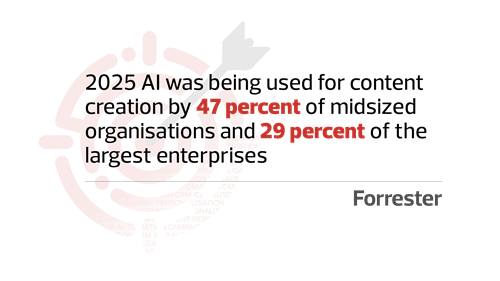
According to Forrester, in 2025 AI was being used for content creation by 47 percent of midsized organisations and 29 percent of the largest enterprises.
While this suggests that AI-assisted content production is becoming increasingly established, the challenge has moved from ‘what to create’ to ‘who to engage, when, and with what’. Hence the value of value of customer context and strategic judgement is also rising, and with it, so too is the value of trusted data for making better decisions about how to engage.
According to IBRS analyst and advisor Dr Joseph Sweeney, the harder problem now was not generating content, but making decisions regarding what was relevant to an individual in the first place.
“Generative AI collapsed the cost of a variant, not the cost of relevance,” Sweeney said.
“AI vendors conflate the two ideas, because content demos are easier and look better than decisioning. Contextual awareness comes from having better, more current data about each target audience member.”
From rules to AI-assisted decisioning
Gartner vice president analyst Ben Bloom saw a similar gap between the promise of one-to-one personalisation and what organisations could deliver today. While AI had accelerated the creation of dynamically generated content in advertising, he said real-time personalisation based on first-party data across web and commerce remained harder to achieve.
“So far this is more hype than reality,” Bloom said.
“We consider this use case of dynamic personalisation to still be mostly ambition versus reality.”
The clearest opportunity appeared to lie in improving the decisions behind personalisation, especially as customer journeys become more complex.
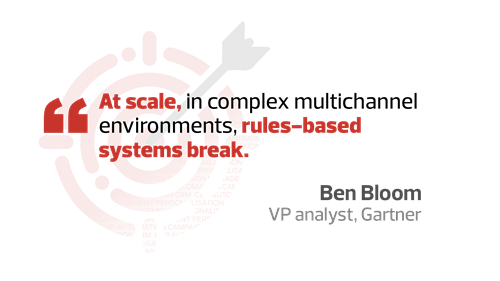
“At scale, in complex multichannel environments, rules-based systems break,” Bloom said.
“They either oversimplify and lose relevance or become unmaintainable through exploding rule complexity.”
It was here that AI also showed value, by enabling content to be continuously re-optimised at an individual level as behaviour changed. This was particularly true across journeys involving multiple channels and where timing and tone could matter as much as the content itself.
This means that a shift in the marketing operating model was needed. Rather than building campaigns sequentially through design, rule configuration, launch and measurement, AI allowed personalisation to become a more continuous process of orchestration and experimentation, with content and decisions constantly adjusted in response to customer behaviour.
Bloom suggested this shifted marketing away from an “artisanal” campaign model towards a more standardised and measurable approach.
However, it also exposed how the effectiveness of AI-driven personalisation depended heavily on the quality of the information being fed into those systems, and placed greater weight on the quality of the underlying data.
Separating signals from noise
The co-founder of the B2B marketing community Generate, Lara Vandersluis, said the challenge was not defined by the volume of information available.
“There’s plenty of data out there, but the key is in being disciplined about which signals are actual intent, and what you do with them next,” Vandersluis said.
Intent-based personalisation also depended on having a clearly defined ideal customer profile and strong underlying CRM discipline.
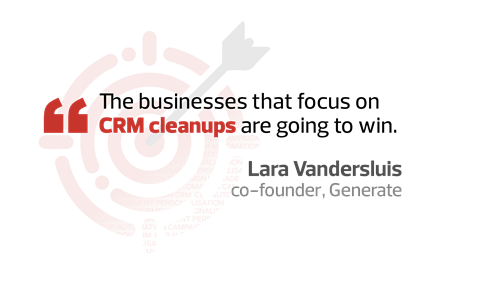
“The businesses that focus on CRM cleanups are going to win,” she said.
That marked a shift away from simply collecting first-party data towards interpreting it well enough to inform the next action. In account-based marketing, Vandersluis said identifying intent was increasingly the differentiator, with personalisation then layered on top.
The shift towards decisioning was occurring at the same time that AI was becoming more deeply embedded into the martech platforms themselves. Vandersluis expected many standalone AI tools would be consolidated into larger platforms through acquisition or native development.
“Slowly but surely the big players will swallow up the small, either through acquisition, or sometimes by building their own tooling in-platform,” she said.
That could ultimately mean fewer tools for marketers to manage, although not necessarily lower costs, as AI capabilities become premium features within larger platforms. AI was moving from being a feature inside those platforms to an agent capable of acting across them.
“As a marketing leader, your org chart will have agents and people sitting side by side,” Vandersluis said.
Agents raise the governance stakes
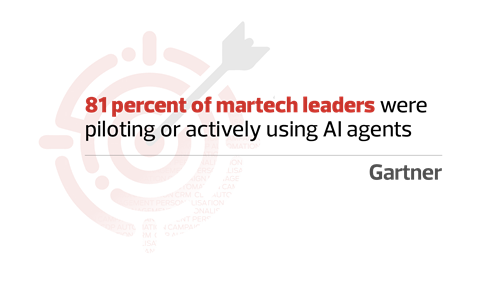
Adoption of agents in marketing is rapidly moving beyond theory. A 2025 Gartner survey found 81 percent of martech leaders were piloting or actively using AI agents, although 45 percent said vendor-provided agents were not meeting promised business-performance expectations.
Bloom saw this same shift changing the skills required of marketers. If AI agents could interact with the underlying functionality of martech platforms, marketers might spend less time mastering complex interfaces and more time deciding what those systems should do and how their output should be governed.
“It absolutely accelerates the burden on marketing teams to emphasise critical thinking, strategic thinking, and having sufficient investments in TrustOps to be able to depend on the output of the AI that they’re using,” Bloom said.
For marketers, this created practical questions regarding which systems agents could access, what they could act on, and where human oversight was required.
Vandersluis said these governance questions became critical once AI was provided with access to core systems.
“AI tools are being connected into core systems like CRMs, and platforms can’t distinguish between a personal and a company AI account,” Vandersluis said.
“The privacy and security questions are real.”
Those concerns are also reflected among Australian consumers. The Office of the Information Commissioner’s 2026 privacy survey found 69 percent regarded AI as a privacy risk, while just 4 percent trusted AI companies, and more than four in five wanted a right to human review of AI decisions.
Adoption remains the constraint
And despite rapid vendor innovation, the pace of adoption inside marketing teams remains uneven.
“I’d suggest we are in a new era of marketing technology, but the lag is due to time,” Vandersluis said.
“Marketers are lacking the time and space to experiment and innovate because the BAU still has to get done.”
For now, that meant the strongest returns were likely to remain concentrated in clearly defined applications rather than wholesale transformation.
“ROI is real, but it’s concentrated in specific well-scoped use cases rather than a broad transformative uplift,” Vandersluis said.
Case study: Bupa
Bupa has consolidated 90 percent of its customer and health data onto a single platform to personalise healthcare before, during, and after a customer sees a clinician.
The healthcare and insurance company’s Connected Care strategy is using consolidated data to extend personalisation beyond marketing into health management by building a more complete view of individual customers.
According to Bupa chief data officer, Ed Falconer, this unified view of customer and health data is creating the ability to provide a more predictive model of care.
“Personalisation within Bupa is far broader than just a marketing/targeting story,” Falconer said.
“It is much more about health management and helping customers identify and find the right clinician at the right time and helping them manage themselves against their health needs at that moment in time.”
This strategy is the outcome of a significant evolution for Bupa. By the late 2010s its acquisition-fuelled growth model had led customers to often be connected to multiple data services. Falconer and his team have since consolidated the company’s data onto a single Databricks-powered platform.
“If you are going to deliver connected care across the products and health services that you provide, you fundamentally need a single source of information and health data relating to the individual, so you can truly offer joined-up health care for your customers,” Falconer said.
The personalisation team now draws on around 1500 data features from the platform to support decisioning across millions of customer touchpoints each year. The consolidation has also accelerated Bupa’s data and analytics processes, with outcomes now delivered more than eight times faster than three years ago, while many data tasks have shifted from weekly to daily delivery.
Breadth and speed are critical to Bupa’s Connected Care strategy, which is based on personalised care and health plans, and which requires Bupa to respond to different health moments in a customer’s journey. Falconer said this ability would become increasingly important over time.
“I want to be predictive, so that I can actually start guiding a customer to not be unwell,” Falconer said. “Therefore, predictive elements start playing in the heartland of what data can do.
“All of that has a degree of technology, data, and AI capability embedded within it. That is the work that we are doing every single day to get to the point of making sure that we are getting better at creating those moments and experiences for our customers that really help them manage that journey.”
AI will play an increasingly important role in Connected Care. Falconer described one area of focus as being the use of AI to document health plans following consultations, to make them readily accessible to customers and more likely to be followed.
While marketing was not the key driver for personalisation at Bupa, Falconer said the organisation still benefitted through the ability to make personalised service recommendations, such as informing customers when they had an unused benefit, or how to take advantage of Bupa-aligned services.
He said Bupa was also using NPS to measure whether its efforts to better understand customers were translating into improved experiences.
“We want to make sure that we keep increasing our NPS by creating more knowledge and understanding about our customers through data,” Falconer said.
The push towards more personalised and predictive care is also leading Bupa to explore digital representations – or digital twins – of customers, with the goal of presenting health information differently depending on whether it was being used by the customer, a clinician, or the business.
“The first step is very much the data representation of the patient or the customer,” Falconer said.
The strength of Bupa’s data platforms also present significant scope for the introduction of agentic AI, although at this time Falconer said the company was some way from widespread adoption.
“We are approaching it with caution and enthusiasm, but we are not going to be using agentic in the health sphere at this point,” he said.
“Where we see value in agentic is where we can actually control it, contain it, practice it, experiment with it, and do it properly, in our back-office processes.
“We expect it to deliver us a significant amount of productivity gains, but the real work comes back to ‘how you do this properly’.”
Falconer said privacy, governance, and customer consent would always be foundational to the data platform, particularly as Bupa expanded its use of predictive models and AI across sensitive health data.
“Our job is to make sure that when we are starting to scale agentic, we have the foundations absolutely rock solid so that all of these principles around being able to monitor performance, review ethical use, and ensure that we understand costs, are all being monitored and managed in hyper-controlled way.”
Explore the report
Read the chapters below for insights into Australia's evolving marketing technology landscape.