
.png&h=420&w=748&c=0&s=0)
Artificial intelligence has rapidly moved from experimentation to business strategy. Yet alongside the allure of AI-enabled efficiencies, cost savings and other buzz-wordy benefits, enters whole new world of risk that many organisations are only beginning (or not) to understand.
The question facing CIOs, CISOs, risk leaders and executives is no longer whether AI will change their business. The real question is: how do we govern it securely?
As AI becomes embedded into business operations, organisations are encountering challenges that many current cybersecurity frameworks are not readily designed to address. Questions around data privacy, model integrity, third-party AI services, compliance obligations and organisational accountability are creating uncertainty for businesses that are facing pressure to compete based on AI-based advantages.
At the same time, regulatory expectations are evolving. The Australian Signals Directorate continues to enhance cybersecurity guidance through initiatives such as the Essential Eight, while cybersecurity agencies across the Five Eyes alliance have highlighted concerns around the risks associated with increasingly capable AI systems. Boards and executive teams are now expected to demonstrate not only cyber resilience, but also effective governance over emerging technologies.
For many organisations, the challenge is knowing where to start.
The fundamentals still matter
Historically, cybersecurity programs focused on protecting networks, devices and data. These security domains remain critical; AI, of course, introduces additional considerations that require broader governance oversight.
Business leaders need visibility into:
- How AI tools are being used across the organisation
- What data is being shared with AI platforms
- Whether AI-generated outputs can be trusted
- How regulatory requirements apply to AI-enabled processes
- Who is accountable for AI-related risks and decisions
Without clear governance structures, organisations risk exposing sensitive information, introducing compliance gaps and creating operational vulnerabilities that could have significant business consequences.
The reality is that AI governance, as well as Cybersecurity in general, is not purely an IT issue and it never has been. It is a business risk issue that requires collaboration between technology, security, legal, compliance and executive leadership teams.
Building a Foundation for AI Risk Management
The organisations making the most progress with AI adoption are not necessarily moving the fastest. They are moving with purpose.
A strong foundation begins with understanding where AI is already present within the organisation, what it is actually being used for and is it really providing any of the boons expected
In an ideal world, business leaders already have mechanisms in place to identify and manage potential risks, establish governance frameworks and implement controls that support innovation without compromising security or compliance.
Unfortunately, this is often not the case with key cybersecurity fundamentals not in place or in many cases by-passed in the race to embrace ‘game-changing’ AI capabilities.
Effective AI governance should align with existing risk management and cybersecurity programs while addressing the unique challenges that AI introduces. This approach allows organisations to unlock the benefits of AI while maintaining stakeholder confidence and organisational resilience.
The Need for Practical Guidance
The volume of information surrounding AI regulation, governance and security can be overwhelming. Many organisations are searching for practical, actionable advice that helps them make informed decisions today while preparing for tomorrow's risks.
This is exactly why Security Centric is bringing together cyber governance experts Paul Hossack and Alex Ward, hosted by Angie Fung, for our upcoming webinar:
Cyber Risk in the AI Era: Where Do We Begin?
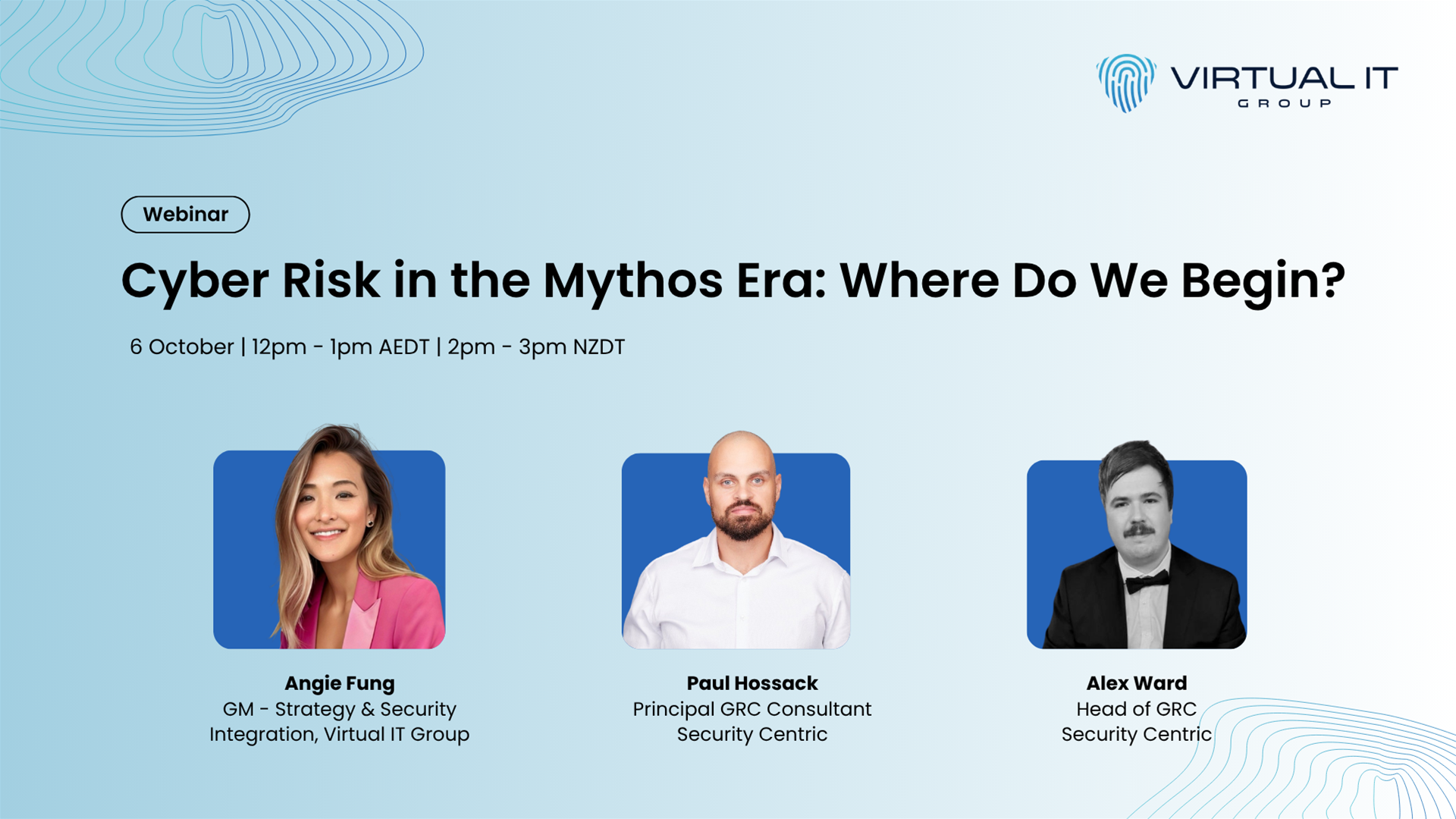
Together, they will explore:
- Practical approaches to AI governance
- Emerging cyber risks associated with AI adoption
- Regulatory and compliance considerations
- Strategies for assessing and managing AI-related risk
- Building a roadmap for long-term cyber resilience
Whether your organisation is actively implementing AI or just starting to evaluate its potential, this session will provide the guidance needed to navigate an increasingly complex risk landscape.
The future of AI offers enormous opportunity. Organisations that establish the right governance foundations today will be best positioned to realise that opportunity securely and responsibly.



.jpg&h=140&w=231&c=1&s=0)
.jpg&h=140&w=231&c=1&s=0)
.jpg&h=140&w=231&c=1&s=0)
.jpg&h=140&w=231&c=1&s=0)


.png&w=100&c=1&s=0)
 Sydney Cloud & Datacenter Convention 2026
 iTnews Executive Retreat - Security Leaders Edition
 Can Testing Keep Up? Quality in the Age of Accelerating Delivery
 iTnews Resilience, Rewired Breakfast
 RIMPA Live Convention 2026


.jpg&h=271&w=480&c=1&s=1)
.jpg&h=271&w=480&c=1&s=1)
.jpg&h=271&w=480&c=1&s=1)
.jpg&h=271&w=480&c=1&s=1)



