

Getting started with AI was the easy part. But for many organisations today, turning their isolated AI experiments into an organisation-wide capability that generates real, ongoing return on investments that can be grown and expanded across the enterprise is proving much harder.
The first wave of AI adoption was defined by experimentation, as organisations trialled chatbots and copilots, developers embraced generative coding tools, and employees discovered ways to improve individual productivity. While many of these initiatives delivered genuine productivity gains, translating those gains into consistent, measurable business outcomes has not been smooth sailing.
The challenge when scaling AI today is how to deploy it consistently enough to deliver enterprise-wide value.
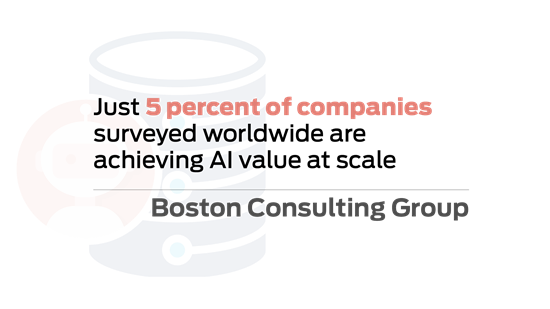
Boston Consulting Group's September 2025 report The Widening AI Value Gap found that only 5 percent of 1,250 companies surveyed worldwide were achieving AI value at scale, despite widespread investment. The report concluded that successful AI scaling depended more on organisational capabilities such as governance, data foundations, operating models, and workforce readiness than on deploying more sophisticated models.
The challenge of scaling AI becomes even more apparent in agentic AI programs. Forrester’s 2026 report The State of Agentic AI reported that despite three quarters of enterprise leaders saying they were adopting agentic AI, only a small minority were running it in meaningful production beyond ‘agent-ish’ chatbots, with true scaled multiagent systems proving rare.
While much of the discussion regarding scaling AI has focused on technologies and foundation models, Gartner's research finds that organisations with successful AI initiatives invested up to four times more in data and analytics foundations, including data quality, governance, AI-ready people, and change management.
The World Economic Forum reached a similar conclusion in its 2025 report AI in Action: Beyond Experimentation to Transform Industry, which found that advancing AI adoption required a mixture of ecosystem capability, organisational trust, self-governance principles, and talent development, backed by appropriate security built on a strong digital core.
Examples of scaled AI implementation do exist, but they are often restricted to specific functions or tasks. Software engineering provides one of the clearest examples of AI successfully embedded at scale, with structured artefacts, established workflows, and continuous review processes making AI easier to integrate.
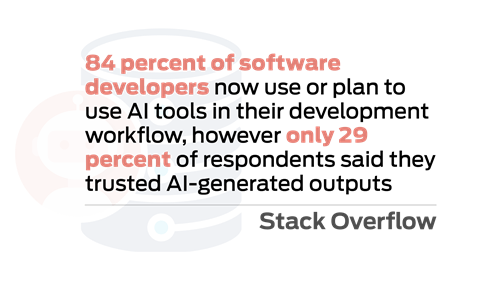
According to the 2025 Stack Overflow Developer Survey, 84 percent of software developers now used or planned to use AI tools in their development workflow, with 52 percent reporting a positive impact on productivity. However, only 29 percent of respondents said they trusted AI-generated outputs – highlighting why governance and human oversight remain critical even as AI becomes embedded in software engineering.
Taken together, these findings suggest the barriers to AI scale are now predominantly organisational rather than technical. As foundation models become increasingly capable and widely available, competitive advantage is shifting away from access to AI and towards the governance, data foundations, operating models, and workforce capabilities required to deploy it effectively across the enterprise.
The next phase of scaling enterprise AI is likely to be defined not by the models used, but by the organisational discipline required to convert AI investment into sustained business value.
Case Study – Brickworks
As part of its efforts to build the foundations for scaling enterprise AI, the Australian building products manufacturer Brickworks is using AI itself to improve data quality.
Having spent the past year building its data platform, governance framework, and stewardship model, the Sydney-based company is now accelerating data cleansing with AI agents while preparing for broader enterprise AI use cases, from analytics to conversational access to business data.
Brickworks’ general manager for data, integration, and automation James Cosier said the pace of AI development generally had reinforced the need to get the fundamentals right.
"The ultimate goal is to get clean data that can be used in support of AI tools, so that they do their best work," he said.
Rather than treating data quality as a prerequisite that delayed AI adoption, Brickworks was using AI itself to accelerate the work needed to support broader enterprise AI deployment.
Rather than relying solely on business teams to identify and correct incomplete records, the company was using AI agents to analyse similar records and recommend values for missing data fields, with subject matter experts validating the recommendations before they were applied.
"It expedites the process, and we've managed to clean a lot of data in a very short amount of time," Cosier said.
"That's actually AI being in service of data quality as opposed to data quality being in service of AI."
While AI was helping accelerate the process, Cosier said success still relied on establishing clear data ownership across the business, with Brickworks identifying data stewards and owners responsible for maintaining the integrity of information within their domains.
"I can give them the tools and the time and the support to clean the data, but ultimately this is their data, and we live and die by the integrity of data," Cosier said.
Alongside those governance changes, Cosier said Brickworks had put in place many of the foundational elements needed to support AI over the longer term, including data glossaries, dictionaries, and documentation that will eventually underpin semantic layers and AI-powered discovery.
"Those are really the foundational components for semantic layers and things like that, so all of that documentation that data engineers don't really enjoy doing suddenly becomes vital,” Cosier said.
"You've got to eat your vegetables – you have got to get this stuff sorted."
To support that effort, Brickworks has developed data quality dashboards for each business domain, allowing teams to identify where issues existed, understand their nature, and determine who was responsible for remediation.
"You need to hold a mirror up to the data in the first place and circulate the numbers," Cosier said.
The dashboards also allowed the business to track improvements over time, recognise teams that improved data quality, and demonstrate progress as information became more AI-ready.
Underpinning that work is a modern data platform built around Snowflake, which serves as a central repository for information brought together from ERP, CRM, HR, health and safety, and other operational system data, with Boomi providing connectivity between different data sources.
"A lot of times in analytics and data roles you spend a lot of your time saying no to people, but with tools like that and the right thinking applied to them, you can say yes – which is a great feeling," Cosier said.
While some data domains were already mature enough to support more advanced AI use cases, Cosier said Brickworks was deliberately taking a measured approach, proving value through practical pilots before expanding more broadly.
"It's tempting to abandon what you're doing now to go and try something new and shiny, but we're sticking to our guns and getting the foundations right, and scaling after that."
Scaling AI Champions

How the Fair Work Commission safely deployed Agentic AI in weeks, not years
Australia’s Fair Work Commission has shown that government AI can move quickly without compromising governance. By deploying governed AI agents in weeks, the Commission has reduced manual work, improved oversight and strengthened service delivery, while keeping explainability, security and human accountability at the centre of its approach.

Scaling innovation safely: innovating through rapid prototyping with the mission in mind
Scaling AI from prototype to production requires more than speed or technical capability. For government and defence, success depends on disciplined engineering, strong governance, trusted data and early engagement with operational users. Leidos Australia explains how these foundations can turn promising demonstrations into secure, sustainable mission capabilities.
Browse the report
Click on the tiles below to read each chapter of the State of Data & AI 2026 report.


State of Data and AI Champions
State of Data & AI 2026 champions will be featured here.