Insurance Australia Group (IAG) is targeting high-volume data ingestion processes across its businesses for improvement using AI and automation, in a bid to curtail time spent on manual entry and administration.
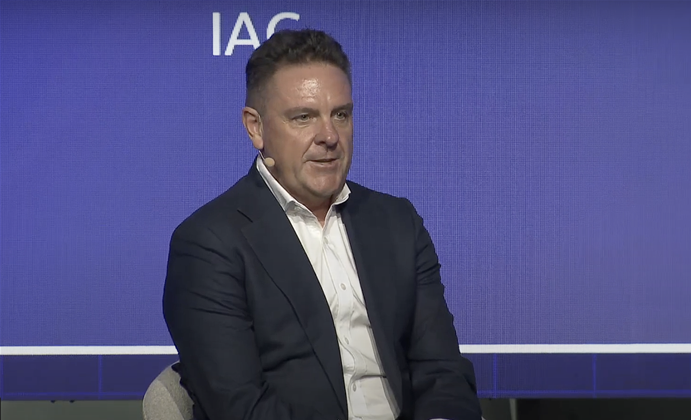
Executive general manager of CX and growth in two of IAG’s intermediated brands – CGU and WFI – Damien Gallagher told an Appian summit that the insurer is in the midst of a “commercial enablement” program, reducing time spent on administrative tasks and the number of manual controls in its environment.
Gallagher said that when the business case was brought before the IAG board, it contained an example of property underwriters “having to touch seven different systems” in their line of work.
“They’d probably take up to half a day … just ingesting the information that our partners have provided us about our customer's risk. That's before we do anything to put an offer in front of a customer,” Gallagher said.
“You can imagine then what that means in terms of the growth opportunity, but also the colleague experience. No one likes to sit there and do administration.
“If you're an underwriter, what you like to do is really understand risk and provide solutions.
“Unlocking that [personnel and productive] capacity was a really important part of what we set out to achieve.”
The insurer sought to cut out manual steps by ingesting data directly into its underwriting tools.
”In that property space, we have three key documents that come from our partners. And they could be anything from an asset schedule with one or two pieces [of property] on it to thousands of locations and asset types,” Gallagher said.
“Aside from that, we're also getting the schedule, which is the risk that the customer wants us to transfer, as well as their previous history.
“All of that was [being] entered manually.”
IAG set a goal of extracting data from these documents and ingesting it into the underwriting system automatically with an accuracy of circa 98 percent.
Although this was initially optical character recognition-driven, IAG later piloted how AI and large language models might also assist, engaging Appian.
The company had initially viewed AI’s capabilities in the ingestion space as nascent, with the technology better suited as an “assistant” to people.
“We probably thought about AI for a while as assistive to people, but it's far more than that and it will be at the heart of the process change that we want to make, the experiences that we want to be able to deliver,” Gallagher said.
“We quickly learned through that proof-of-concept what the power of AI was going to be able to deliver, but at 68 percent [accuracy] we were a long way away from where we needed to be.
“In a couple of short months, working really closely with the whole of the Appian team, both here in Australia and overseas, we got ourselves to a level of confidence where it was around 96 to 98 percent and that was in about September [last year].
“We still needed to operationalise it and integrate into the business, but that gave us a whole lot of confidence that what we set out to achieve was possible and that we were really going to be able to unlock the value that we wanted.”
Gallagher also said that IAG unwittingly trialled the technology on what turned out to be one of its most complex ingestion tasks.
“Maybe the spoils on the other side is that when you tackle the most complex [process], you prove the solution [has] broader uses,” he said.
“What we learned out of tackling probably the more complex ingestion use case we had in our business is the ability to stretch [the same technology] across a number of other different areas.
“We have a lot of high-volume data ingestion pieces in our business, whether it's in the client acquisition journey [or the] claims journey.
“I think there's a lot of opportunity that we're seeing as a result of what we've been able to do.”
IAG has long looked to automation to simplify its processes. It has also implemented GuideWire as a single claims processing platform.




.jpg&h=140&w=231&c=1&s=0)

.jpg&h=140&w=231&c=1&s=0)


.png&w=100&c=1&s=0)
 iTnews Executive Retreat - Security Leaders Edition
 Sydney Cloud & Datacenter Convention 2026
 Can Testing Keep Up? Quality in the Age of Accelerating Delivery
 iTnews Resilience, Rewired Breakfast
 RIMPA Live Convention 2026