Aussie bandwidth demand unchanged by SKA split


Terabit-per-second links floated.

The long-awaited decision late last week to split the Square Kilometre Array project between rival bidders South Africa and Australia has not dampened bandwidth requirements for the local project.
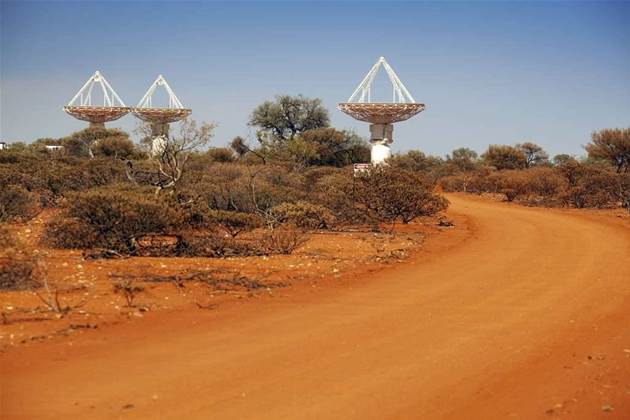
Although "the majority of SKA dishes" under phase one will be built in South Africa from 2016, Australian project director Brian Boyle said Australian IT requirements were largely unchanged from what its single-site proposal.

"The phase one deployment in Australia is pretty much close to the full phase one deployment that we had anticipated in terms of overall IT requirements," Boyle told iTnews.

"The dual-site model changes nothing in that regard. We're not correlating data in real-time with South Africa.

"It's very much getting the reduced data from Australia out to the rest of the world and we have planned for more than sufficient bandwidth in order to do that."

An analysis of the SKA dual-site solution given to organisers this month suggested 1.4 terabits per second of bandwidth would be needed for the Australian portion of the project at its peak.

Australia's ability to meet those needs was questioned during the bidding process, with organisers raising concerns over bandwidth costs and connectivity.

The years-long bidding war between Australia and South Africa was delayed in March when organisers of the $2 billion project could not reach a majority decision on one winner.

At the time, the SKA Site Advisory Committee said Australia had sufficient local fibre connectivity but the cost of additional active components - estimates in the hundreds of millions - left the country with a "medium to high level weakness" against South Africa.

Australian phase one array to generate petabits per second

The ultimate decision, handed down in the Netherlands on Friday, will see Australia expand the $100 million Australian SKA Pathfinder under construction in remote Western Australia to add low frequency and survey telescopes by 2020.

The frequency range is optimised for large-scale surveys and particularly for researching topics such as dark matter and dark energy, according to academics.

South Africa will build out its MeerKAT array to explore portions of space in the medium to higher frequencies, optimised for detecting weaker signals in space.

According to Boyle, New Zealand - a joint bidder with Australia - would not play a significant part in the project until phase two, scheduled for early next decade.

While Australia's responsibilities under the SKA are somewhat reduced compared to its bid, Boyle estimated the project would still gather some six petabits per second of data from local telescopes during phase one.

It would use $46 million worth of local and international fibre connectivity earmarked for use by the ASKAP project to operate the array in Western Australia, including a 40 Gbps connection between the telescopes and the Pawsey Centre.

It leveraged government-funded fibre links built under the $250 million Regional Broadband Blackspot Program to Geraldton in Western Australia, while using on international capacity leased by the Australian research network AARNet.

Much of the data generated by the telescopes will be processed on-site, as well as at the $80 million Pawsey Centre in Perth. Australian data would be stored locally but replicated globally.

Datasets gathered separately by the South African and Australian telescopes would only be collated on-demand by scientists that required both sets for specific experiments.

"You'd imagine there would be repositories around the world, including in South Africa and Australia themselves, where all the datasets would be brought together and you'd be allowed the chance to look at objects across a wide frequency range with data taken from both sites," Boyle said.

Up to 99 percent of the raw data generated under phase one of the SKA will ultimately be dumped as scientists seek to gain grip on the sheer amount of storage required for the project.

Boyle said the organisation would store "as much as we can afford to", with an effort to retaining as much raw and process data as possible.

"It's certainly petascale and it will be pushing the exascale in the size of the data," he said.

Copyright © iTnews.com.au . All rights reserved.


Aussie bandwidth demand unchanged by SKA split


Top Stories
ATO commits to complexity
Greater demand, fewer apps.
 
Photos: AusCERT 2013 day two
The second day of the Queensland security conference.
 
The illusion of cognitive computing
Opinion: IBM's Watson is a marketing success.
 
 
Sign up to receive iTnews email bulletins
   FOLLOW US...

Latest VideosSee all videos »

Bankwest builds continuous delivery capability
To automatically deploy test/dev sandboxes by mid-year.
Veterans' Affairs sets sights on modernisation
Data safe with Human Services, CIO says.
Citi Australia drops platform customisations
Technology chief shifts focus from building to leveraging systems.
VicRoads restructures IT team
Department moves to align with industry benchmarks.
Zurich Australia extends IT team offshore
Malaysian staff served from Australian data centres.
Leigh Berrell - Utilities CIO of the Year
Yarra Valley Water CIO Leigh Berrell accepts his Benchmark Award for Utilities CIO of the Year.
Wayne McMahon - Retail CIO of the Year
Domino's Pizza CIO Wayne McMahon accepts his Benchmark Award for Retail CIO of the Year.
Inside Perpetual's ongoing IT transformation
CIO Jenny Levy discusses how outsourcing will help the firm "simplify, refocus and grow".
Managing Complexity - Defence's Daniel McCabe
Daniel McCabe, Assistant Secretary of Australia's Department of Defence, provides the audience at the iTnews Data Centre Strategy Summit with a deep dive into the organisation's data centre consolidation program.
How Facebook designed the data centre from scratch - Marco Magarelli
The full keynote by Facebook data centre architect Marco Magarelli at the Australian Data Centre Strategy Summit. Magarelli details the design considerations behind the social network's Prineville, Oregon; North Carolina and Luleå, Sweden data centres.
Modernising Legacy Data Centres - Telstra's Jon Curry
Telstra general manager of managed data centres Jon Curry guides the audience at the iTnews Australian Data Centre Summit through the build of the telco's Clayton, Victoria data centre.
NSW Government launches NABERS data centre rating tools
Matthew Clark from the NSW Department of Environment guides facilties managers through the details of the new NABERS data centre energy rating tool at the Australian Data Centre Strategy Summit.
NABERS launch panel: Australian Data Centre Strategy Summit
Matthew Clark (NSW Dept of Environment), Greg Boorer (Canberra Data Centres), Glenn Allan (National Australia Bank), Mike Andrea (Strategic Directions) and Bob Sharon (Green Global Consulting) discuss the impact of the NABERS data centre rating.
Judges notes: Fortescue Metals [The Benchmark Awards]
iTnews' panel of judges discuss Fortescue Metals 'New World of Work" project, one of three shortlisted finalists for the Industrials category of the CIO Benchmark Awards.
Judges notes: Retail [The Benchmark Awards]
iTnews' panel of judges discuss the shortlisted finalists for the Retail category of the CIO Benchmark Awards.
Judges notes: Pacific Aluminium [The Benchmark Awards]
iTnews' panel of judges discuss Pacific Aluminium's lightning fast service desk refresh, one of three shortlisted finalists for the Industrials category of the CIO Benchmark Awards.
Judges notes: Domino's Pizza [The Benchmark Awards]
iTnews' panel of judges discuss Domino's Pizza's shift to hosted services, one of three shortlisted finalists for the Retail category of the CIO Benchmark Awards.
Judges notes: McDonald's Australia [The Benchmark Awards]
iTnews' panel of judges discuss McDonald's Australia's new self-service portal for employees, one of three shortlisted finalists for the Retail category of the CIO Benchmark Awards.
Judges notes: ING Direct [The Benchmark Awards]
iTnews' panel of judges discuss ING Direct's 'Bank in a Box', one of three shortlisted finalists for the banking and finance category of the CIO Benchmark Awards.
Judges notes: Yarra Valley Water [The Benchmark Awards]
iTnews' panel of judges discuss Yarra Valley Water's insourcing project, one of three shortlisted finalists for the Utilities category of the CIO Benchmark Awards.
Latest Comments
Polls
Do you prefer the Coalition's NBN policy?

   |   View results
Yes
  19%
 
No
  81%
TOTAL VOTES: 1731

Vote