The Federal Attorney-General's second-in-command has encouraged the creation of a self-regulated industry code between internet service providers and rights holders to combat piracy issues.
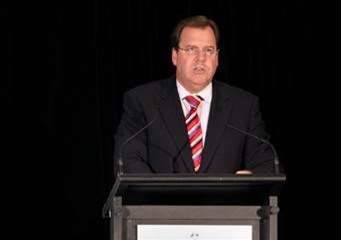
Department secretary Roger Wilkins joins a growing chorus of views from rights holders, service providers, user groups and copyright experts agreeing an industry code would be preferable to further litigation or copyright legislation.
Wilkins initiated talks with several large service providers over the issue last month, in light of ongoing negotiations with rights holders.
He told attendees of the Copyright Law and Practice Symposium in Sydney that the speed, anonymity and cross-jurisdictional nature of online transactions meant "conventional" regulatory models had become "severely challenged".
"In order to safeguard and secure copyright ... we need to take a look at a new and somewhat unconventional approaches to information and law enforcement," he sold.
"My belief is that solutions will rely on new business models that create incentives for consumers and other market participants to comply with the copyright law and also the technological innovation of the copyright owners.
"They are going to emerge through cooperative agreements and participation between copyright owners and service providers."
The existing Copyright Act provided space for an industry code to be formed on the issue, he said.
While Wilkins is effectively willing to take a back-seat to industry discussion, he warned Government involvement is required to facilitate an agreement and ensure consumer protections are safeguarded in any resulting industry code.
The Attorney-General's department is set to conduct further meetings with internet providers before the end of the year.
Talks between service providers and rights holders have been held separately from those with Government.
Those have been underway since November last year, with Communications Alliance CEO John Stanton this week championing success in reaching leeway with most affected creative industries.
Stanton said parties had made "more progress in the last six months than in the past five years" but just what kind of code would eventuate remains unclear.
Vanessa Hutley, former Microsoft counsel and lead for music and wider content rights groups, said copyright holders had moved for a "graduated response" mechanism such as those implemented in France and more recently in New Zealand.
The French experience, she said, had proved successful. A total of 650,000 first notices had been delivered since implementation in January 2010, according to blog TorrentFreak, and 44,000 owners received a second strike.
A total 60 users faced termination of internet access on their third strike.
Australian representatives of content owners, however, had not condoned a termination mechanism. Instead, ISPs would impose an "effective sanction" against users after sending multiple "educational" warnings under the suggested regime.
Hutley declined to comment on threats from smaller rights holders to begin mass individual lawsuits such as those attempted over the past decade in the US.
She said the continued negotiations with service providers were the preferred method.
Holly Raiche, of the Internet Society of Australia, singled the US memorandum of understanding signed earlier this year as an example of effective cooperation as it required a verified connection between the infringement and the user who had infringed.
But she warned Australian ISPs will first have to agree on a uniform acceptable usage policy for users, as many currently differed wildly on copyright provisions.
Read on to page two for the alternate path - copyright law changes.
The Federal Government has also moved ahead with public consultation on potential changes to copyright legislation.
The laws were last amended in 2006 to include safe harbour provisions that brought Australia into line with provisions of the free trade agreement with the United States.
In his keynote to the symposium, Federal Attorney-General Robert McClelland announced progress to two of three measures he had proposed on copyright amendments in February.
These included a discussion paper [pdf] proposing a broadened definition of safe harbour provisions to include online content providers such as Google in addition to internet service providers.
The discussion paper had initially proposed streamlining the process required by copyright owners to identify an internet subscriber thought to have infringed copyright.
However, the initial document posted Friday appears to have been removed with its replacement no longer mentioning the streamlining aspect.
The Attorney-General's department told iTnews that the the original version of the document had been "mistakenly posted" on Friday and immediately withdrawn.
The department did not clarify whether the discovery process proposal would be introduced at a later date.
McClelland said any changes to copyright legislation required the Government to "effectively balance" protections for both copyright owners with internet user rights.
But Michael Fraser, director of the Communications Law Centre at the University of Technology, Sydney, disputed the notion that previous uses of balance had been effective in past amendments to the Copyright Act, which had nearly tripled in size over several decades.
"There has been insufficient public policy explanation and justification of amendments to the Copyright Act," he said.
"This circumstance has perhaps inadvertently led to a process of copyright law reform predicated on a so-called 'balance' where the meaning of the term 'balance' has sometimes been reduced to mean a 50-50 split between the claims of the interests which are sitting at the law reform negotiation table.
"It is fair in its way in that it is not biased to any interest [but] reform becomes more piecemeal and incoherent, the Act gets closer - three times longer than when I first read it - more complex and it lacks integrity."
Concerns on the ineffectiveness of copyright legislation in the current technological climate had led Fraser and other copyright experts to form part of an advisory group to the Australian Copyright Council to back the notion of an industry-led code.
The code, they suggested, would be legislated into future amendments to the Copyright Act in order to set out clear definitions of repeat infringers and provisions for dealing with such subscribers.
Default standards built into the Act would function as a "fallback" to the code, requiring any service provider or eligible party who did not agree with the code to still be liable for requirements under safe harbour laws.
The Communications Alliance's Stanton said he hopes an agreement can be reached by the first quarter of next year but is uncertain that can be achieved.
"We're in this position partly because the copyright legislation in this country and many other [countries] has failed," he said.
"Things will continue to move fast in this space and whatever regime we're able to agree to put in place, I think we ought to be prepared to continually review that, test its effectiveness and modify it as necessary so that it remains an effective means of addressing what is a very complex and fast-moving problem."
ALRC review update
McClelland also announced initial terms of reference provided to the Australian Law Reform Commission on potential amendments to the Copyright Act would include determining whether current exemptions to legislation are "adequate and appropriate".
The terms are set to be released for public consultation before being passed onto the commission by the end of the year.
Attempts to reform legislation are likely to coincide with ongoing litigation between film studios and service provider iiNet as the parties begin appeal hearings in the High Court this December.


.jpg&h=140&w=231&c=1&s=0)




 iTnews State of Security Breakfast
 iTnews State of Data & AI Breakfast
 The 2026 iAwards
.jpg&w=120&c=1&s=0) Integrate 2026
Integrate 2026
 Security Exhibition & Conference





_(1).jpg&h=140&w=231&c=1&s=0)