NextDC warns global transit could beat NBN prices


Contemplates future with limited competition.

NextDC founder Bevan Slattery has warned it might eventually be cheaper to haul internet traffic from Iraq to Sydney than across domestic routes in the same city if NBN Co is handed a legislated monopoly for fibre.
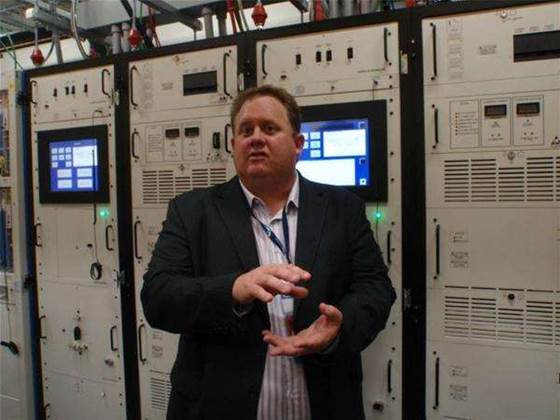
Slattery added his voice to a throng of telco luminaries calling for drastic changes to the NBN Access Bill currently before parliament.

The Bill is meant to prevent competitors from 'cherry-picking' certain areas for fibre expansion before NBN Co's rollout arrives.

Telcos and ISPs say the Bill's wording is ambiguous and effectively prevents them performing even the smallest upgrades to existing fibre networks.

"Upon reading, the Bill doesn't appear to be about cherry-picking," Slattery said in a senate submission [pdf].

"It appears to be about completely removing competition altogether."

Slattery used his experience as the founder of Pipe Networks to illustrate the impact competition could have in a market dominated by one or two players.

He said that before Pipe's arrival, a dedicated Gigabit Ethernet connection on an international cable route out of Australia cost $300,000 a month – around $300 per Mbps per month.

In the three-and-a-half years it took to complete Pipe's PPC-1 cable between Sydney and Guam, competitors upgraded their own links, launched new capabilities and significantly dropped their prices to combat the newly-introduced competition.

"Transit pricing for that 1 Gbps service has dropped from $300,000 a month in 2006 to just $40,000 a month today," Slattery noted.

"This price has dropped almost 50 percent in just 12 months and 85 percent in three years with competition".

Slattery warned that if competition was outlawed in an NBN world, there would be "little incentive for NBN Co to innovate and become more efficient in a market where there is no competition".

"In fact, with the collapsing price of transit in Australia through competition, it is quite possible that within a few years it will be cheaper to get bandwidth from Iraq to Sydney than from Sydney to Sydney ([because] NBN Co is looking to charge $20 /Mbps for house to PoI [point of interconnect] bandwidth aggregation from Premises to the PoI)," Slattery said.

In other words, it could cost more to transfer internet traffic from an NBN-connected house to the point-of-interconnection to an ISP network in the same city than to push that traffic more than halfway across the globe.

Slattery said there was no government or market worldwide that was contemplating "removing competition as part of the advancement of broadband in their country – and for good reason".

Slattery's former company, Pipe Networks, sought an exemption from the cherry-picking rules in its own senate submission, claiming its business is a "fundamentally different beast from networks such as the NBN."

Slattery sold Pipe to ISP TPG last year before setting up NextDC, a data centre operator.

ISPs Internode and HaleNET also sought various levels of amendments to the controversial bill.

Copyright © iTnews.com.au . All rights reserved.


NextDC warns global transit could beat NBN prices
"umbria wrote: The objective of the NBN is to build a framework that will deliver high-speed broadband to all Australians as cheaply as possible If you consider $43 billion ' cheap' then ..."
By advocate


Comments: 10
umbria
Feb 28, 2011 12:31 PM
This submission shows precisely why NBNCo is and must remain publicly-owned.

Since the good old days before VoIP (and yes, I realise that after fifteen years the free market has still denied VoIP-capable broadband to 40% of Australians), Telecom Australia has routed local calls interstate, even via Darwin, if local nodes were congested, but they still charge you more for STD calls, even though all calls are routed via the route that suits the network at the time. The STD rort still exists for most people.

Now Mr Slattery has made his dough from selling PIPE to Soul/TPG, reducing competition in upstream backhaul to the annoyance of many.

Watching Macquarie, he has identified the next golden egg-laying hen to be data centres. These will indeed be profitable when we all use our fibre-supplied upload speeds to maintain offsite hard disk backups, recoverable quickly thanks to fibre download speeds.

It is no surprise to see him advocate for his business interests to secure cheaper links to NBN for his expected large data volumes, but it is a bit hypocritical given what he did with PIPE.
bslattery
Feb 28, 2011 1:29 PM
Umbria,

"This submission shows precisely why NBNCo is and must remain publicly-owned."

No. It shows what happens when you re-create monopolies and remove competition.

"Now Mr Slattery has made his dough from selling PIPE to Soul/TPG, reducing competition in upstream backhaul to the annoyance of many."

That's just baseless FUD. PIPE/TPG have not restricted backhaul to any ISP, in fact it has expanded quite dramatically. Happy to sight a list of examples of where backhaul has been reduced? Of course you can't.

"These will indeed be profitable when we all use our fibre-supplied upload speeds to maintain offsite hard disk backups, recoverable quickly thanks to fibre download speeds"

Their use will be limited due to bit-taxing on the CVC to the PoI and lack of competition.

"It is no surprise to see him advocate for his business interests to secure cheaper links to NBN for his expected large data volumes, but it is a bit hypocritical given what he did with PIPE".

Simply shows you don't understand the basic principles of what I have written about. I have always been an advocate for competition, as Australia has suffered at the hands of a "lack of it".

[b]

PS: I won't be operating any network @ NEXTDC. Unlike others like Macquarie, I'm a DC provider only (not Cloud etc..)


umbria
Feb 28, 2011 3:06 PM
My apology, Mr Slattery, if I gilded the lily a bit.

There was a lot of criticism of Whirlpool when PIPE's international capacity became the property of one ISP. That is probably all that can be said, and I should have expressed it in those terms.

I do wish you well in your new undertaking. Heaven knows we need all the domestic customer-focussed data centres we can get as demand explodes for hosted storage.

The NBN's monopoly explicitly ends where non-Internet-facing VPNs begin, so there should be no problem maintaining an excellent and fast-growing revenue stream from private networks on non-NBN fibre backhaul to your facilities.
MerariSchroeder
Feb 28, 2011 7:26 PM
Any cherry-picking legislation is proof that the NBN plan is flawed. No other country will have their metro areas subsidising rural areas. So the already inflated prices which result from building the NBN, will be even higher. Australia will be disadvantaged, having to opt for lower capacity plans.

Imagine this scenario, plus hands dipping into any start-ups pockets.

On possible alternative is to have the rural subsidy feeding in seperate from NBNCo. Add $10 to the rates or whatever, but don't tie it to subscription prices. This way there is no need for cherry-picking legislation at all. Just an idea...
ITnovice
Feb 28, 2011 9:42 PM
The claims made by NextDC founder Bevan Slattery are absolutely outrageous. NBN Co is Not Telstra and never will be so to compare the Telstra monopoly to NBN Co is just ridiculous.

If the Government allows NBN Co to be undercut significantly by competitors, the taxpayers will lose out. That is why they want to regulate against it. It actually levels the playing field as everyone uses NBN Co's services and are forced to compete with each other on that basis.

This scare-mongering, guesstimating, and fudging of the truth in an attempt to benefit one's own company is just plain wrong. The more this occurs, the further the NBN moves away from a technical and economic exercise and becomes a useless political football.
singo79
Feb 28, 2011 10:09 PM
@MerariSchroeder - I am pleased that you have not bashed the fact that there is a rural subsidy. Too often I have come onto articles and forums such as these only to see people with the attitude of 'if you don't like high prices then move to the city to get better prices and services'.

I find those comments insulting and short sighted! Often the people making those comments are ignorant of many factors that would make such a move financially devastating for our economy.

It may seem as though it is unfair for city dwellers to subsidise the rural residents, however it is not as simple as the city subsidising the bush. In fact it is often the bush subsidising the city. After all where is vast majority of our taxes spent, where is all of the infrastructure invested? The cities receive the lions share of the money despite contributing less economically then that of the bush. With mining royalties, mining exports, farming exports and distribution of local produce the bush contributes heavily towards our economy and way of life, but has less money spent on it in terms of facilities and infrastructure.

This is why I strongly believe in the NBN and what it is going to deliver for ALL Austrlians.

Again I respect the fact that you have acknowledged the need for a subsidy, but you simply disagree with how they plan to implement the subsidy.
HubertCumberdale
Feb 28, 2011 10:09 PM
ITnovice wrote:
This scare-mongering, guesstimating, and fudging of the truth in an attempt to benefit one's own company is just plain wrong.

People do need something to read in The Australian dont they ;)
bslattery
Mar 1, 2011 12:40 AM
Hi Singo79,

I completely agree with the idea of a subsidy! I did a presentation at Commsday in March 2010 where I first brought this up. I suggested put in up to $10B as a possible subsidy in which the country didn't expect to get a "commercial return" but where there was a social/equitable/gdp/productivity return. You can work out how much through a cost/benefit analysis.

This is a much better way to proceed as it takes substantial pressure off trying to make the busines case stack up (such as trying to stop competition through legislation like this). It also should happen first and also guarantees that if the busines case is flawed the regional, rural and remote Australian's don't get shafted again, through a reduced rollout.

Check out page 14 of the presentation here:
http://www.commsday.com/commsday/wp-content/uploads/2010/04/Pipe-Networks-Bevan-Slattery.pdf

Cheers

[b]
umbria
Mar 1, 2011 8:25 AM
Talk of subsidies and stifling backhaul competition are both furphies designed to reinforce prejudices.

In 2001 the Productivity Commission outlined (pp 3-4) its vision for regulation of the telecommunications industry. It must be focussed on delivering the best possible service to the customer, must do so as cheaply as possible, and must not be concerned if this has impacts on the incumbent telcos. The whole thrust was about closing the digital divide, which hurts both urban and rural Australian. Ten years on, after some disastrous pandering to the free market, we have commenced at last.

The objective of the NBN is to build a framework that will deliver high-speed broadband to all Australians as cheaply as possible now and for many decades to come, and to let any retail service providers sell their product to any Australian, regardless of their geography and the last-mile technology used.

Anything which hinders this outcome - such as concessions to incumbent backhaul providers - WILL be circumvented, because Australians have re-elected an unpopular government because the coalition said it would can the fibre. The current crop of complaints from those who don't want to change their current plans as the country moves forward are nothing new.

Blacksmiths were miffed when people started buying cars, but this not only averted the prediction that Sydney would be six feet deep in horse manure by 1920, but also created opportunities for mechanics, car salesmen, panel beaters, tow truck drivers and - for better or worse - oil companies. And it gave people a degree of mobility they had never known.

There will be lucrative opportunities for incumbent backhaul providers in operating VPNs and selling capacity to NBNCo itself.

Broadband to rural and regional Australia will take pressure off capital cities by attracting many people to relocate. It will also make more regional customers accessible to city businesses. The bush has been implicitly subsidising cities forever, and will do so more efficiently when it is not constrained by poor communications, so let's lay the subsidy furphy to rest. This is about universal broadband, not creating a new two-class system. Practically everyone gets fibre, and we all get the same prices and access to service providers.
advocate
Mar 1, 2011 9:26 AM
umbria wrote:


The objective of the NBN is to build a framework that will deliver high-speed broadband to all Australians as cheaply as possible

If you consider $43 billion ' cheap' then go for it.

Anything which hinders this outcome - such as concessions to incumbent backhaul providers - WILL be circumvented,

It will? I know the NBN Co is a monopoly and intends to be the only fixed line service to the home game in town, but it's news to me that all that Telstra, Optus, Pipe etc backhaul that is out out there in the ground are after any concessions and it is gong to be 'circumvented'.

because Australians have re-elected an unpopular government because the coalition said it would can the fibre.

They have? - how do you know the reason behind how Australia voted and why?

The current crop of complaints from those who don't want to change their current plans as the country moves forward are nothing new.

Huh? that doesn't even make any sense, what are you on about here, what 'complaints'?

Blacksmiths were miffed when people started buying cars, but this not only averted the prediction that Sydney would be six feet deep in horse manure by 1920, but also created opportunities for mechanics, car salesmen, panel beaters, tow truck drivers and - for better or worse - oil companies. And it gave people a degree of mobility they had never known.

Err what? - the relationship to the taxpayer funded NBN rollout in that off topic rant escapes me.

There will be lucrative opportunities for incumbent backhaul providers in operating VPNs and selling capacity to NBNCo itself.

Thank you Mr NBN Co Chairman, you know all about these 'lucrative' VPN and capacity contracts in the future how?

Broadband to rural and regional Australia will take pressure off capital cities by attracting many people to relocate.

Really? - I look forward to the figures from Tasmania about all the people from the mainland states flocking to Tassie because they now have active NBN!

It will also make more regional customers accessible to city businesses.

Nonsensical rubbish.

The bush has been implicitly subsidising cities forever, and will do so more efficiently when it is not constrained by poor communications, so let's lay the subsidy furphy to rest. This is about universal broadband, not creating a new two-class system. Practically everyone gets fibre, and we all get the same prices and access to service providers.

That argument is totally incoherent and without any factual basis whatever.
Comments have been disabled for this article.
 
 
Top Stories
Review: Microsoft Surface Pro
A year is a long time in the computer hardware business.
 
 
NBN Co could miss revised June fibre targets
Analysis: Cutting it fine in the race to the line.
 
 
Sign up to receive iTnews email bulletins
   FOLLOW US...

Latest VideosSee all videos »

iTnews Academy: Microsoft Windows Server 2012 - Hyper-V
Interview: Australia's 'cloud-last' policy is dangerous.
Interview: Vivek Kundra on Australia's 'cloud last' policy
Bankwest builds continuous delivery capability
To automatically deploy test/dev sandboxes by mid-year.
Veterans' Affairs sets sights on modernisation
Data safe with Human Services, CIO says.
Citi Australia drops platform customisations
Technology chief shifts focus from building to leveraging systems.
VicRoads restructures IT team
Department moves to align with industry benchmarks.
Zurich Australia extends IT team offshore
Malaysian staff served from Australian data centres.
Leigh Berrell - Utilities CIO of the Year
Yarra Valley Water CIO Leigh Berrell accepts his Benchmark Award for Utilities CIO of the Year.
Wayne McMahon - Retail CIO of the Year
Domino's Pizza CIO Wayne McMahon accepts his Benchmark Award for Retail CIO of the Year.
Inside Perpetual's ongoing IT transformation
CIO Jenny Levy discusses how outsourcing will help the firm "simplify, refocus and grow".
Managing Complexity - Defence's Daniel McCabe
Daniel McCabe, Assistant Secretary of Australia's Department of Defence, provides the audience at the iTnews Data Centre Strategy Summit with a deep dive into the organisation's data centre consolidation program.
How Facebook designed the data centre from scratch - Marco Magarelli
The full keynote by Facebook data centre architect Marco Magarelli at the Australian Data Centre Strategy Summit. Magarelli details the design considerations behind the social network's Prineville, Oregon; North Carolina and Luleå, Sweden data centres.
Modernising Legacy Data Centres - Telstra's Jon Curry
Telstra general manager of managed data centres Jon Curry guides the audience at the iTnews Australian Data Centre Summit through the build of the telco's Clayton, Victoria data centre.
NSW Government launches NABERS data centre rating tools
Matthew Clark from the NSW Department of Environment guides facilties managers through the details of the new NABERS data centre energy rating tool at the Australian Data Centre Strategy Summit.
NABERS launch panel: Australian Data Centre Strategy Summit
Matthew Clark (NSW Dept of Environment), Greg Boorer (Canberra Data Centres), Glenn Allan (National Australia Bank), Mike Andrea (Strategic Directions) and Bob Sharon (Green Global Consulting) discuss the impact of the NABERS data centre rating.
Judges notes: Fortescue Metals [The Benchmark Awards]
iTnews' panel of judges discuss Fortescue Metals 'New World of Work" project, one of three shortlisted finalists for the Industrials category of the CIO Benchmark Awards.
Judges notes: Retail [The Benchmark Awards]
iTnews' panel of judges discuss the shortlisted finalists for the Retail category of the CIO Benchmark Awards.
Judges notes: Pacific Aluminium [The Benchmark Awards]
iTnews' panel of judges discuss Pacific Aluminium's lightning fast service desk refresh, one of three shortlisted finalists for the Industrials category of the CIO Benchmark Awards.
Judges notes: Domino's Pizza [The Benchmark Awards]
iTnews' panel of judges discuss Domino's Pizza's shift to hosted services, one of three shortlisted finalists for the Retail category of the CIO Benchmark Awards.
Judges notes: McDonald's Australia [The Benchmark Awards]
iTnews' panel of judges discuss McDonald's Australia's new self-service portal for employees, one of three shortlisted finalists for the Retail category of the CIO Benchmark Awards.
Latest Comments
Polls
Will you quit any cloud services in light of PRISM?

   |   View results
Yes
  59%
 
No
  41%
TOTAL VOTES: 90

Vote