Obama lays out US$18.7 billion wireless plan


To be funded by US$27.8 billion spectrum auctions.

U.S. President Barack Obama has outlined his plan to expand high speed wireless Internet service to 98 percent of Americans while reducing the U.S. deficit by US$9.6 billion over the next 10 years.
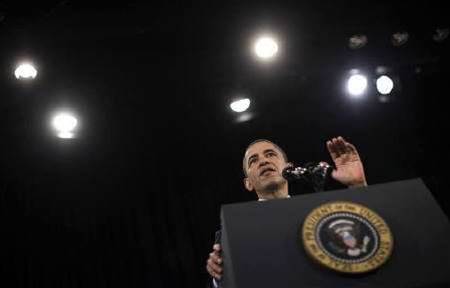
During a trip to Marquette, Michigan -- a politically important state that has been especially hard hit by the rough U.S. economy -- the president proposed investing US$5 billion into a fund that will ensure fast wireless technology is made available to rural areas across the country.

"This isn't just about a faster internet or being able to find a friend on Facebook. It's about connecting every corner of America to the digital age," Obama told an audience at Northern Michigan University.

He also called for US$10.7 billion to be invested in developing a wireless network to support public safety agencies, a proposal that will be in his fiscal 2012 budget, due to be released on Monday.

During his State of the Union address Obama, a Democrat, called for expanding high-speed wireless services to satisfy a voracious appetite of consumers and businesses for the technology.

His administration has endorsed making 500 megahertz of wireless airwaves, or spectrum, available over the next decade to meet the growing demand for broadband services, including the widely popular Apple iPad and proliferation of smartphones.

The Federal Communications Commission hopes to "repurpose" 120 megahertz of spectrum through incentive auctions where television broadcasters would voluntarily give up spectrum in exchange for a portion of the auction proceeds.


WASHINGTON TO RAISE US$27.8 BILLION

"By selling private companies the rights to these airwaves, we won't just encourage private investment and expand wireless access; we'll actually going to bring in revenues that lower our deficits," Obama said.

The White House said it expects those auctions and more efficient use of government spectrum to raise US$27.8 billion over the next decade. That figure is an estimate, however, and could end up lower or higher depending on the success of the auctioning process.

Congress must pass legislation to give the FCC the authority to conduct the incentive auctions. There could be resistance from lawmakers if they fear the auctions could apply undue pressure to broadcasters in their districts to give up spectrum.

In addition to the fund to help rural areas, Obama proposes putting US$3 billion from those proceeds towards "research and development of emerging wireless technologies and applications," the White House said in a statement ahead of the president's trip.

Another US$9.6 billion from the proceeds would be applied to curbing the deficit, a key goal of Obama's next two years in office and a top demand from Republicans, who control the House of Representatives and will likely make deficit reduction a high profile topic in the 2012 presidential campaign.

Obama's fiscal 2012 budget will focus on deficit curbs while investing in areas such as Internet broadband that the president believes are crucial for boosting U.S. competitiveness.

(Additional reporting by Jasmin Melvin; Editing by Xavier Briand).



Copyright Reuters Copyright Reuters. Click for restrictions.


Obama lays out US$18.7 billion wireless plan
"Obama shouldn't be worried about their Broadband, they should fix their health system, their education system etc."
By mad1k5


Comments: 16
damaxx
Feb 11, 2011 2:54 PM
Does anyone have Stephen Conroy email address and let him know that there IS a cheaper and better option to fiber optic? Like the classic quote i heard, "might as well have run coax to every home in Australia when public television was started."
rycrozier
Feb 11, 2011 3:07 PM
There were never going to be prizes for who was first with this. I also hear it's cheap just to do nothing because Australians have awesome broadband already.
umbria
Feb 11, 2011 3:18 PM
@damaxx, I hope you're being ironic!

Wireless is not "cheaper and better" than fibre to deliver universal broadband to Australians. John Howard first announced the goal of delivering universal broadband in 2004, and began exploring FTTN and wireless to try to do do it for $4-6 billion.

John Howard's OPEL and then Kevin Rudd's NBN Mark I were found to actually cost around $20 billion to connect everyone the market had ignored. Both would have resulted in high operating and maintenance costs, and delivered only modest and capped improvements to bandwidth. This is why they were both rejected, because they were just not good enough for that kind of money.

It took five years of detailed work to get to the May 2010 NBN Implementation Report, which examined every cluster of premises in the nation to find the cheapest universal solution.

In fact the cheapest way to deliver at least 12 Mbps to EVERYONE is to first lay fibre to premises in large towns and cities (93% of premises), thereby reducing wireless spectrum congestion and the number of wireless towers required to reach everybody else (4% of premises). Satellite is still needed for remote and black spot coverage of the last 3%.

Best of all, because 93% of premises will then have fibre in the ground, any future speed upgrades happen automatically as equipment is replaced, without ever digging up the fibre.

It is true that 7% will have to settle for wireless and satellite technology that will go out of date within a decade or so, but this is inevitable in a vast country.

Almost every Australian will be on fibre, which of course also means they will have blanket WiFi coverage at low data cost as well, since the data is delivered by fibre.
umbria
Feb 11, 2011 3:29 PM
Like Obama, the Australian Government will soon be auctioning unused spectrum to the cashed-up mobile operators after the switch to digital TV is complete. So can we offset our NBN cost against the proceeds too?*

What would the Economist analysts-for-hire think about that?

(* Yes, I am being ironic.)
Ace
Feb 11, 2011 4:04 PM
It won't be long before 'high-speed wireless' will be akin to saying 'high-speed steam train'. Certainly high-speed compared to dial-up modem, but woefully slow compared to what cabled networks can achieve. All Obama is after is getting most people a internet connection, because in the US where privatisation rules, no company is going to hook up a country town unless there is a cost benefit to them.

Edited by Ace: 11/2/2011 04:26:01 PM
MerariSchroeder
Feb 11, 2011 5:21 PM
There are so many technology experts out there who think that everyone wants to pay for the fastest and newest. If you talk to most people out there, they're happy to read their email. If you look at the statistics the highest wage earners are 80% likely to have internet compared to the lowest where it's at 35%. Clearly there are burning questions requarding demand and cost.

We will all see in the coming years who wins in the international rankings. The US with LTE-A covering 98% for $18.7bn for 200M residents, OR Australia with FTTP covering 93% for $43bn for 20M residents. In the US, those needing more than 1Gbps peak speeds - such as medium and large enterprise will be paying for direct fibre. NBNCo will be haunted by debt and low margins. US-NBNCo will be sailing ahead and expanding with savings (perhaps even to FTTH where it's "needed"). Australians will be slogged with higher cost baseline broadband. Americans will once again sail ahead with even cheaper/more-accessible-to-the-common-citizen internet.

[Umbria] "John Howards' OPEL ... were found to actually cost around $20bn"
No it wasn't. FTTN was estimated at the last election to cost around $6bn with 98% coverage. (And yes FTTN would be the best fixed line option, as it is extendable to FTTH)
HubertCumberdale
Feb 11, 2011 6:36 PM
MerariSchroeder wrote:
We will all see in the coming years who wins in the international rankings. The US with LTE-A covering 98% for $18.7bn for 200M residents, OR Australia with FTTP covering 93% for $43bn for 20M residents.

wow you make it seem like such a bargain, 98% coverage for just $18.7bn and 1gbit speeds you say? maybe NBNco has got it all wrong and should rethink...

MerariSchroeder wrote:

those needing more than 1Gbps peak speeds - such as medium and large enterprise will be paying for direct fibre.

oh I see so only "medium and large enterprises" would need 1gbps, everyone else can just be satisfied with the whatever lower standard wireless can provide because it cant actually provide what fiber can is that the logic?

MerariSchroeder wrote:

NBNCo will be haunted by debt and low margins.

Unsubstantiated claim.

MerariSchroeder wrote:

Americans will once again sail ahead

With wireless? LOL

anonymous
Feb 11, 2011 8:13 PM

@Merari "FTTN was estimated at the last election to cost around $6bn with 98% coverage. (And yes FTTN would be the best fixed line option, as it is extendable to FTTH)".

And the tooth fairy will bring you gold. Honest.

Have another look at what FTTN would actually have cost and covered (it was the previous election, not the last one), and try to confront reality. FTTN was Telstra's dream because it would have allowed them to choke off competition. It would have cost far more than the quoted $6bn and would have exposed nearly everybody to monopoly rent-taking.

And FTTN is not "extendable" to FTTP without spending nearly as much again as an original FTTP install.

You really should try a bit harder to separate ideology from fact.
davmel
Feb 11, 2011 8:27 PM
@MerariSchroeder "We will all see in the coming years who wins in the international rankings. The US with LTE-A covering 98% for $18.7bn for 200M residents"

Yeah, sure, they'll sail ahead with <200kbps average throughput wireless..... PLEASE STOP WITH ALL YOUR BS!
Wireless has MILLIONS of times less capacity than fibre and that is a fact. Go and count up all the spectrum available in the infra-red light band and compare that with all the pitifully small spectrum available in the radio frequency bands. Go back and study physics in school before sprouting absolute garbage about how wireless is all we'll need.

@MerariSchroeder "Americans will once again sail ahead with even cheaper/more-accessible-to-the-common-citizen internet."

America is on the verge of imploding with their national debt which is past 14 TRILLION dollars and growing steadily. By the time their wireless internet construction starts the Republicans will be back in power and stop any spending. If it goes ahead there won't be any people left in America that could afford to use it as they'll all be homeless or squatting.
Ace
Feb 11, 2011 11:28 PM
I suppose I'd better respond to @MerariSchroeder since everyone else is!

You seem to be implying that you can get up to 1Gbps over public wireless!?! You can't even get 100mbps over wireless, and realistically, you're looking at up to 10mbps...if you can get a reliable connection at all - often tricky given the amount of everything else invading the same or neighbouring spectrums, and reinforced walls...and trees etc.

You mention "most people". I assume this is based upon some survey that questions a representative sample of people across society. The problem with this kind of survey is that you're talking about infrastructure that will only be in place in 6-10 years from now. So todays 20yr olds will be 30. Will todays 20 yr old have the same expectations for bandwidth as todays 30 yr olds? No, they will want a lot more - and stats prove it.

Now 6-10 year is only when the infrastructure is put in place. Actually what you should be looking at to at least 15-20 years from now, when the infrastructure put in today is in full use. What will peoples expectations then be?

Wireless is at best a short-term band-aid when considered at a national infrastructure level. I'm pretty sure Obama and his advisors know this.
mad1k5
Feb 13, 2011 2:04 AM
Oh great, just what we need Wireless fanatics...

MerariSchroeder: USA is one of the largest debt countries in the world.
HubertCumberdale
Feb 14, 2011 1:00 AM
mad1k5 wrote:
Oh great, just what we need Wireless fanatics...

MerariSchroeder: USA is one of the largest debt countries in the world.


Don't expect a response, when faced with the "tough" questions merari will cower in a corner and sob uncontrollably... I didn't even bring up the upload speed issue this time, regardless this is the sort of thing to be expected from the progress hating anti-NBN crowd and wirelesstards all logic goes out the window when you must defend the Liberal party hive.
Maxxi2
Feb 14, 2011 9:29 AM
OK, let's take a direct quote from the article folks:

"the president proposed investing US$5 billion into a fund that will ensure fast wireless technology is made available to rural areas across the country."

Let's repeat the critical aspect really really really clear:

"will ensure fast wireless technology is made available to rural areas across the country"

again for the slow ones:

"will ensure fast wireless technology is made available to rural areas across the country"

for the really slow ones:

"will ensure fast wireless technology is made available to rural areas across the country"

for the obtuse amongst us:

"will ensure fast wireless technology is made available to rural areas across the country"

Keywords coming up for those that cannot get past 5 words...

"to rural areas across the country"

Now THE keywords for the luddites amongst us:

"rural areas"

and now in repitition to get the mesage across real clear:

"rural areas"

"rural areas"

"rural areas"

"rural areas"

"rural areas"

hmmmmm, nice message, pretty clear and all about **RURAL** areas.


Now to the real motivation for ther initiative:

""By selling private companies the rights to these airwaves, we won't just encourage private investment and expand wireless access; we'll actually going to bring in revenues that lower our deficits," Obama said."

The reality (tough word that one) is that wireless is an EXCELLENT expansion to fixed fibre (or whatever) networks. I use wireless as well.

BUT, I always use fixed access where it is available as it is almost (!!) always faster, more reliable and more resilient.

The typical exceptions being many hotels where WLAN access is excellent and more flexible to use, however this again is just an expension of the hotels fixed broadband connection, just like my house.

In theory wireless connections can reach 1Gbps, but drop dramatically when multiple users are online on the same network segment (errr the whole idea of the internet).

Ace
Feb 14, 2011 10:16 AM
My understanding @Maxxi2 is that IF I had a base station outside my front door, I MIGHT be able to get 100mbps. How does one get 1Gbps wireless in real life? Do I need a dish and clear line-of-site to the transmitter? I know IEEE 802.16m lays out a standard for 1Gbps, but getting anywhere near 1Gbps is surely unrealistic.
Maxxi2
Feb 14, 2011 3:46 PM
@Ace: In total agreement with you.

Some folks are trying to project the theoretical 1Gbps, which I am sure can be demonstrated in a lab environment, will simply be available as a viable commercial product at some stage in forseeable future.

I contend, and agree with you, that this is unrealistic, and contend that those taking a lab environment testing that has never been applied in a mixed and real life commercial environment, are blowing out of so many holes simultaneously that I surprised that they do not shrink up to the size and shape of a dried prune...

In other words: Blatant misinformation under the motto:

"Throw enough crap around and some is sure to stick in the minds of some people..."
mad1k5
Feb 14, 2011 4:48 PM
Obama shouldn't be worried about their Broadband, they should fix their health system, their education system etc.
Comments have been disabled for this article.
 
 
Top Stories
Project management lessons from the QLD Health payroll inquiry
Analysis: How not to run a major IT project.
 
Review: Asus Fonepad
Calling on the Big Phone.
 
Photos: Highlights from SAP Sapphire Now 2013
All the keynote action from one of the world's biggest SAP events.
 
 
Sign up to receive iTnews email bulletins
   FOLLOW US...

Latest VideosSee all videos »

Bankwest builds continuous delivery capability
To automatically deploy test/dev sandboxes by mid-year.
Veterans' Affairs sets sights on modernisation
Data safe with Human Services, CIO says.
Citi Australia drops platform customisations
Technology chief shifts focus from building to leveraging systems.
VicRoads restructures IT team
Department moves to align with industry benchmarks.
Zurich Australia extends IT team offshore
Malaysian staff served from Australian data centres.
Leigh Berrell - Utilities CIO of the Year
Yarra Valley Water CIO Leigh Berrell accepts his Benchmark Award for Utilities CIO of the Year.
Wayne McMahon - Retail CIO of the Year
Domino's Pizza CIO Wayne McMahon accepts his Benchmark Award for Retail CIO of the Year.
Inside Perpetual's ongoing IT transformation
CIO Jenny Levy discusses how outsourcing will help the firm "simplify, refocus and grow".
Managing Complexity - Defence's Daniel McCabe
Daniel McCabe, Assistant Secretary of Australia's Department of Defence, provides the audience at the iTnews Data Centre Strategy Summit with a deep dive into the organisation's data centre consolidation program.
How Facebook designed the data centre from scratch - Marco Magarelli
The full keynote by Facebook data centre architect Marco Magarelli at the Australian Data Centre Strategy Summit. Magarelli details the design considerations behind the social network's Prineville, Oregon; North Carolina and Luleå, Sweden data centres.
Modernising Legacy Data Centres - Telstra's Jon Curry
Telstra general manager of managed data centres Jon Curry guides the audience at the iTnews Australian Data Centre Summit through the build of the telco's Clayton, Victoria data centre.
NSW Government launches NABERS data centre rating tools
Matthew Clark from the NSW Department of Environment guides facilties managers through the details of the new NABERS data centre energy rating tool at the Australian Data Centre Strategy Summit.
NABERS launch panel: Australian Data Centre Strategy Summit
Matthew Clark (NSW Dept of Environment), Greg Boorer (Canberra Data Centres), Glenn Allan (National Australia Bank), Mike Andrea (Strategic Directions) and Bob Sharon (Green Global Consulting) discuss the impact of the NABERS data centre rating.
Judges notes: Fortescue Metals [The Benchmark Awards]
iTnews' panel of judges discuss Fortescue Metals 'New World of Work" project, one of three shortlisted finalists for the Industrials category of the CIO Benchmark Awards.
Judges notes: Retail [The Benchmark Awards]
iTnews' panel of judges discuss the shortlisted finalists for the Retail category of the CIO Benchmark Awards.
Judges notes: Pacific Aluminium [The Benchmark Awards]
iTnews' panel of judges discuss Pacific Aluminium's lightning fast service desk refresh, one of three shortlisted finalists for the Industrials category of the CIO Benchmark Awards.
Judges notes: Domino's Pizza [The Benchmark Awards]
iTnews' panel of judges discuss Domino's Pizza's shift to hosted services, one of three shortlisted finalists for the Retail category of the CIO Benchmark Awards.
Judges notes: McDonald's Australia [The Benchmark Awards]
iTnews' panel of judges discuss McDonald's Australia's new self-service portal for employees, one of three shortlisted finalists for the Retail category of the CIO Benchmark Awards.
Judges notes: ING Direct [The Benchmark Awards]
iTnews' panel of judges discuss ING Direct's 'Bank in a Box', one of three shortlisted finalists for the banking and finance category of the CIO Benchmark Awards.
Judges notes: Yarra Valley Water [The Benchmark Awards]
iTnews' panel of judges discuss Yarra Valley Water's insourcing project, one of three shortlisted finalists for the Utilities category of the CIO Benchmark Awards.
Latest Comments
Polls
Do you prefer the Coalition's NBN policy?

   |   View results
Yes
  19%
 
No
  81%
TOTAL VOTES: 1643

Vote