Support the NBN? Malcolm's in the middle


No guarantee of bipartisan support.

Opposition communications spokesman Malcolm Turnbull has repeated calls for a cost-benefit analysis of the Federal Government's National Broadband Network plan, but couldn't guarantee bipartisan support for the NBN project should such an analysis endorse it.
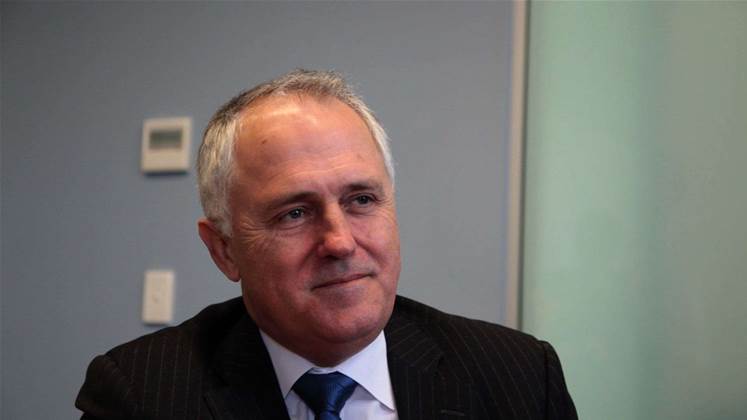
Turnbull on Sunday said that a "big tick" from a Productivity Commission-led analysis of the National Broadband Network would be "incredibly persuasive", but he again stopped short of saying he would support the broadband project in that eventuality.

Turnbull is due to introduce to parliament today a private members bill seeking to force a cost-benefit analysis on the national broadband network.

Yesterday, Turnbull again faced the question of what he would do if the cost-benefit analysis he consistently called for came up in favour of the Government's NBN project.

He told iTnews last month that he wouldn't commit to support the $43 billion project in the "unlikely" event that such an analysis concluded fibre-to-the-home should proceed.

And a month later, his position appeared not to have changed, despite at least one report suggesting Turnbull's comments heralded the coming of bipartisan support for the NBN.

"I would not, as a matter of principle, give a blank cheque to anyone, even the Productivity Commission, but if the Productivity Commission were to report on the NBN as they should, and if they were to give it a big tick from a cost-benefit point of view, it would be incredibly persuasive," Turnbull told Channel Ten's Meet the Press yesterday.

"I think it would obviously change a lot of people's perceptions.

"It would have a huge impact but nobody in their right mind gives a blank cheque to anyone, even someone as a well resourced as Gary Banks and the Productivity Commission."

Turnbull did not specify whether he or the Coalition would be persuaded by a positive outcome of a cost-benefit analysis.

Turnbull claimed yesterday that relatively static growth in fixed line broadband connections compared to mobile broadband was proof that investing in a next-generation fixed network was flawed.

"The government is... backing one technology where every indication from the market is that it is moving in another direction," he said.

Turnbull also said that the shadow cabinet and Liberal Party would examine the text of the re-introduced Telstra split bill this week.

Does the NBN need a cost-benefit analysis? Read telco expert David Havyatt's case for and against here and have your say in our poll on the iTnews home page.


Copyright © iTnews.com.au . All rights reserved.


Support the NBN? Malcolm's in the middle
"@RB, You're right, "The point of calling for the CBA is to do 2 things:" 1) Impose more cost on the project for no benefit, given that any reasonable person will understand that it is impossible ..."
By anonymous


Comments: 6
realitybites
Oct 25, 2010 11:53 AM
"Turnbull on Sunday said that a "big tick" from a Productivity Commission-led analysis of the National Broadband Network would be "incredibly persuasive", but he again stopped short of saying he would support the broadband project in that eventuality."

Either pee or get off the pot Malcolm..
umbria
Oct 25, 2010 3:27 PM
In 2001 the Productivity Commission was asked to produce a report on the future of telecoms but explicitly told not to propose Telstra's structural separation. They managed to include a whole section advocating structural separation of the fixed infrastructure, prefaced by the statement that they were not going to recommend it, as instructed by the government!

Any nong can see that even a back-of-an-envelope skeletal list of the certain and likely benefits of near-ubiquitous fibre will whip the pants off the cost profile of building it.

For a start, households will knock $30 a month of the average monthly landline phone and broadband bill, which equates to the $30 a month per taxpayer if the $26 billion was to be recovered only from personal income tax over a decade. If this maths is correct (well is it? anyone?), there is possibly no net cost to taxpayers to build the NBN, which gives us 93% speed-agnostic fibre coverage, allowing 97% wireless coverage at 12 Mbps to be free of congestion. This will be utterly life-changing for the 40% of Australians currently without broadband, and won't be too shabby for the rest of us.
Bazwalt
Oct 25, 2010 4:21 PM
Quote:
Turnbull did not specify whether he or the Coalition would be persuaded by a positive outcome of a cost-benefit analysis.


Turnbull is not in the middle. He has made it very clear that he has no intentions of supporting the NBN regardless of the outcome of the CBA.

So my question would be, What is the point? Why does he push so much for a CBA if there is not a chance at all that he will agree with its results?

Sounds like someone just isn't getting what they want so they instead opt to kick up the dust a little bit.
RB
Oct 25, 2010 4:47 PM
The point of calling for the CBA is to do 2 things:
a) substantiate whether the decision to spend $43B of taxpayer money is based on sound economics; and
b) to provide transparency in what the costs are both now and into the future (so that Australian citizens are aware of what to expect).

On the issue of household costs, clearly the $30 will not be saved. Published iiNet pricing shows only $10 advantage at present and that's based on NBN Co providing access for free.

We really need to see the CBA so that NBN Co can be held to what the wholesale price is going to be which will determine what retail pricing is likely to be.

The lack of transparency is a farce. Comments above stating that there will be no line rental and yet project cost is going to be $26B are directly contradictory. It is only through substantial take-up and substitution of line rental to NBN Co fees that the project cash draw-down gets reduced to $26B.

We need a CBA so that there is clarity on exactly what it's going to cost taxpayers and users.
meski
Oct 25, 2010 4:51 PM
We've already had one analysis, another one should be seen as what it is, a delaying tactic. A hard economic CBA, is, as many have said in the past, not really possible to do because of the difficulty of assessing benefits.
anonymous
Oct 26, 2010 12:04 PM

@RB, You're right, "The point of calling for the CBA is to do 2 things:"

1) Impose more cost on the project for no benefit, given that any reasonable person will understand that it is impossible to accurately project costs/benefits ahead for fifty years; and

2) Delay, delay, delay while the opposition and the media corporations run their self-serving FUD campaigns.

You also seem somewhat confused about the distinction between a CBA and a deployment policy, since what you are (very reasonably) asking for is an outline of the proposed access conditions.
Comments have been disabled for this article.


Top Stories
Australian miners send drones to work
In-depth: Unmanned aerial vehicles in the resources sector.
 
The New Zealand telco problem
Opinion: Could Telstra save Kiwi telcos?
 
IT price probe to 'name and shame' gougers
Industry ducking the issue, committee claims.
 
Sign up to receive iTnews email bulletins
   FOLLOW US...

Latest VideosSee all videos »

Latest Comments
Polls
Should the Government enact new legislation to protect copyright holders in the digital age?

   |   View results
Yes
  19%
 
No
  81%
TOTAL VOTES: 496

Vote