Stallman calls for end to ‘war on sharing’


GNU founder warns of threats to a free digital society.

View larger image View larger image View larger image

See all pictures here »

Surveillance, censorship, restrictive data formats and software-as-a-service threatened the freedom of IT users, GNU founder and free software activist Richard Stallman claimed.
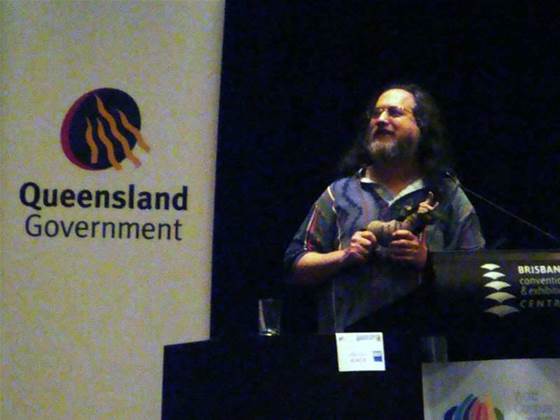
In a keynote presentation at the World Computer Congress in Brisbane on Tuesday, Stallman asserted that digital society had to be "free" in order to be a benefit, and not an attack.

"It may turn out that technology is a huge disaster for society," he said, highlighting its potentials for censorship and surveillance.

He criticised Australian plans to force telcos and ISPs to store browsing and call logs in a similar fashion to the European Directive on Data Retention.

The proposal was led by the Attorney-General's department, which in July claimed that the release of details "may lead to premature unnecessary debate".

Stallman argued that it was never "too early to debate the question of whether the government should watch all of us".

"Often they don't record what people say, but who they speak with," he said about data retention.

"That's enough for them to attack whatever political opposition groups they seek to destroy. No country is safe and immune to the possibility of a tyrant," he said.

Noting that "surveillance is one of the major dangers" to a free digital society, Stallman also criticised government surveillance of cars in the UK.

Censorship was another threat, he said, highlighting Australian ISP-level filtering plans and current penalties for hosting or linking to prohibited online content.

"This is intolerable in a free country," he told local and international delegates. "It's an ugly assault on human rights."

"Digital technology is a platform for convenient censorship ... It's not just China and Iran anymore; we have to fight against censorship wherever we are."

War on sharing

Stallman named Microsoft, Adobe, Amazon and Apple in his tirade against proprietary software and "restrictive data formats".

Asserting that a user either controlled, or was controlled by, a program, Stallman said a "non-free" program essentially was an instrument that gave vendors power over users.

The term "free" was not about price, he said. Rather, it required four "essential freedoms": to run software as a user wished; to access source code and compute freely; to distribute the software; and to modify and distribute modified copies of the code.

Stallman called digital rights management (DRM) technologies "malware" that could monitor usage and said they were "explicitly designed to do things to the detriment of users".

Using software-as-a-service (SaaS) was the same as using non-free software, he said, because users did not have access to the source code or executable file.

"SaaS means that instead of doing your computing in your own computer, you do it by sending the relevant data to someone else's computer," he said.

"You absolutely can't study it, and you absolutely can't change it, and you're even further away from having control over your computing."

Art tax

Stallman called for an end to the "global war on sharing", where the use and distribution of software was controlled.

While artists and musicians were "not entitled to" compensation from listeners, Stallman said governments could introduce a tax to support their work.

He had two suggestions. In the first, governments would collect taxes and distribute these resources to authors or artists according to the cube root of their popularity so "fairly successful" artists would be adequately supported.

Alternatively, artists, authors and musicians could use a voluntary payment method that allowed users to donate small amounts at the push of a button.

"A lot of people will push that button because it feels good to support the artist," Stallman said.

"To end the war on sharing is an imperative," he said. "Its goal is bad because sharing is good; sharing is the way we build a society."

Stay tuned to iTnews for a one-on-one video interview with Richard Stallman that will be posted this afternoon.


Copyright © iTnews.com.au . All rights reserved.


"Fuck the artist. There, now that the labels and I are thinking alike, I think I can explain this particularly juicy "war on something" (WoS). Like every WoS, it makes a nice hook for inserting ..."
By martyfmelb


Comments: 23
johnpro2
Sep 23, 2010 7:25 AM
Free stuff ..yes I love it.Implying that most media should be free is ridiculous in the extreme.
Certainly free products help folk ..unfortunately my Woolworths supermarket here in Brisbane refuses to recipricate and will evcen prosecute five finger discounters.

Jp
hellfire
Sep 23, 2010 7:36 AM
I agree with Stallman to a point that censorship has no place in our society especially at ISP level on the internet. It is a gross invasion of privacy to monitor and keep a persons usage details on file. After all this is a free non-communist country but with a fabian socialist as PM maybe it's not free anymore?
RaTTyRaTT
Sep 23, 2010 8:56 AM
Not sure I can totally agree to this, some points yes, some points no.
Not everyone can just expect to create something (artists) and get nothing for it. All well and good to donate when they are generating elsewhere - but if the 'government handouts' actually work - yay, but I think many of us know that it is not always that simple.
In the meantime, artists who give away their songs just get to go Falun Gong and eat air right??? No problem - they're not really productive members of society... sounds more like the old days where Artists needed patrons to actually be able to eat... Stallman needs a head check... why would he want to create an underclass, which effectively would end up dying of starvation, et all and not end up existing at all. (who'd be an artist...)

I think this guy needs to try it from the flipside = too busy trumpeting his horn though...

Innovation (ideas) and the like are critical, but people should receive some 'good' recompense for what they provide - otherwise 'why' provide it in the first place... Better to be a drone who just gets handouts then - or pushes paper in offices, and turns off their brain...

in advocating this - he's advocating the whole communist system effectively... taking from the people have achieved more and disbursing it to the ones who haven't.

Sorry, that's like asking Gates to give me a few million just because I said so! hmmm - I think his security guards won't let me in the door...

Stallman should think that the effect of also this kind of thing is to begin challenges up & down the strictures of Society, as if this is applicable - what about land rights? Does this mean that I can also just walk in to his home throw my swag down on the floor and camp in his loungeroom??? after all - why should he have exclusive access to a location on this planet that I don't have??? I demand full and unrestricted access to every part of this planet. ... ... duhhhhh people!!! small pebbles = bigger rocks, mountains fall!!!
Graeme Harrison (prof at-symbol post.harvard.edu)
Sep 23, 2010 9:02 AM
Bigger than the four types of 'openness' Stallman would like to see in software, is a more basic right to have the output stored in an ISO-approved format. I can't believe that 25 years after Microsoft copied most of WordPerfect's user interface to make 'Word', such a huge proportion of users worldwide 'elect' to store their own documents in a proprietary format, that has a history of constant change... when OpenOffice is free and allows ISO formats and ISO-approved PDF output. Surely guaranteed future access to your own data is more important than an ability to access source code!

And the NSW Road & Traffic Authority is not that far behind the UK in terms of tracking movements of all vehicles, with cameras everywhere and auto-recognition of number plates. Nominally it is to allow a bankrupt state to charge >$1000 for every time a citizen drives an unregistered car (>$500 for unregistered and >$500 for uninsured - but it is at the State's insistence that third-party personal insurers must end policies on the date of registration expiry). But the long-term effect is that the State can now monitor all movement of citizens, which has big implications for an Orwellian future.
chrislove
Sep 23, 2010 9:03 AM
This seems like a load of rubbish. Why should creators of software and/or music be expected to give away their work for free?

When I look around me I don't see other people being asked to give away the fruits of their labour for free.

Does this guy work for free? Or is he lucky enough to work in an industry where he feels he should be paid for what he produces?
gbyrneg50
Sep 23, 2010 9:59 AM
We need to get rid of copyright. If you buy a product it is yours. The idea of "intellectual property" is a nonsense. The person who creates the article gets a big advantage by being the first to put it out there. If others copy it for their own use so be it.
deteego
Sep 23, 2010 12:10 PM
chrislove wrote:
This seems like a load of rubbish. Why should creators of software and/or music be expected to give away their work for free?

When I look around me I don't see other people being asked to give away the fruits of their labour for free.

Does this guy work for free? Or is he lucky enough to work in an industry where he feels he should be paid for what he produces?


If you actually read the article, he wasn't talking about the pricing of software but about open standards (the amount of people not reading properly on this site is starting to scare me)

His final suggestion was an art tax, so such people would get paid, but not for every copy of content they sell through physical means

Edited by deteego: 23/9/2010 12:11:52 PM
RB
Sep 23, 2010 2:15 PM
I think Mr Stallman has missed the point of SAAS. With SAAS you now no longer need to own the computer to run the software on plus all of the infrastructure required for it to run 24/7.

The point of SAAS is that it is no longer "software" it is now "service". A small business (eg. florist) does not want to have to run a mail server, anti-virus, firewall, UPS, etc ... they just want 24/7 email. Hence they purchase the email "service" at a fraction the cost of doing it themselves. AND, they don't want to "study" and "change" the software on an email server ... they just want it to work.
Sams
Sep 23, 2010 2:20 PM
'The point of SAAS is that it is no longer "software" it is now "service".'

The problem with SAAS is vendor lock-in. On the other hand, if you have SAAS running on open source software, then you can move you data from one provider to another, and yet still enjoy SAAS. I dream of a world where moving from one SAAS provider to another is like the process of transferring a domain.
RB
Sep 23, 2010 2:35 PM
Data portability is nothing to do with "open source software". For example, there's nothing portable about Joomla and Wordpress.

This is where Graeme Harrison is right ... software should use open, portable standards to allow interoperability. Good SAAS systems provide this already. Consider something like ARIBA and Facebook ... both proprietary systems that have extensive APIs for third-party interfaces and data exchange.

While the concept of "open source software" seems attractive the reality is that is has failed. The vast majority of in-use software is propriety. People buy software because they want the products that commercial software development delivers.
Ezy2Confuze
Sep 23, 2010 3:54 PM
These two points get me:

"to access source code and compute freely"

Why, how many average users would know what the code means let alone be able to cha nge it? It's all right to say this from a Developers view but be reasonable, most people don't care how Word or Excel or Outlook works, they just want to be able to create their documents and send them out, from a Developers view, why should I allow you to change my code and reverse engineer my code that I worked hard on, get your own ideas and stop being lazy.

"to distribute the software; and to modify and distribute modified copies of the code."

With the prevalance of virus attacks etc, if you allow people to do these things, how do you defend yourself and your code in the event it is used by less scrupulous people? Uou may be able to prove it wasn't your code at fault but then again mud does stick. Once bitten, people are going to be very wary of using anything that they think is even remotely linked to the dodgy code in question, unless you have a hell of a good marketing team like Apple or Microsoft.
brightside
Sep 24, 2010 1:20 AM
It doesn't matter that the average user can read the code or change it himself and I agree that most users just want the thing to work. The number of software developers will always be outnumbered when compared to the number of normal users. It doesn't matter because, if there was just one developer among one million users, then that developer could modify the software to give it a much needed feature or fix the latest virus exploit, and all the normal users would benefit as a result.

To use the obligatory car analogy: Most owners have no idea and don't car how their car work, they just want to start it up and go. Likewise, the number of mechanics is heavily owith software utnumbered compared to the number of drivers, but if you have troubles a mechanic can fix the car for you and he does not have to worry about breaking any patents or copyright while doing it. And, while the normal driver seldom wants to build a whole new engine, he might feel like changing the tires or perform other custom jobs on it, and he wont be sued by the manufacturer for doing so.

Providing access to source code gives users with the same freedom on the computer as they have in other areas.
levymetal
Sep 24, 2010 2:28 AM
Brightside, I have to disagree with your comment. You imply that developers can't add that much needed feature to closed software. But most popular applications support plugins which allow developers to add more functionality. And for any paid software, you'd expect security patches to be priority - and they are. Now, here's the fun bit. Let's look at Photoshop. Everyone could just get Gimp. It's free. It's open source. So why do so many people still use Photoshop? Because it costs money. Photoshop is as good as it is because it's NOT free. Paid software allows more time, effort, and research to go into the product. The result? Better software (most of the time anyway). I don't see why people complain about paid/closed software. For every paid software there's a free equivalent. It's unbelievably easy to use open source software for 100% of your computing use. Yet people would prefer to argue against paid/closed software than switch to the open source counterparts. The interesting thing about your mechanic analogy is that people know that when they need their car fixed, they take it to a mechanic and they pay the mechanic for their time. On the other hand, most people would expect the feature or virus patch for their software for free, I doubt people have got money in their hands ready to pay a developer for their time making the features they want. Software development seems to be the only industry where people expect everything to be free and open. In any other industry the thought of it is ludicrous. No one else works for free, why should developers?
CyrusLesser
Sep 24, 2010 8:05 AM
If Mr Stallman were paid based on the cube root of those who agree with him he might take a different tack!
Sams
Sep 24, 2010 9:39 AM
RB: "Data portability is nothing to do with "open source software". For example, there's nothing portable about Joomla and Wordpress."

Open source doesn't equate to portability - that's true - but it is an enabler. You actually blew away your own argument by pointing out Joomla and Wordpress. I can very easily move from one Joomla or Wordpress provider to another by dumping and restoring the corresponding MySQL database through a nice web panel interface.

You can also have portability by using open standards as you pointed out, but or proprietary SAAS this is usually done poorly and in a limited way. For example: if you have a an non-trivial database, dumping CSV will (a) not automatically importable to another SAAS, because the schema will be different and (b) typically omits much useful valuable database structure. If you have to use an API and write a program or script to do this, then that is *not* what we mean by portability.

"Good SAAS systems provide this already. Consider something like ARIBA and Facebook"

When we are talking about SAAS here for business we mean things like CRM/ERP and accounting software. In any case, I can't speak for ariba, but Facebook is *not* portable as explained above.

levymetal: "So why do so many people still use Photoshop? Because it costs money"

No, not even close - do some research.

"No one else works for free, why should developers?"

I only deal in open source software, and make a good living. Go figure. You misinterpret the word "free". Free in Free Software means freedom/liberty/unencumbered, not free as in free beer.
oz_ollie
Sep 24, 2010 9:50 AM
"And for any paid software, you'd expect security patches to be priority - and they are."

@levymetal - you obviously haven't been in the IT industry for very long. Microsoft have security holes that were reported years ago and still haven't been fixed. The security hole highlighted by Tavis Ormandy in June this year was known about by Microsoft since at least 2004 (Security Bulletin MS04-015) but wasn't fixed. You are at Microsoft's mercy when any problems are identified, you can't fix them regardless of the impact they have on your business. This goes for Adobe as well - I've been trying to get a solution to a problem with Adobe CS4, and now with Adobe CS5, since February of this year. Their first reaction - "it's something you've done". It doesn't matter that this problem is also affecting thousands of other users throughout our organisation.

Open source software doesn't mean it has to be "free as in beer" - you can pay developers to create or modify the code. This happens all around the world - people get paid to develop open source software.

@chrislove - Richard Stallman has developed plenty of software and given it away for free. Look at the Free Software Foundation if you want more information.

Do I agree with everything Richard Stallman says? No. However, he is willing put his software where his mouth is - fully complying with his 4 basic freedoms.
levymetal
Sep 24, 2010 12:26 PM
Sams: "No, not even close - do some research."

Perhaps I wasn't clear about how I came to that conclusion. Why do people use Photoshop? Because it's one of the best graphics editing software available. Why is it one of the best? Because of the amount of development that's gone in to it. How did they get so much quality development into it? Because they had the money do to so. Therefore, Photoshop is so good, because it's a paid piece of software. Had Photoshop been a community open-source project, maybe it wouldn't have been any good. Who knows though, maybe Photoshop was just lucky. If you think this is wrong, perhaps some input instead of "do some research"?

It's not about misinterpreting the word 'free'. There's a high correlation between software being 'open source' and 'free (not paid)'. You can release a piece of software under the GNU GPL and charge money for it. Someone can then come along and buy your software and release it for free. So why would anyone pay for your software when someone else has just released it for free? Maybe there's another licence that stops people distributing modified (or even unmodified) copies of your software for free. But then you've lost most of the benefits of open source if people are only developing for themselves and aren't able to redistribute what they make.

Sure, people can still make money out of open source, but for consumer level applications, how many people would pay for software if it was legal to obtain a copy for free? You might make a living fine, but if everything was open source then there would be a lot of developers earning a lot less than they currently do. If you disagree with that statement explain how.
deteego
Sep 24, 2010 1:26 PM
levymetal wrote:
Sams: "No, not even close - do some research."

Perhaps I wasn't clear about how I came to that conclusion. Why do people use Photoshop? Because it's one of the best graphics editing software available. Why is it one of the best? Because of the amount of development that's gone in to it. How did they get so much quality development into it? Because they had the money do to so. Therefore, Photoshop is so good, because it's a paid piece of software. Had Photoshop been a community open-source project, maybe it wouldn't have been any good. Who knows though, maybe Photoshop was just lucky. If you think this is wrong, perhaps some input instead of "do some research"?

There are numerous reasons why Gimp isn't on the same level as Photoshop, and it has little to do with it being open source. I would also argue that an open source project (Linux Kernel) is multitudes better then the Windows kernel, and there are many other examples of open source programs that are ahead of proprietary counterparts

Quote:
It's not about misinterpreting the word 'free'. There's a high correlation between software being 'open source' and 'free (not paid)'. You can release a piece of software under the GNU GPL and charge money for it. Someone can then come along and buy your software and release it for free. So why would anyone pay for your software when someone else has just released it for free? Maybe there's another licence that stops people distributing modified (or even unmodified) copies of your software for free. But then you've lost most of the benefits of open source if people are only developing for themselves and aren't able to redistribute what they make.

No you are making a massive misinterpretation (at best). Stallman is referring to open standards, this has nothing to do with giving away software for free. Thats like saying America is a fascist country because it has a president.

Quote:
Sure, people can still make money out of open source, but for consumer level applications, how many people would pay for software if it was legal to obtain a copy for free? You might make a living fine, but if everything was open source then there would be a lot of developers earning a lot less than they currently do. If you disagree with that statement explain how.


Its gaining money in other areas, have a look at Red Hat as an example (and they are a VERY profitable company, its not like they are going bankrupt)

Edited by deteego: 24/9/2010 01:27:08 PM
levymetal
Sep 24, 2010 2:03 PM
deteego: "There are numerous reasons why Gimp isn't on the same level as Photoshop, and it has little to do with it being open source."

Please elaborate/explain if you disagree then. It's easy to say someone's wrong without providing any explanations or examples.

deteego: "No you are making a massive misinterpretation (at best). Stallman is referring to open standards, this has nothing to do with giving away software for free."

Did you even read what I wrote? I wasn't talking about everyone just giving away software for free. In my example (that you actually quoted) I was talking about selling software under the GNU GPL. Someone else can then come along, buy your software, and distribute it for free, and they are within their rights to do that under the GPL. It's not very difficult to see that the original developer is at a disadvantage if other people can legally distribute his software for free when he's charging for it.

Don't take this as a full argument against open source. I think open source is a great thing, but there are some cases where open source does not benefit everyone involved. Open source and proprietary software both have their places in this world.

I do agree that there are some open source applications that are better than proprietary counterparts. I use many myself. I just don't see why people need to argue against proprietary software when 95% of the time there's an open-source counterpart that they could use instead. If the proprietary option just so happens to be better, decide what's more important.

Edited by levymetal: 24/9/2010 03:09:49 PM
Sams
Sep 25, 2010 12:01 AM
levymetal: "if everything was open source then there would be a lot of developers earning a lot less than they currently do. If you disagree with that statement explain how"

It's your thesis, so the onus is on you to prove it. If I say there are pink elephants on Uranus, should I expect you to build a spaceship to fly there to disprove it? Even if you could support your assertion (which I doubt), it isn't very interesting. If council workers made more money sabotaging cars instead of fixing the roads, then that's still bad strategy not a good one because it fails to look at the bigger picture. Surely any (hypothetical - note I don't argue this) argument for proprietary software would be something along the lines saves the consumers money, or is better for productivity, efficiency, and society in general, not some self-serving goal that it puts more money in the pockets of developers!?
Sams
Sep 25, 2010 12:26 AM
levymetal: "Why do people use Photoshop? Because it's one of the best graphics editing software available."

No .. do some research.
deteego
Sep 25, 2010 11:38 AM
levymetal wrote:
deteego: "There are numerous reasons why Gimp isn't on the same level as Photoshop, and it has little to do with it being open source."

Please elaborate/explain if you disagree then. It's easy to say someone's wrong without providing any explanations or examples.

Google would do a better job of explaining it then I would

Quote:
Did you even read what I wrote? I wasn't talking about everyone just giving away software for free. In my example (that you actually quoted) I was talking about selling software under the GNU GPL. Someone else can then come along, buy your software, and distribute it for free, and they are within their rights to do that under the GPL. It's not very difficult to see that the original developer is at a disadvantage if other people can legally distribute his software for free when he's charging for it.


And if you would look at the example of Red Hat, such software isn't designed to be sold. Money is made off the services provided to supplement the software, or the installation etc etc etc

Quote:
Don't take this as a full argument against open source. I think open source is a great thing, but there are some cases where open source does not benefit everyone involved. Open source and proprietary software both have their places in this world.

Open source, by design, benefits society the most (and not necessarily the company). I agree its difficult for a company to make insane profits and create vendor locking principles off open source, but then again I believe companies should care about making profit from releasing great programs, and not making profits at all cost (in my belief a lot of corporations run like this)

Quote:
I do agree that there are some open source applications that are better than proprietary counterparts. I use many myself. I just don't see why people need to argue against proprietary software when 95% of the time there's an open-source counterpart that they could use instead. If the proprietary option just so happens to be better, decide what's more important.

I also use whats best, its just unfortunate that the good proprietary programs are on an OS which I hate (windows) which is what causes issues for me (again the whole vendor locking argument)
martyfmelb
Sep 26, 2010 1:22 AM
Fuck the artist.

There, now that the labels and I are thinking alike, I think I can explain this particularly juicy "war on something" (WoS).

Like every WoS, it makes a nice hook for inserting my choice of oppressive laws and other behaviour control mechanisms to get people behaving how *I* want. Everyone who gets on the bandwagon for any particular WoS is in the same boat: the "something" that the war is on is actually *you*, dear populace.

People like *me* need people like *you* to simply shut the fuck up, do what you're told, and turn your money and your power over to us. Anyone who is *for* the piracy WoS is either with me on this, or, is completely ignorant as to how a WoS works but is still useful to me to help my cause.

This WoS, the piracy WoS, is a big one, possibly bigger that the terror WoS and the drugs WoS. It's the only one I can think of whose main thrust is a direct transfer of power from ordinary people to private industry (instead of "to government", the usual subject of submission by the people).

Anti-piracy is also the most abstract WoS, thus the most ripe for my exploitation.

Every human on the planet copies the activities and mannerisms of other humans - it's the basic unit of communication. It's also the basic unit of reproduction - the copy. All life reproduces. So, at what point does the copied thing become a copy*right*ed thing, and how close can we move the goalposts to the kicker? Basically, I need everything to become copyrighted.

Where we are today:
• We DRM'd all your personal information systems: your mobile phones and computers, and a lot of the content inside them.
• We DRM'd your food (terminator seeds, now pretty much the ONLY kind you can buy at a major grocer).
• We DRM'd your pets (a.k.a spay, neuter, sterilise).
• We DRM'd what you thought were just folk songs, so just shut up completely, that ought to ensure you don't break any copyrights.

Where we're going:
• We need people to lap up this message: DRM = safe; non-DRM = unsafe.
• We need people to talk only in "safe sentences": pre-approved, public-domain sentences. Mainly for your own legal safety, but also comes with a whole host of benefits for our close friends, the presiding government.
• We are looking at DRM'ing YOU. Gene patenting. To allow you/your children to continue living with those genes active, you need to keep your gene subscriptions all paid up.
Comments have been disabled for this article.
 
 
Top Stories
Photos: AusCERT 2013 day one
First day of the Queensland security conference.
 
CenITex to move from IT provider to broker
Documents reveal new strategy.
 
eHealth measures missing the point
Opinion: When will the PCEHR lead to patient outcomes?
 
 
Sign up to receive iTnews email bulletins
   FOLLOW US...

Latest VideosSee all videos »

Bankwest builds continuous delivery capability
To automatically deploy test/dev sandboxes by mid-year.
Veterans' Affairs sets sights on modernisation
Data safe with Human Services, CIO says.
Citi Australia drops platform customisations
Technology chief shifts focus from building to leveraging systems.
VicRoads restructures IT team
Department moves to align with industry benchmarks.
Zurich Australia extends IT team offshore
Malaysian staff served from Australian data centres.
Leigh Berrell - Utilities CIO of the Year
Yarra Valley Water CIO Leigh Berrell accepts his Benchmark Award for Utilities CIO of the Year.
Wayne McMahon - Retail CIO of the Year
Domino's Pizza CIO Wayne McMahon accepts his Benchmark Award for Retail CIO of the Year.
Inside Perpetual's ongoing IT transformation
CIO Jenny Levy discusses how outsourcing will help the firm "simplify, refocus and grow".
Managing Complexity - Defence's Daniel McCabe
Daniel McCabe, Assistant Secretary of Australia's Department of Defence, provides the audience at the iTnews Data Centre Strategy Summit with a deep dive into the organisation's data centre consolidation program.
How Facebook designed the data centre from scratch - Marco Magarelli
The full keynote by Facebook data centre architect Marco Magarelli at the Australian Data Centre Strategy Summit. Magarelli details the design considerations behind the social network's Prineville, Oregon; North Carolina and Luleå, Sweden data centres.
Modernising Legacy Data Centres - Telstra's Jon Curry
Telstra general manager of managed data centres Jon Curry guides the audience at the iTnews Australian Data Centre Summit through the build of the telco's Clayton, Victoria data centre.
NSW Government launches NABERS data centre rating tools
Matthew Clark from the NSW Department of Environment guides facilties managers through the details of the new NABERS data centre energy rating tool at the Australian Data Centre Strategy Summit.
NABERS launch panel: Australian Data Centre Strategy Summit
Matthew Clark (NSW Dept of Environment), Greg Boorer (Canberra Data Centres), Glenn Allan (National Australia Bank), Mike Andrea (Strategic Directions) and Bob Sharon (Green Global Consulting) discuss the impact of the NABERS data centre rating.
Judges notes: Fortescue Metals [The Benchmark Awards]
iTnews' panel of judges discuss Fortescue Metals 'New World of Work" project, one of three shortlisted finalists for the Industrials category of the CIO Benchmark Awards.
Judges notes: Retail [The Benchmark Awards]
iTnews' panel of judges discuss the shortlisted finalists for the Retail category of the CIO Benchmark Awards.
Judges notes: Pacific Aluminium [The Benchmark Awards]
iTnews' panel of judges discuss Pacific Aluminium's lightning fast service desk refresh, one of three shortlisted finalists for the Industrials category of the CIO Benchmark Awards.
Judges notes: Domino's Pizza [The Benchmark Awards]
iTnews' panel of judges discuss Domino's Pizza's shift to hosted services, one of three shortlisted finalists for the Retail category of the CIO Benchmark Awards.
Judges notes: McDonald's Australia [The Benchmark Awards]
iTnews' panel of judges discuss McDonald's Australia's new self-service portal for employees, one of three shortlisted finalists for the Retail category of the CIO Benchmark Awards.
Judges notes: ING Direct [The Benchmark Awards]
iTnews' panel of judges discuss ING Direct's 'Bank in a Box', one of three shortlisted finalists for the banking and finance category of the CIO Benchmark Awards.
Judges notes: Yarra Valley Water [The Benchmark Awards]
iTnews' panel of judges discuss Yarra Valley Water's insourcing project, one of three shortlisted finalists for the Utilities category of the CIO Benchmark Awards.
Latest Comments
Polls
Do you prefer the Coalition's NBN policy?

   |   View results
Yes
  19%
 
No
  81%
TOTAL VOTES: 1698

Vote