Quigley: Why an all-wireless NBN is pointless


Commercial return a hot topic.

An all-wireless NBN would require five times the total number of mobile cell sites in Australia today to achieve a committed information rate of 5 Mbps, according to "saturday afternoon" calculations by NBN Co.

NBN Co chief Mike Quigley used his brief appearance at the CommsDay summit in Sydney today to attempt to dispel some of the myths and misquotes on the feasibility of different options for the network rollout.

After spending the past few months dispelling suggestions of a move into layer three, today Quigley dismissed the prospect that the NBN could be built using wireless for last-mile access.

Quigley presented a scenario ("we did some sums for fun on a saturday afternoon") in which a wireless NBN would operate on a contention ratio of 5:1 - business grade - and where NBN Co would have access to the entire spectrum allocation to be vacated in the analogue-to-digital TV switchover - known as 'the digital dividend'.

"To get a committed rate of 5 Mbps, you would need 80,000 cell sites," Quigley said.

"We have 16,000 today so we'd need to multiply today's wireless networks by five to get a committed information rate of 5 Mbps to 60 percent of premises.

"And of course if you have 80,000 cell sites around the country, what do you connect them up with? Fibre. So you still need ubiquitous fibre."

In contrast, NBN Co would deliver speeds of 100 Mbps to 90 percent of homes via fibre.
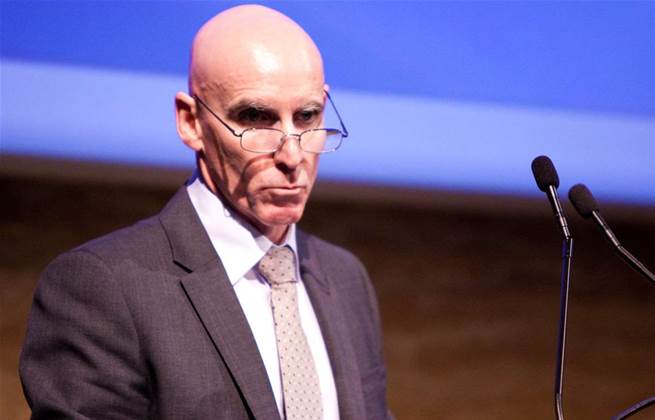
"It's no accident that fibre-to-the-premises is happening on a worldwide basis," Quigley said.

No returns

Quigley also addressed reports on the back of his appearance in front of the NBN Senate Select Committee last week that suggested the NBN would achieve no commercial return for up to 30 years.

"The suggestion that we won't generate a return for 30 years is wrong," Quigley said.

"We will generate a positive return on our costs - that is, be EBITDA positive - before the end of the construction period. We'll recover yearly costs including capital expenditure - become net income positive - a few years after that.

"We'll also be building the project so we repay the Government's equity contribution within the normal life of a telecommunications project - that is, a 20 to 30 year period I think."

That suggestion was later disputed by Pipe Networks chief Bevan Slattery who believed a commercial return was out of the question if the network ended up costing in the region of $43 billion.

"In Australia you can't get a commercial return on building out a $43 billion network. You can't do it," Slattery said.

"Don't play cute, generate spin or bulls--t. Trying to draw out a 30-year payback period, whatever, that's not a commercial return."

Slattery believed such a realisation could force the Government to back away from its commitments for the network, including that it would reach 90 percent of homes with fibre, and also over proposed ownership regimes.

"If [the Government] proceeds with NBN regardless, I don't know if we'll get to the 90 percent. When this thing is not paying out I think that will be a problem," Slattery said.

"The Government ownership of NBN Co could also be 100 percent - prepare yourself for that. I also don't think they will sell out their stake in NBN Co because [the buyer] could not get a commercial return."

The summit continues today.


Quigley: Why an all-wireless NBN is pointless
"@davmel: I think your comments are really helpful. And yes, my estimations were indeed optimistic. But: - You fail to consider that with such a solution, there is no interference from other ..."
By MerariSchroeder


Comments: 7
MerariSchroeder
Apr 20, 2010 6:33 PM
An all wireless NBN is pointless, because NBNCo appear to have a vendetta against wireless technology. If they used the full 238Mhz, as they stated, using LTE which can achieve 300Mbps per 20Mhz, there would be 3.5Tbps / cell. So i'm assuming that in their calculations they only factored in the aging 3.5G technology which in the next 5-10years will be replaced by LTE.

There is currently 42Mbps per cell with Telstra's NextG and smaller amounts with other providers. And customers do well with it, in fact, the telecommunications industry have indicated mobile broadband as one of their fastest growing fields.

3.5Tbps of bandwidth represents almost 100x todays HSPDA speeds. Sharing that in a cell of 500 (simultaneous) users, leaves each with 7Mbps with a 1:1 ratio, or 35Mbps with a 5:1 ration, without requiring any more towers.

Politicians keep trying to talk up the country as being progressive and entering the digital economy. But they only have profiteering in mind, by considering chopping up the UHV V band into 3 or more pieces.

Even if NBN fibre still goes ahead, and my 3.5Tbps estimate is too optimistic, it makes sense to aggregate the bandwidth into a wholesaler (government or private group), so that a customer has access to the full bandwidth. And future upgrades are possible with full spectrum potential.
MerariSchroeder
Apr 20, 2010 6:38 PM
(Forgot to include how coverage could be improved without new cell sites)

If set up as a private group, all mobile providers could place their current sites in a pool, which the company - WholeMobile, could choose the best and pay the owning companies to upgrade the sites.

In all, instead of paying a figurative $2bn each (with 3 figurative players) totally $6bn, but 3 isolated redundant networks. Each could pay $1bn, totalling $3bn, 3.5Tbps, 99.999% coverage and direct wholesale rates to retailers.
Bob
Apr 21, 2010 9:13 AM
Mobiles are fully competitive and private now. You pay your money and decide your coverage and speed. The one with 99% coverage and speed seems to be growing rapidly. The rest are all in the same places so no benefit to pooling them.

Either NBN builds a fixed infrastructure or NBN should provide a subsidy and let it be fully competitive. Then it would be built in a reasonably short time.
MerariSchroeder
Apr 21, 2010 9:48 AM
@Bob "Mobiles are fully competitive and private now."
The issue isn't of private sector competition, it's an issue of waste. If three operators spend $2bn each on creating 3 new LTE networks using 3 different sections of spectrum. You will have 3 overlapping networks (a waste) and only 1/3 of the speed which would have been possible with one (a waste), and costing a total of $6bn instead of around $3bn (a waste). This directly impacts customers, they could have had cheaper, faster and a wider reaching mobile network.

I'm not saying that it has to be government owned. The government should at least tell the private industry to talk about creating an independent private wholesale company to own and wholesale the new LTE network. The wholesale company, would then wholesale to all retailers for the same price (including the big ones which paid for the network).
hsvandrew
Apr 21, 2010 12:49 PM
Wireless technology waste could be improved so we have full coverage across most of the country and not 3 towers in some areas and none in others.

However the NBN and wireless are different technologies with different goals. People need to realise what the "internet" is and why into the future cable will continue to be the main ground link for in building communications (home/office) and wireless will be for mobile use. The speed issues, latency issues and wireless network overload issues will never make it a good choice for TV and reliable business grade broadband delivery for multiple users in an office which is the most important reason for the NBN roll out.

The telco's already deliver a mobile data network which makes money - the NBN is about delivering high speed cable network access to every home and business - Something smart countries have had for years. Even the best "in-lab" wireless technology can not deliver the speeds required for today's high definition content on a commerical user scale in a realible way. Bring on fibre!
davmel
Apr 21, 2010 11:10 PM
Re "MerariSchroeder" comment, your calculations on the network capacity are just ridiculous. For a start the digital dividend spectrum is just 126 MHz wide (from 694 to 820MHz) which can't be all used for downlink. LTE will almost certainly be deployed in FDD configuration and assuming a 6 MHz gap between Tx and Rx spectrum (unrealistic in the reality with even more needed) you're already down to 60 MHz of downlink spectrum.
You're claim that 20MHz of LTE can support 300Mbps is far from a real world sustained network speed. That figure is only estimated for ideal low noise lab experiments where maximum signal to noise ratio can be obtained. Real world sustained speeds outside a shielded RF lab will be in the order of 30-50% of that figure max.
So in reality each cell sector will provide <300 Mbps not the ridiculous 3.5Tbps that you suggest.
With that sort of sustained speed per cell sector you're never going to achieve anywhere near the far greater capacity of FTTN (with 2.45Gbps shared by no more than 32 homes let alone the potential for 10GPON).

Anyone unfortunate enough to be stuck on wireless will have access to significantly fewer next generation IP applications than their fellow Australians connected to a GPON fibre connection. Capacity of fibre will be 100x greater than wireless and continue to grow. Anyone that can't figure that out is clearly deluded by the capacity of wireless networks.
MerariSchroeder
Apr 23, 2010 4:15 PM
@davmel: I think your comments are really helpful. And yes, my estimations were indeed optimistic.
But:
- You fail to consider that with such a solution, there is no interference from other towers.
- Also with such a large portion of spectrum, and a unified network there are "possibly" more advanced techniques which can be used
- According the link in the article, the digital divid end is 582-820.
- Real life demonstration of 1.2Gbps / 80Mhz, which equates to 300Mpbs / 20Mhz. http://www.tmcnet.com/usubmit/2010/04/06/4710816.htm

In summary, i'm sure there will be some challenges for the LTE vendor to make it work, but there's more than enough scope for success.

"Capacity of fibre will be 100x greater than wireless and continue to grow."
Today NICTA have 5-10Gbps wireless for the cost of an ASIC run - ie. $5-$10 / chip. Compare that to around $250 for a 10Gbps fibre transceiver.

Fibre is very much directional wireless, in a controlled medium. Expect much development in the radio directional wireless world. Directional wireless doesn't accept interference or send out interference, so there is potential to use all spectrum between two points, overcoming physical barriers, noise and attenuation of the atmosphere (over the full spectrum).

Granted we do need to backhaul. Every technology has its place. Even wireless has a place for backhaul, but it's mostly left for fibre. Even fibre is used today for big business.

Fibre may well be used in a FTTH situation in Australia, I'm sure there are ways to do it without bankrupting anyone. But ignoring wireless is a mistake, and hopefully a mistake that Quigley won't make when it comes to the crunch.
Comments have been disabled for this article.


Top Stories
The New Zealand telco problem
Opinion: Could Telstra save Kiwi telcos?
 
IT price probe to 'name and shame' gougers
Industry ducking the issue, committee claims.
 
Revealed: 2012 e-government award winners
Government highlights projects, professionals of the year.
 
Sign up to receive iTnews email bulletins
   FOLLOW US...

Latest VideosSee all videos »

Latest Comments
Polls
Should the Government enact new legislation to protect copyright holders in the digital age?

   |   View results
Yes
  19%
 
No
  81%
TOTAL VOTES: 480

Vote