
Plans afoot for new Sydney-US fibre link


Kiwi big wigs plan new Pacific cable.

Competition could be looming for the Southern Cross Cable that carries the majority of Australia and New Zealand's Internet traffic, if a group of New Zealand hi-tech business people behind a second fibre-optic link get their way.
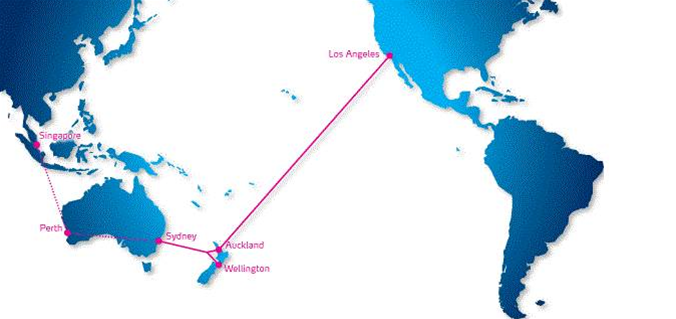
Pacific Fibre has announced plans to build a new international link between Los Angeles, Auckland and Sydney, with potential expansion plans to Perth and Singapore.
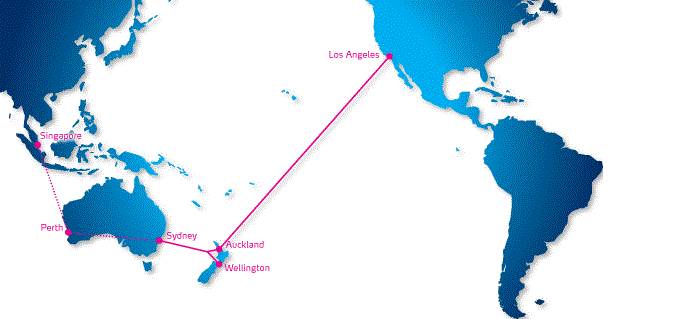
 

click to view full size image
Caption: Pacific Fibre

The Internet industry luminaries behind Pacific Fibre are Rod Drury of SaaS accounting site Xero, Sam Morgan who founded auction site Trade Me and Mark Rushworth, a Telecom New Zealand, ihug and Vodafone veteran.

Sir Stephen Tindall of The Warehouse and backer of wireless ISP Woosh, John Humphrey, formerly of IPSTAR satellite system and management consultant Lance Wiggs - who advised on the sale of Trade Me to Fairfax for NZ$750 million - are also listed as founders of Pacific Fibre.

Rushworth says the new cable will compete head-on with the existing Southern Cross Cable System (SCCS) on price and performance. By utilising newer technology with no hops between Auckland and Los Angeles, Rushworth says the Pacific Fibre cable will have substantially lower latency than the SCCS. This in turn will make it more attractive to customers with demanding real-time applications such as banks and financial institutions.

The cable is estimated to cost just under NZ$900 million Rushworth says, and the goal is to complete it in three years' time. The proposed capacity of the Pacific Fibre cable will be 5.12 Terabits per second and this can be upgradeable to 12 Terabits per second.

Initially, the Pacific Fibre cable will run from LA - Auckland - Sydney with a leg to the NZ capital Wellington.

However, Rushworth says that as part of a second phase as suggested by interested parties to Pacific Fibre, a Sydney - Perth -Singapore leg is being considered, to improve connectivity to Asia.

Internet entrepreneurs Drury and Morgan have been vocal advocates of better network infrastructure and lifting of meagre data caps in New Zealand, and Rushworth says he hopes Pacific Fibre will enable just this by lowering international data transit pricing.

"With around 90 per cent of NZ traffic going to the US, international data pricing is a major reason for the low data caps here," Rushworth says.

State-owned enterprise Kordia, that operates in both NZ and Australia was quick to welcome the Pacific Fibre initiative.

CEO Geoff Hunt says Kordia has been talking to Drury and the other founders over the past few months, and says it will team up with Pacific Fibre.

Kordia is currently proposing to build a trans-Tasman link, the PPC-2, that connects to Pipe Networks in Australia.


Plans afoot for new Sydney-US fibre link
"Primeribfan, Agreed. I had just assumed that with Pacific Fibre's talk of using the 'latest technology' (I assume they mean a DFF system) that the repeater spacing would have been about the same ..."
By Moist von Lipwig


Comments: 8
Tim
Mar 11, 2010 10:28 PM
The only risk of a direct NZ->US link is that as technology allows for a link around the Pacific rim without underseas repeaters, it will be faster for NZ traffic to head towards Australia and then head to Indonesia, Guam, Japan, Russia, Alaska, and then on the overland routes to the cores in the US. The technology existed since before Pipe ran their link, its odd to try an undersea route with million dollar repeaters ever 200 km when you can put much cheaper repeaters on dray land.
scan06disk
Mar 11, 2010 11:16 PM
Will having more repeaters increase latency ?

Also, having another fiber cable would release pressure on the SXC cable.

I can compare the speeds between an SXC cable and PPC1, I've got both BPCable & Internode, and i can honestly say Internode kicks ass in Speeds, to anywhere in the world ! But BPCable on the other hand has lower latency ! LOL !
Primeribfan
Mar 12, 2010 9:30 AM
Tim,

Wow, where do I start? Aside from the increased distance by going CCW around the Pacific Rim (>24,000km vs 11,000km direct), there is a HUGE issue about obtaining rights of way through dozens of different countries, let alone thousands of different land owners in each country. A direct submarine link (or even via Hawaii) would only need to negotiate with 2 countries, and a handful of private owners at the landing points. Not to mention that it is not land all the way around the PacRim, so submarine links would still be required - all of which are too long to be unrepeatered.

++++++++++++++

Scan06disk,

Repeaters in older systems converted the optical signal to electrical signals for re-timing, re-shaping & then reamplification. This caused some latency. Modern systems are fully optical, in that the optical signal is boosted by pump lasers at each repeater, ie straight through. As such, latency is not an issue with the repeaters
Tim
Mar 14, 2010 10:39 PM
Primeribfan,
You miss the point.
You can get between 4,000 and 12,000 km today with high speed modern undersea cables without any undersea repeaters but your limited to about 2,000 km for the very, very fast links. You don't have to go overland (except where it is cheap and easy to do so), the idea is you just put your million dollar repeater stations up on dry land where they cost a fraction of the undersea ones and you use full signal regeneration so you can send far more bits along the glass. The result is that you should be able to go the long way and get 160 ms ping times which is still faster than using the undersea repeaters with optical repeaters. It also means 4000 km of cable cost about about $30 mil and not $50 mil for the undersea route. If you can get from the US to Hawaii in without repeaters, then you can hit Australia and New Zealand using dry land repeaters with just using territories of NZ, AUS or USA. There are more sites to negotiate but that is far cheaper than spending a cool million every 200 km.
Primeribfan
Mar 15, 2010 6:51 PM
Tim,

Very interested to know where your information is coming from. As someone who has been working in the submarine cable industry for 20 years, I have never heard of 4,000-12,000km UNREPEATERED submarine systems. To the best of my knowledge, the longest single operational unrepeatered submarine link is of the order of 400-500km (only an order of magnitude less than you quote).

The longest single REPEATERED submarine link installed is of the order of 9000-10000km
Moist von Lipwig
Mar 16, 2010 7:52 AM
Tim,

There's another part to all of this that you've forgotten. The single biggest limiting factor on ping times is physics. The speed of light in glass dictates the ping time. Your overland route would have horrific ping times because there's a fair bit of glass in your suggestion.

I agree wholeheartedly with Primribfan. I have never heard of an unrepeatered cable being longer than a few hundred km. Besides, Pacific Fibre themselves say that they are building a repeatered cable system (albeit with repeaters allegedly closer together than those on SCCN).
Primeribfan
Mar 16, 2010 3:53 PM
To maintain a good S/N ratio, the longer the system the shorter the distance between repeaters. Also, generally the higher the design capacity (number of multiplexed wavelengths) the shorter the repeater span.
Moist von Lipwig
Mar 16, 2010 10:29 PM
Primeribfan,

Agreed. I had just assumed that with Pacific Fibre's talk of using the 'latest technology' (I assume they mean a DFF system) that the repeater spacing would have been about the same as SCCN.
Comments have been disabled for this article.


Top Stories
Allianz taps finance IT overhauls for Cobol skills
Insurer commits to legacy investments.
 
NSW Government signs mega data centre deal
iTnews gets the skinny on the IT deal of the year.
 
Illawarra Coal plants fibre optics in Hume Highway
BHP subsidiary monitors impact of longwall mining on road.
 
Sign up to receive iTnews email bulletins
   FOLLOW US...

Latest VideosSee all videos »

Latest Comments
Polls
Should the Government enact new legislation to protect copyright holders in the digital age?

   |   View results
Yes
  18%
 
No
  82%
TOTAL VOTES: 372

Vote

