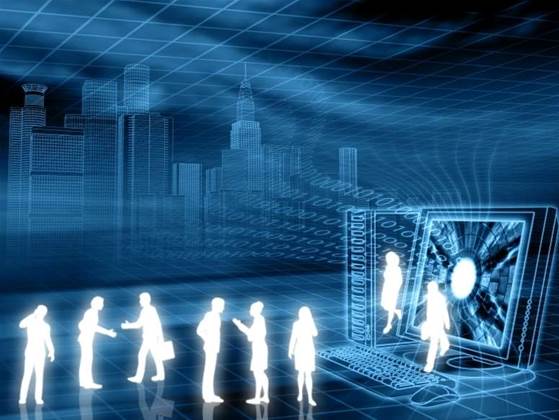
"Now, six years later, I have been at Microsoft for 28 years and I can say that I have lived through four revolutions."
Ballmer broke down these four "computing revolutions" as:
- The personal computer becoming an affordable mainstream product which put computing power in the hands of individuals for the first time
- The emergence of the Graphical User Interface making it easier for users to take advantage of the power of computing
- The rise of the internet when email became an everyday communications tool and information became dramatically easier to find and share
- The rise of web 2.0 in which the internet evolved from static pages and information to become a platform for services, and for publishing and sharing information
"In my 28 years at Microsoft I have lived through four computing revolutions but they have simply been a foundation for the much more profound changes to come in the next revolution," he said.
Ballmer went on to lay out the key trends he believes are shaping this impending revolution.
"The first is the hardware advances that are putting more and more processing power into smaller and smaller devices," he said.
"The second is significantly expanded storage on PCs and devices of all sizes, and in massive data centres around the world. A third trend is the availability of wireless broadband networks everywhere."
Ballmer also highlighted the growing use of natural user interfaces, both in terms of displays that are driven by touch and gestures as well as the advancement of speech recognition systems.
"During the fifth revolution, expanded processing, huge amounts of storage, ubiquitous broadband, natural user interfaces and screens everywhere will help us address global warming, and improve healthcare and education for billions of people around the world," he explained.
"It will transform human social interaction and make computers more useful and more personal. Access to information, communications and computing capabilities will be seamless and natural."
Describing his vision of personal empowerment in the fifth revolution, Ballmer said that, although we now use computing in more and more places, it is still too complicated and disconnected.
Managing this increasing content across multiple devices and sources involves a high degree of difficulty, according to Ballmer.
"During the fifth revolution this will change. Soon, you will be able to call up any document, photo or media file instantly on whatever device is at hand," he said.
"You will not need to know where your information is stored. It will not matter what device you are using. You will just log on, click and instantly get access."
Ballmer predicted that communications will move seamlessly between voice, text and video, and from device to device, and that a single 'digital identity' will tie this all together.
"During the fifth revolution software will begin to learn your habits, understand your preferences and predict your needs," he explained.
"If you think about it, your computer already has a lot of this information. During the fifth revolution, we will teach the computer how to use it."
Ballmer also foresees a fundamental shift in social interaction as digital technology becomes an increasingly important part of how we connect with other people.
He pointed out the growing popularity of social networking sites, but also highlighted claims that many younger users have a high percentage of friends they have never actually met, communicating only through email, instant messaging and social websites.
Ballmer added that this will not just be used for personal communications, but will be important at work particularly with the development of technologies such as 3D holographs to help make interaction more personal, even at long distance.
Similarly, parents will be able to form tight communities with teachers, administrators and other parents to help bring up their children.
Finally Ballmer believes that the fifth revolution will give people "the ability to better understand and address global issues that affect billions of people, including education, healthcare, and environmental change".
Technology will be used to help millions of children currently unable to attend school to get an education, and ease the challenges of overcrowded schools, outdated teaching methods and a global shortage of qualified teachers.
"At the heart of these issues is the problem of scale. Today, there are classrooms around the world where brilliant teachers deliver innovative and exciting curricula," said Ballmer.
"The challenge is to extend that kind of quality education from a handful of students in a single classroom to hundreds of millions of students around the globe."
Similarly, improvements in processing power, storage, broadband networks, natural user interfaces and ubiquitous screens will help address issues of scale in healthcare and climate change.
"As computing continues to become more powerful, more affordable and more connected it will give billions more people around the world a chance to take advantage of incredible new social and economic opportunities so they can lead better lives. And that will truly be revolutionary."


.jpg&h=140&w=231&c=1&s=0)


.jpg&h=140&w=231&c=1&s=0)




 iTnews State of Security Breakfast
 iTnews State of Data & AI Breakfast
 Forrester's AI Forum Sydney
 The 2026 iAwards
.jpg&w=120&c=1&s=0) Integrate 2026
Integrate 2026







_(1).jpg&h=140&w=231&c=1&s=0)