Australia turns to homegrown drones

 
Page 2 of 2 | Single page
View larger image View larger image View larger image

See all pictures here »

UAVs come in two design flavours - fixed-wing and vertical take-off and landing (VTOL). By appearance, it's the difference between having an aircraft that resembles a plane or a helicopter (or quadcopter).

There are advantages and disadvantages of each type of craft, but essentially they can be boiled down to flight efficiency, image accuracy, take-off and landing, and payload capability.
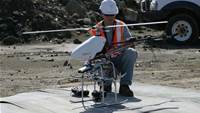
While fixed-wing UAVs are generally noted for their flight efficiency for aerial mapping applications, they may face challenges operating in smaller, more confined areas on mine sites.

"I believe the fixed-wings have gotten some traction because fixed-wings do cover a large amount of area more cost efficiently," Cyber Technology project manager Joshua Portlock says.

"However, they are also a bit limited in their operation and flexibility when doing closer range, higher resolution work."

VTOL UAV operators frequently cite image overlap and overshoot as key areas where their craft excel over fixed-wing UAVs.

For aerial mapping or stockpile surveys, several passes over a site may be required to build up an accurate image of the survey area.

The UAV's ability to turn around at the end of each pass impacts its flight efficiency.

"To do say 25 hectares [a 500m x 500m area], [fixed-wing UAVs] would have to overshoot - so they'd fly over that 500 metres then they'd overshoot... to do a big arc and turn around and come back again," Portlock says.

"It's inefficient use of flight time to cover that relatively small area.

"A VTOL can pop up and position itself accurately within that half kilometre square to [go] back and forth quite time-effectively."

Crosswinds may also impact the number of passes required to complete a site survey. Fixed-wing UAVs may require more passes to counter the effect of crosswinds on image capture, says Adam Technology's Jason Birch.

"If there's crosswinds then the images all have a skew to them unless you have a more sophisticated camera that allows you to compensate for that," Birch says.

"Because of the degree of sideways angle in the images, [fixed-wing UAVs] tend to fly very high overlaps which means you get a lot more photos for the same area.

"Even though they're flying faster and able to fly for longer [than VTOL UAVs], they don't actually get more coverage in the end because they're soaking it up with the extra overlaps to try and make sure there's no gaps between the images."

VTOL operators also see take-off and landing as a key area of ascendancy over fixed-wing craft.

Most fixed-wing UAVs require a landing strip for both take-off and land. The Gatewing X100 used by the Australian arm of Belgian mine giant Sibelco is slightly different, in that it uses a catapult launcher for take-off. However, it still requires a flat surface to belly land.

The makers advise "an 'airstrip' without obstacles measuring 30m wide and 150m long".

"The X100 lands typically within a 15m radius but due to barometric errors a 150m long airstrip is advised to be sure of a safe touch down," the company states.

Although this did not appear to be a hindrance to Sibelco, HELImetrex chief executive Ray Gillinder sees it as a disadvantage in the confines of a mine environment.

"What people fail to realise is on mine sites there's a lot of OH&S scenarios in place," Gillinder says.

"In certain mine sites [where] you've got a set of stockpiles or washer plant, you're working in a fairly confined area. There's sometimes not a lot of opportunity to put the aircraft down within close quarters."

Gillinder questions the long-term impact of landing a UAV on its fuselage, particularly on an unprepared landing strip.

"Mine sites are typically very rugged terrain, and a lot of bare earth," he says.

A YouTube video from Spain shows the wheel-less Gatewing X100 belly-land on flat, albeit rough, terrain. The undercarriage is not visible.

iTnews contacted the Australian distributor of the X100, Pitcher Partners, for comment, but a representative was unavailable at time of publication.

"We find that the availability of take off and landing [with VTOL] allows us to work a lot tighter, a lot closer [to mine infrastructure]," Gillinder says.

Portlock concurs: "You can take off from a compact area. You don't need to have a launching mechanism and a recovery area, so even if it's quite obstructed environment, you can still VTOL out of the small area you've got to work from".

Close-working is also a current regulatory requirement. The Civil Aviation and Safety Authority (CASA) only allows UAVs to be operated in visual meteorological conditions - i.e. within sight - and to a height of 400ft (121m) if special approvals aren't sought (pdf).

"Visual range is only about one kilometre at most," Birch says. "As soon as you get past a kilometre away you really can't see them.

"That limits how big your [flying] footprint is on a single flight anyway, which negates a fair bit of the advantage of a fixed-wing."

This article is part of a special investigation into the use of UAVs in Australian mines. Stay tuned to iTnews tomorrow for the next installment.

Copyright © iTnews.com.au . All rights reserved.


Top Stories
ATO commits to complexity
Greater demand, fewer apps.
 
Photos: AusCERT 2013 day two
The second day of the Queensland security conference.
 
The illusion of cognitive computing
Opinion: IBM's Watson is a marketing success.
 
 
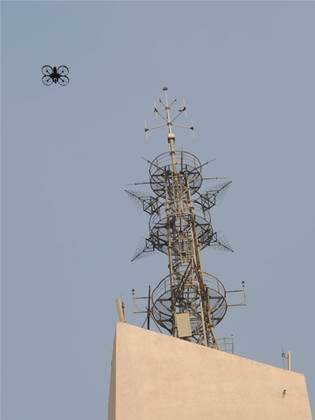
A homegrown CyberQuad UAV by Perth-based Cyber Technology inspects a communications tower. (Courtesy: Cyber Technology).
Sign up to receive iTnews email bulletins
   FOLLOW US...

Latest VideosSee all videos »

Bankwest builds continuous delivery capability
To automatically deploy test/dev sandboxes by mid-year.
Veterans' Affairs sets sights on modernisation
Data safe with Human Services, CIO says.
Citi Australia drops platform customisations
Technology chief shifts focus from building to leveraging systems.
VicRoads restructures IT team
Department moves to align with industry benchmarks.
Zurich Australia extends IT team offshore
Malaysian staff served from Australian data centres.
Leigh Berrell - Utilities CIO of the Year
Yarra Valley Water CIO Leigh Berrell accepts his Benchmark Award for Utilities CIO of the Year.
Wayne McMahon - Retail CIO of the Year
Domino's Pizza CIO Wayne McMahon accepts his Benchmark Award for Retail CIO of the Year.
Inside Perpetual's ongoing IT transformation
CIO Jenny Levy discusses how outsourcing will help the firm "simplify, refocus and grow".
Managing Complexity - Defence's Daniel McCabe
Daniel McCabe, Assistant Secretary of Australia's Department of Defence, provides the audience at the iTnews Data Centre Strategy Summit with a deep dive into the organisation's data centre consolidation program.
How Facebook designed the data centre from scratch - Marco Magarelli
The full keynote by Facebook data centre architect Marco Magarelli at the Australian Data Centre Strategy Summit. Magarelli details the design considerations behind the social network's Prineville, Oregon; North Carolina and Luleå, Sweden data centres.
Modernising Legacy Data Centres - Telstra's Jon Curry
Telstra general manager of managed data centres Jon Curry guides the audience at the iTnews Australian Data Centre Summit through the build of the telco's Clayton, Victoria data centre.
NSW Government launches NABERS data centre rating tools
Matthew Clark from the NSW Department of Environment guides facilties managers through the details of the new NABERS data centre energy rating tool at the Australian Data Centre Strategy Summit.
NABERS launch panel: Australian Data Centre Strategy Summit
Matthew Clark (NSW Dept of Environment), Greg Boorer (Canberra Data Centres), Glenn Allan (National Australia Bank), Mike Andrea (Strategic Directions) and Bob Sharon (Green Global Consulting) discuss the impact of the NABERS data centre rating.
Judges notes: Fortescue Metals [The Benchmark Awards]
iTnews' panel of judges discuss Fortescue Metals 'New World of Work" project, one of three shortlisted finalists for the Industrials category of the CIO Benchmark Awards.
Judges notes: Retail [The Benchmark Awards]
iTnews' panel of judges discuss the shortlisted finalists for the Retail category of the CIO Benchmark Awards.
Judges notes: Pacific Aluminium [The Benchmark Awards]
iTnews' panel of judges discuss Pacific Aluminium's lightning fast service desk refresh, one of three shortlisted finalists for the Industrials category of the CIO Benchmark Awards.
Judges notes: Domino's Pizza [The Benchmark Awards]
iTnews' panel of judges discuss Domino's Pizza's shift to hosted services, one of three shortlisted finalists for the Retail category of the CIO Benchmark Awards.
Judges notes: McDonald's Australia [The Benchmark Awards]
iTnews' panel of judges discuss McDonald's Australia's new self-service portal for employees, one of three shortlisted finalists for the Retail category of the CIO Benchmark Awards.
Judges notes: ING Direct [The Benchmark Awards]
iTnews' panel of judges discuss ING Direct's 'Bank in a Box', one of three shortlisted finalists for the banking and finance category of the CIO Benchmark Awards.
Judges notes: Yarra Valley Water [The Benchmark Awards]
iTnews' panel of judges discuss Yarra Valley Water's insourcing project, one of three shortlisted finalists for the Utilities category of the CIO Benchmark Awards.
Latest Comments
Polls
Do you prefer the Coalition's NBN policy?

   |   View results
Yes
  19%
 
No
  81%
TOTAL VOTES: 1738

Vote