Ants build cheapest networks


Supercolony trails follow mathematical Steiner tree.

An interdisciplinary study of ant colonies that live in several, connected nests has revealed a natural tendency toward networks that require the minimum amount of trail.
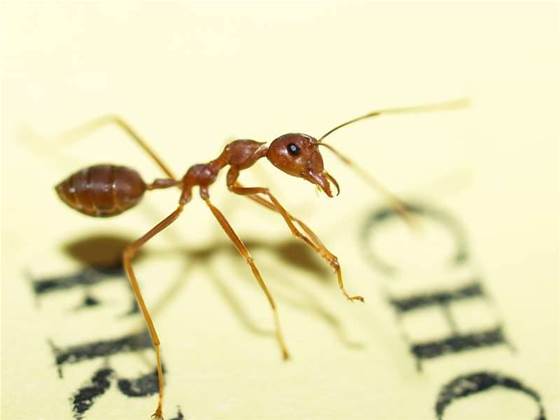
Researchers studied ‘supercolonies’ of Argentine ants with 500, 1000 or 2000 workers to identify methods for self-organising sensors, robots, computers, and autonomous cars.

They put three or four nests of ants in empty, one-metre-wide circular arenas to observe how they went about connecting the nests.

As with railway networks, directly connecting each nest to every other nest would allow individual ants to travel most efficiently, but required a large amount of trail to be established.

Instead, the ants used central hubs in their networks – an arguably complex design for creatures that University of Sydney biologist Tanya Latty described as having “tiny brains and simple behaviours”.

Ants model a Steiner minimum tree. Credit: Tanya Latty et al

“We found that ants almost always made networks that minimised the total amount of trail, consistent with optimisation at a colony level, rather than at an individual level,” Latty told iTnews.

“In many cases, they did a remarkable job of making networks that looked almost exactly like the mathematical shortest path, called a ‘Steiner tree’.”

Argentine ants form trails by tapping the ground with their abdomens to leave behind trails of pheromones that attract other ants.

Because pheromones evaporate over time, trails have a “maintenance cost” of worker ants that continuously march along the trail to lay down pheromones.

Kai Ramsch and Martin Middendorf of the University of Leipzig’s Parallel Computing and Complex Systems Group hoped to apply the ants’ networking methods to organic computing systems.

“Clearly, in order to work together the components of an organic computing system need to be connected,” said Ramsch and Middendorf, who collaborated with Latty for the study.

“Hence, a central question is: How can many components be connected by a network that is formed by the components themselves in a self-organized way?”

In a separate study of Argentine ants last year, University of Sydney biologist Chris Reid speculated that ants and their pheromones could be modelled by data packets that left behind a line of code that expired after a set period of time.

The German computer scientists noted that the digital “evaporation rate” of artificial pheromones would be varied according to speed, distance, number of information packets and network structure of a computer network.

“It is necessary to change the evaporation rate for the artificial pheromones so that they fit to application,” they told iTnews in an e-mail exchange. “This can be simulated with our models.”

A network in four hours

The team found that ant colonies completed the majority of network formation within their first two hours in the arena.

Each experiment lasted a total of six hours, although very few topological changes were observed after four hours.

Latty said she initially suspected that the ants were building low-maintenance networks because they had too few resources to directly connect each nest.

That theory was deemed unlikely, when the researchers found larger supercolonies dedicated their additional resources to building paths that essentially improved the robustness of the network.

A Steiner minimum tree with one extra edge. Credit: Tanya Latty et al.
Steiner minimum tree with an extra edge. Credit: Tanya Latty et al.

The researchers hoped that their study of ant colonies would also yield “self-healing” organic computing networks, since nodes were controlled individually and not by a central control unit.


Copyright © iTnews.com.au . All rights reserved.


Ants build cheapest networks
"Or maybe Tony could employ them to eat it."
By Stuart21


Comments: 3
antsalive
Feb 18, 2011 12:15 PM
Steiner tree would make sense if no ant leaves the current nest knowing which one he was going to. Destination is determined by majority voting at the nexus?
Bourkie
Feb 20, 2011 10:50 AM
...can we employ them to build the NBN?
Stuart21
Feb 23, 2011 4:07 PM
Or maybe Tony could employ them to eat it.
Comments have been disabled for this article.
 
 
Top Stories
Photos: HTC One vs Samsung Galaxy S4
Android giants battle it out.
 
Project management lessons from the QLD Health payroll inquiry
Analysis: How not to run a major IT project.
 
Review: Asus Fonepad
Calling on the Big Phone.
 
 
Sign up to receive iTnews email bulletins
   FOLLOW US...

Latest VideosSee all videos »

Bankwest builds continuous delivery capability
To automatically deploy test/dev sandboxes by mid-year.
Veterans' Affairs sets sights on modernisation
Data safe with Human Services, CIO says.
Citi Australia drops platform customisations
Technology chief shifts focus from building to leveraging systems.
VicRoads restructures IT team
Department moves to align with industry benchmarks.
Zurich Australia extends IT team offshore
Malaysian staff served from Australian data centres.
Leigh Berrell - Utilities CIO of the Year
Yarra Valley Water CIO Leigh Berrell accepts his Benchmark Award for Utilities CIO of the Year.
Wayne McMahon - Retail CIO of the Year
Domino's Pizza CIO Wayne McMahon accepts his Benchmark Award for Retail CIO of the Year.
Inside Perpetual's ongoing IT transformation
CIO Jenny Levy discusses how outsourcing will help the firm "simplify, refocus and grow".
Managing Complexity - Defence's Daniel McCabe
Daniel McCabe, Assistant Secretary of Australia's Department of Defence, provides the audience at the iTnews Data Centre Strategy Summit with a deep dive into the organisation's data centre consolidation program.
How Facebook designed the data centre from scratch - Marco Magarelli
The full keynote by Facebook data centre architect Marco Magarelli at the Australian Data Centre Strategy Summit. Magarelli details the design considerations behind the social network's Prineville, Oregon; North Carolina and Luleå, Sweden data centres.
Modernising Legacy Data Centres - Telstra's Jon Curry
Telstra general manager of managed data centres Jon Curry guides the audience at the iTnews Australian Data Centre Summit through the build of the telco's Clayton, Victoria data centre.
NSW Government launches NABERS data centre rating tools
Matthew Clark from the NSW Department of Environment guides facilties managers through the details of the new NABERS data centre energy rating tool at the Australian Data Centre Strategy Summit.
NABERS launch panel: Australian Data Centre Strategy Summit
Matthew Clark (NSW Dept of Environment), Greg Boorer (Canberra Data Centres), Glenn Allan (National Australia Bank), Mike Andrea (Strategic Directions) and Bob Sharon (Green Global Consulting) discuss the impact of the NABERS data centre rating.
Judges notes: Fortescue Metals [The Benchmark Awards]
iTnews' panel of judges discuss Fortescue Metals 'New World of Work" project, one of three shortlisted finalists for the Industrials category of the CIO Benchmark Awards.
Judges notes: Retail [The Benchmark Awards]
iTnews' panel of judges discuss the shortlisted finalists for the Retail category of the CIO Benchmark Awards.
Judges notes: Pacific Aluminium [The Benchmark Awards]
iTnews' panel of judges discuss Pacific Aluminium's lightning fast service desk refresh, one of three shortlisted finalists for the Industrials category of the CIO Benchmark Awards.
Judges notes: Domino's Pizza [The Benchmark Awards]
iTnews' panel of judges discuss Domino's Pizza's shift to hosted services, one of three shortlisted finalists for the Retail category of the CIO Benchmark Awards.
Judges notes: McDonald's Australia [The Benchmark Awards]
iTnews' panel of judges discuss McDonald's Australia's new self-service portal for employees, one of three shortlisted finalists for the Retail category of the CIO Benchmark Awards.
Judges notes: ING Direct [The Benchmark Awards]
iTnews' panel of judges discuss ING Direct's 'Bank in a Box', one of three shortlisted finalists for the banking and finance category of the CIO Benchmark Awards.
Judges notes: Yarra Valley Water [The Benchmark Awards]
iTnews' panel of judges discuss Yarra Valley Water's insourcing project, one of three shortlisted finalists for the Utilities category of the CIO Benchmark Awards.
Latest Comments
Polls
Do you prefer the Coalition's NBN policy?

   |   View results
Yes
  19%
 
No
  81%
TOTAL VOTES: 1651

Vote