Mozilla will take the first small step towards deploying an anti-tracking mechanism being pushed for by the US Federal Trade Commission.
The FTC called for a "do not track" program to prevent online marketing companies from tracking the activities of internet users in August, 2010.
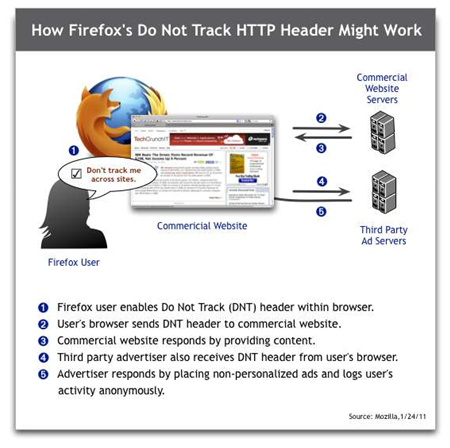
Mozilla said that Firefox users would soon be able to set their browsers to indicate they did not wish to be tracked by behavioural ad-services.
Mozilla's system would work by sending a "Do Not Track HTTP" header to such services when the preference is activated.
However, Firefox's anti-tracking tool is only the first step. Website operators will need to tweak their services to acknowledge the header and then voluntarily stop tracking that user.
The desired outcome for users is that they will eventually stop seeing ads based on sites they've previously visited, according to Mozilla's wiki page.
"The challenge with adding this to the header is that it requires both browsers and sites to implement it to be fully effective," explained Mozilla's privacy lead, Alex Fowler.
"Mozilla recognises the chicken and egg problem and we are taking the step of proposing that this feature be considered for upcoming releases of Firefox."
The softly-softly approach offered by Mozilla comes as the US considers imposing rules on a sector that has largely escaped regulation and relies heavily on tracking.
The FTC last December outlined a proposal that threatened tighter regulation and criticised the industry for its sluggish progress on consumer protection.
Mozilla's tool is not expected to deliver fast change, but could provide a way forward by providing an indicator of consumer attitudes toward behavioural-targeted advertising.
"Servers don't know about this yet, so it won't have immediate effect on tracking," wrote Sid Stamm, a developer who wrote a user interface for Mozilla's opt-out system.
"But in the meantime the presence of the header can be observed by web sites (in a similar way to a cookie) to help understand how desired opt-out of OBA [Online Behavioural Ads] is."



.jpg&h=140&w=231&c=1&s=0)





 iTnews State of Security Breakfast
 iTnews State of Data & AI Breakfast
 The 2026 iAwards
.jpg&w=120&c=1&s=0) Integrate 2026
Integrate 2026
 Security Exhibition & Conference








_(1).jpg&h=140&w=231&c=1&s=0)