
The cost of Canberra's poor IT procurement record

 
Page 1 of 2 | Single page

Half a billion reasons agencies should have to use open tenders.

OPINION: Australian taxpayers should be concerned about the ease with which our Federal Government agencies are flaunting regulations that should compel them to purchase large volumes of goods and services via an open tender process.

Commonwealth Procurement Guidelines insist on tender processes for transactions above $80,000 (or $400,000 if a Government corporation rather than an agency).

These guidelines are intended to drive value for the Australian taxpayer and to reduce the potential for corruption.

But as we have most recently seen in the case of the Department of Health – which has outsourced its IT services to the same supplier on several consecutive occasions without going to tender – the CPGs are too easily skirted using escape clauses that otherwise could mask laziness, incompetence or, at worst, corruption.

Before we dive into the Health story again – let’s take a macro view of what these loopholes could cost the taxpayer.

iTnews findings:
  • That over $3.2 billion of the $8.3 billion the Federal Government has spent on IT and telecommunications contracts during the 3+ years of the current ALP Government has been direct sourced rather than purchased via mandated tender processes.
  • The Australia’s Department of Health and Ageing has spent 76 percent of its IT contract budget on direct deals during this period, versus 52 percent at Human Services and 8 percent at the ATO.

Methodology

I'd encourage you to visit the AusTender web site. Do a search for “Contract Notice by Procurement Method Criteria”.  Start with “all agencies” but restrict your search to spend on IT and telecoms – and use the current term of the ALP Government as your date range (Dec 07 til now). It is also important to choose $80,000 and up for the contract value, in accordance with the CPG guidelines.
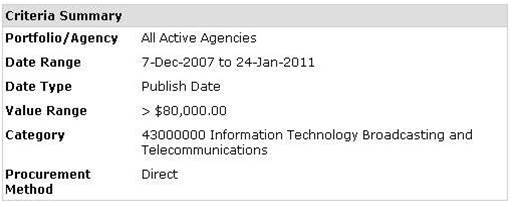
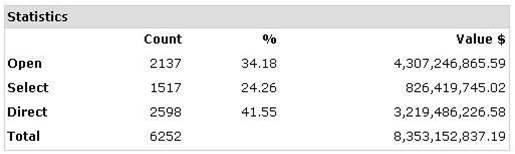
Of the $8.35 billion spent on IT and telecoms during the term of the current ALP Government (in purchases above $80K), $3.21 billion (38 percent) of the contract value or 41.5 percent of contracts were purchased/signed via a direct sales process rather than a tender.

This means that agencies chose to purchase IT and telecommunications without going to open tender on almost as many occasions as they followed the guidelines.

These statistics track roughly in line with the 39 percent of occasions agencies went direct across all purchasing categories, which represents $42 billion of $106 billion in contract spending during the term of the current Government.

[NB - The statistics on AusTender do not go back far enough for a valid comparison of the current ALP Government versus the Howard years, as AusTender only launched in 2003 and the current requirements for publishing procurement was introduced in July 2007.]
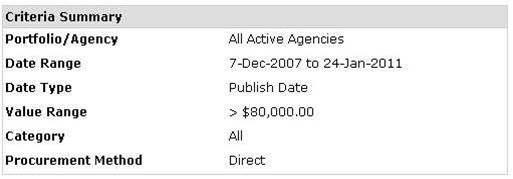
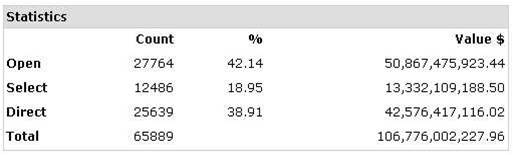
It is here we need to stop and ask the question: What kind of savings could we expect from a tender process being applied to that $3.13 billion of IT and telecoms contracts or $42 billion across the board?

It’s a difficult formula to construct based on a lot of variables. Tender processes, to be sure, cost agencies money and need to be streamlined – but that’s why we have the $80,000 threshold. You don't want to have to write a tender document to buy some coffee at Civic Coles.

The assumption has obviously been made by the Department of Finance that above this threshold ($80K), the savings derived from the influence of market competition are likely to kick in and outweigh the cost of the tender process.

Would 20 or 25 percent savings be a good estimate? I’d like to hear your opinion on this in the comment field below. Because at that rate, one could assume savings of over half a billion dollars on IT and telecoms alone, and $8 billion across the Government. That would be a headline worth writing.

I put this issue to the Department of Finance, asking whether the rates at which procurement is going direct was higher than they would prefer.

But a spokesman for the department claimed that the CPG's simply represent a "procurement policy framework within which agencies determine their own specific procurement practices."

In other words, there is a marked difference between guidelines and law.

"It is therefore not a question of what percentage of covered procurement is direct sourced, but whether it is appropriately direct sourced," the spokesman said. 

Further, the Department of Finance has never intervened in an agency's procurement process.

"Under the devolved financial framework, the Chief Executives (or the head of the Government agency) are responsible for their agency's processes and any breaches in the Financial Framework (including the requirements of the CPGs) are reported in their annual certificate of compliance," the department said.

So if not Finance, who does watch agency procurement? The Audit Office (ANAO) on occasion - but only after significant media attention. Otherwise, the heads of departments have every incentive to cover up any laziness, incompetence or corruption on the part of their procurement officers.

Now that we've looked at the macro view, let’s drill down to the most recent agency to go direct on IT – the Department of Health and Ageing (again, using the +$80,000 threshold).
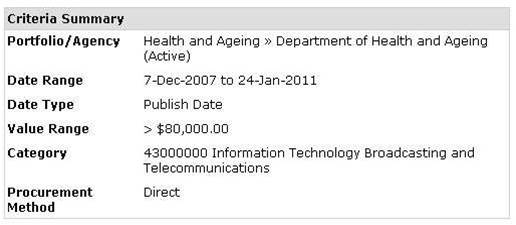
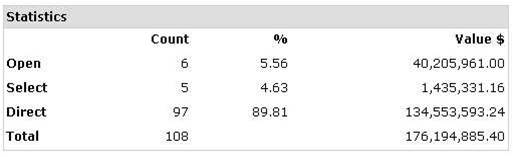
DOHA has used a ‘direct’ line of purchasing for 97 out of 108 (90 percent) tenders during the term of the current ALP Government. In value terms, that is some $134 million of the $176 million (76 percent) of the contract value on IT and telecommunications that did not go to tender.

To be fair, let’s compare Health's record to other big users of IT in the Federal Government. The Australian Tax Office has gone direct on 58 out of 77 occasions over the same period (75 percent of occasions), but that represents only 8 percent ($81 million) of the $1 billion it contracted. Human Services has gone direct in 19 out of 41 occasions over the same period (46 percent of occasions), which represents over half ($72 million or 52 percent) of its $137 million contract value.

Why is DOHA spending three-quarters of its IT budget direct, compared with half at Human Services or less than 10 percent at the ATO? Read on to find out.


Copyright © iTnews.com.au . All rights reserved.


The cost of Canberra's poor IT procurement record
"Brett - want a corker of a story, do a comprehensive case study of the Systems for People project from start to finish - oh sorry, it's not finished yet is it. BTW - where is the ombudsman that ..."
By MightyBlues


Comments: 12
RaTTyRaTT
Jan 25, 2011 5:46 PM
Ooh this is a goodie indeed also. Time and again we have seen large procurement contracts handed out rather than tendered along with big purchasing requirements that have 'ironically' just gone to a single panel provider, which have turned out to cost WAY MORE than what even a smaller no-frills SMB could provide in pricing. As a SMB organization, we often have to even fight to stay alive in the >80k arena, as many %&$$@$! IT managers use the 'panel' as a shield to hide behind. It's completely moronic, and even worse when you hear the rumblings of AGIMO's heavy handedness, along with complete snubbing of the law in relation to 'restraint of trade' which they advocate to agencies. This is such a sore point, which is shown when you hear agencies saying "We'd love to buy from you, as we know you are cheaper - but we have been TOLD we must buy from a preselected supplier, and only the products we are TOLD to buy.
This is a major rort, and even more ironically the Government says they are SMB friendly, yet on one hand they smile & say 'come participate' but on the other make the conditions of participation impossible for smaller businesses to compete in. I know major vendors (Who do win the contracts) will fly specialists from overseas in, and spend millons to win big contracts - even if they take a loss, simply as they have to show they are doing things. Small business 'cannot' compete in this situation, not to mention - if a SMB does try to get on a panel, there's no guarantee they will ever be used as panel participation states that being on the panel is not a guarantee of getting procurement quotes.

Whole mess is totally up the pole and frankly I think people should be sacked and tossed to the SMB market to be shredded.
RaTTyRaTT
Jan 25, 2011 5:49 PM
Oh and I forgot to mention the wonderful morass of Reg9 and Reg10, single or multi-year contracts = combined with the hoops that agencies have to go through to get them signed, since the RUDD control requirement went through in 2007. (aka: everything had to have his signature - control freak he was!) You want a Reg10-MultiYear contract, FORGET IT! Still goes to DoFD and mostly gets nayed since they usually say 'preferred providers are ignored' in favour of 'panel' providers who don't provide the best price anyway.
RaTTyRaTT
Jan 25, 2011 5:51 PM
Oh, and specifically about the DOHA outsourcing - I was there when it was originally outsourced, and that was a total %*^@ up if I ever saw one. Even more so was IBMGSA's handling of their 'partners' (which they were lumped with under the contract) who they got rid of at the renewal ASAP!!! Quite funny really. We saw a change from good 'internal' services, to a total botch job following transition. Ridiculous!
peterhau
Jan 25, 2011 6:51 PM
Brett, The federal government information that you have used is not telling the whole story. of the directs, how many were local tier1 players, consortia companies and how many were globals? what percentage were renewals of existing contracts, extensions to provide continuity of services for specific departments?

what is the cost of removing the incumbent in favor of a new player? how much taxpayer money goes down the drain if you pull out the outsourcer and replace with another?

Take a close look at the ATO deal with Lockheed Martin. How many SMEs could provide the services that were part of the contract? how many ARE providing services to the ATO via the contract? LM is the Prime, and they have gained access to the technology players in the smaller and middle end of town.

Why did IBMGSA get rid of their partners at renewal? why would they disadvantage smaller players? cost. the cost that IBMGSA had to pass to the client was greater with the use of partners, than it was if they went alone.

RaTTyRaTT, mate, you have missed several key points. there are changes afoot, there are plans for a complete overhaul of certain models of engagement, but remember, in canberra, if you rattle the cage of big business and they work out who you are, good luck in getting an invitation to participate in the big deals.

The current procurement guidelines happened when the ESA was abandoned. who was in power then? not rudd, but Howard. We ended up with the MUL, and the damage meant that companies who hadn't spent the time to understand govt suddenly had a free pass to get on the list.

I know of several SME companies that have won big deals in Government, and the panels are creating a bad taste for most of us, but there are wins out there, they just aren't visible. organisations like CollabIT are fighting for the SME players, there are people in AGIMO who are working hard to make it a fair system for all, but, as with anything like this, it will take time.

BTW, who held the HIC / Medibank account prior to IBMGSA, back in the mid 90's? who held the old DEEWR account? not big players, SME resellers. Now the panels are here again, we need to find innovative ways to win.

more recently, a very small reseller with an interesting model approach to market won a sizeable sole source deal with a government owned corporation. and a contract renewal went through for a sizeable chunk of defence business to a consortia.

These companies aren't globals, they are SME. your peers. perhaps before playing the blame game, it is worth haveing a bit of a look at the departments you are targeting, and whether the risk analysis they did about your company had any sway in the decision. If a govt department takes on a high risk SME reseller over a low risk global, and the punt is a bad one, back to tender we go, and more tax money is wasted finding a replacement.
deepthroat
Jan 25, 2011 7:23 PM
Peterhau, whilst on the subject of missing the point. Brett's article does not seek to discriminate between SME or global players. Brett rightly nails the point that under the governments own rules they are required to market test for goods and services over a certain dollar value. Sure there are rules that allow things to be direct sourced - 13 of them in fact. The point is that some departments are making up their minds to not test the water based on the advice of "It Consultants" - of course none of these people are aligned with any of the incumbant suppliers - or are they?? Ask Health to reveal the name of their IT Consultant and where he comes from, you might be surprised.Here's a hint he worked for IBM.
BrettWinterford
Jan 25, 2011 7:23 PM
@peterhau - of course its about cost. Its about the quotes the incumbents give, for example, to pull out a mainframe and port the apps to x86. The quotes are inflated to create fears of cost blowouts and maintain incumbency. re: DOHA - I don't blame IBM, I'd milk a cow if it got that fat. But where is the accountability for those running the departments?
peterhau
Jan 25, 2011 8:58 PM
deepthroat, what about the damage done by a guy who worked for DoD, then Customs, then AFP, now who knows? architect for several panel type agreements, and the consultants base their decisions on the market influences, and the potential increase of cost to the department for a change from the incumbent.

re the quotes, speaking as one who was with a company that was quoting for a sizable chunk of the fed govt business and winning it, love to know where the idea was that they would be inflated. they are not. the only organisation who wins in the RFT and RFQ process is the department. Margins have declined steadily over many years, the only way to win business is to sell services to implement it, and with the panels, even that isn't possible.

The accountability falls at the feet of the Dept of Treasury, senate estimates, and AGIMO. If these departments feel that the lack of approach to market is unfounded, the dep sec is notified and the process is investigated. This is also a costly exercise. There have been instances in the past where departments have been caught doing the wrong thing, and there have been repercussions.

The 2007 to 2011 report shows all instances of procurement, and there are many instances where the direct or select procurements are the result of a panel, several departments have all got a panel of some sort in play at the moment, and, whilst the panel runs, they don't go to market.
deepthroat
Jan 25, 2011 10:17 PM
Peterhau, I think I know who you mean - is he an Assistant Secretary these days with the initals RC?. And you are almost spot on when you say the only winner in the RFT process is the department - then again maybe they should win by ensuring that the tax payers get value for money by keeping all of their suppliers on their toes. If they dont then you get situations where telephone systems can cost 3-5million more than they should or RAM for a server can cost a 100k instead of 6k. I too am a big fan of SME's and 'tier two' suppliers - I am a bigger fan of seeing my tax dollars spent as effectively as possible.
peterhau
Jan 26, 2011 9:41 AM
Ram for servers that cost 100k are down to the manufacturer, and the stringent requirements that they place on the use of 3rd party memory. in order for the Fed Govt market to be effective, we need an overhaul of the approach to market, but removing the current template for tenders isn't an easy replacement process. BTW, I know who you mean, but I was thinking about JM.
deepthroat
Jan 26, 2011 10:19 AM
100k for RAM that costs just 6k is gouging - nothing to do with manufacturer - more to do with a supplier that is protected at the executive level and doesnt have any performance pressure applied through market testing.
MightyBlues
Jan 26, 2011 11:11 AM
Business is business - SME or MNC the objective is to make a healthy profit ... as much as I hate some of the practices employed by the big guys - market forces are at play that no one can effect. The metrics of most importance in this situation lie on the APS side of the fence - those metrics are the perception of 'risk' and simple incompetence/apathy.
Risk - it's riskier to engage an SME for 200k than to engage an MNC for $400M - why does that perception exist?
Incompetence/Apathy - there's less paperwork and effort in rolling over a contract than there is in undertaking an open procurement process. Some examination should also be done on CIO thinking around consolidation of the number of vendors they deal with (the business driver for panels) ... what's the real story here - saving money? ... or is it just easier to get home by 5.21pm when you only have to interface to 3 or 4 guys in armani pinstripe suits. Not to mention that the panels cruel innovation (but that's another story)
MightyBlues
Jan 26, 2011 11:15 AM
Brett - want a corker of a story, do a comprehensive case study of the Systems for People project from start to finish - oh sorry, it's not finished yet is it.
BTW - where is the ombudsman that was announced last year ... the invisible man ... hope the fee he's being paid covers his royal canberra membership.
Comments have been disabled for this article.
 
 
Top Stories
ATO commits to complexity
Greater demand, fewer apps.
 
Photos: AusCERT 2013 day two
The second day of the Queensland security conference.
 
The illusion of cognitive computing
Opinion: IBM's Watson is a marketing success.
 
 
Sign up to receive iTnews email bulletins
   FOLLOW US...

Latest VideosSee all videos »

Bankwest builds continuous delivery capability
To automatically deploy test/dev sandboxes by mid-year.
Veterans' Affairs sets sights on modernisation
Data safe with Human Services, CIO says.
Citi Australia drops platform customisations
Technology chief shifts focus from building to leveraging systems.
VicRoads restructures IT team
Department moves to align with industry benchmarks.
Zurich Australia extends IT team offshore
Malaysian staff served from Australian data centres.
Leigh Berrell - Utilities CIO of the Year
Yarra Valley Water CIO Leigh Berrell accepts his Benchmark Award for Utilities CIO of the Year.
Wayne McMahon - Retail CIO of the Year
Domino's Pizza CIO Wayne McMahon accepts his Benchmark Award for Retail CIO of the Year.
Inside Perpetual's ongoing IT transformation
CIO Jenny Levy discusses how outsourcing will help the firm "simplify, refocus and grow".
Managing Complexity - Defence's Daniel McCabe
Daniel McCabe, Assistant Secretary of Australia's Department of Defence, provides the audience at the iTnews Data Centre Strategy Summit with a deep dive into the organisation's data centre consolidation program.
How Facebook designed the data centre from scratch - Marco Magarelli
The full keynote by Facebook data centre architect Marco Magarelli at the Australian Data Centre Strategy Summit. Magarelli details the design considerations behind the social network's Prineville, Oregon; North Carolina and Luleå, Sweden data centres.
Modernising Legacy Data Centres - Telstra's Jon Curry
Telstra general manager of managed data centres Jon Curry guides the audience at the iTnews Australian Data Centre Summit through the build of the telco's Clayton, Victoria data centre.
NSW Government launches NABERS data centre rating tools
Matthew Clark from the NSW Department of Environment guides facilties managers through the details of the new NABERS data centre energy rating tool at the Australian Data Centre Strategy Summit.
NABERS launch panel: Australian Data Centre Strategy Summit
Matthew Clark (NSW Dept of Environment), Greg Boorer (Canberra Data Centres), Glenn Allan (National Australia Bank), Mike Andrea (Strategic Directions) and Bob Sharon (Green Global Consulting) discuss the impact of the NABERS data centre rating.
Judges notes: Fortescue Metals [The Benchmark Awards]
iTnews' panel of judges discuss Fortescue Metals 'New World of Work" project, one of three shortlisted finalists for the Industrials category of the CIO Benchmark Awards.
Judges notes: Retail [The Benchmark Awards]
iTnews' panel of judges discuss the shortlisted finalists for the Retail category of the CIO Benchmark Awards.
Judges notes: Pacific Aluminium [The Benchmark Awards]
iTnews' panel of judges discuss Pacific Aluminium's lightning fast service desk refresh, one of three shortlisted finalists for the Industrials category of the CIO Benchmark Awards.
Judges notes: Domino's Pizza [The Benchmark Awards]
iTnews' panel of judges discuss Domino's Pizza's shift to hosted services, one of three shortlisted finalists for the Retail category of the CIO Benchmark Awards.
Judges notes: McDonald's Australia [The Benchmark Awards]
iTnews' panel of judges discuss McDonald's Australia's new self-service portal for employees, one of three shortlisted finalists for the Retail category of the CIO Benchmark Awards.
Judges notes: ING Direct [The Benchmark Awards]
iTnews' panel of judges discuss ING Direct's 'Bank in a Box', one of three shortlisted finalists for the banking and finance category of the CIO Benchmark Awards.
Judges notes: Yarra Valley Water [The Benchmark Awards]
iTnews' panel of judges discuss Yarra Valley Water's insourcing project, one of three shortlisted finalists for the Utilities category of the CIO Benchmark Awards.
Latest Comments
Polls
Do you prefer the Coalition's NBN policy?

   |   View results
Yes
  19%
 
No
  81%
TOTAL VOTES: 1735

Vote

