Fruit fly brains for wireless deployments


Scientists apply insect nervous system to distributed computing.

A newly developed algorithm could improve distributed computer networks using principles behind the biological development of a fruit fly.
Described in the journal Science this week, the algorithm could allow engineers to effectively deploy distributed systems in a wider range of situations.

Current distributed networks typically communicate via a so-called 'maximal independent set' (MIS) of 'leader' nodes that connect to non-leader elements, but not each other.

Network elements self-select to join the MIS using an iterative, probabilistic method that is based, in part, on how many connections each element has with others.

According to machine learning researcher Ziv Bar-Joseph, the self-selection method is 'rapid' but requires a great deal of communication and advance knowledge of how components are connected to each other.

That requirement was energy-intensive and could be an issue for randomly distributed sensors, he said, highlighting ad hoc sensor networks and swarms of nanorobots as examples.

Bar-Joseph and his colleagues in Israel and the US studied the development of fruit flies, taking particular interest in how flies' brain cells organised themselves.

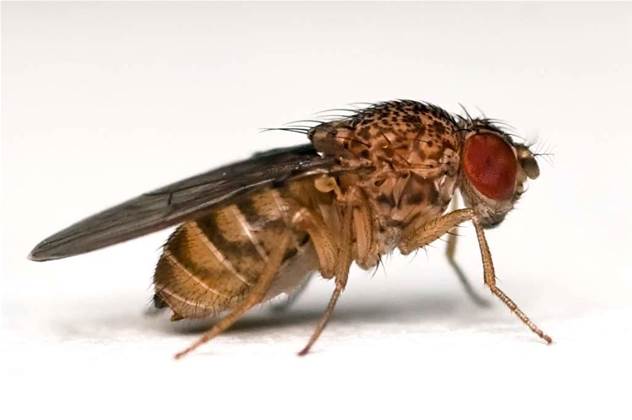
During larva and pupa stages, some cells self-selected to become sensory organ precursors (SOPs) that controlled sensory bristles on flies' bodies - like MIS nodes in a sensor network.

"MIS for sensor networks is similar [to SOPs] in some ways," said Bar-Joseph, of Carnegie Mellon University.

"[In distributed electronic networks], we are trying to obtain some globally smart behaviour from a collection of relatively cheap and weak processors.

"Similarly, each cell in our brain is pretty limited in terms of what it can do, but collectively they can do wonderful things."

Digital fly brains

While the researchers did not yet know how exactly fruit fly brains developed, Bar-Joseph expected their observations to be sufficient for an MIS selection algorithm.

"People have been looking at this for decades," he told iTnews. "It's not completely figured out yet [but] we don't care how the fly got to the solution."

The team closely observed two clusters of approximately 20 brain cells in each of 10 fruit fly pupae for three hours.

Unlike current MIS selection methods, the SOP selection process did not require cells to know the number of non-selected cells they neighboured.
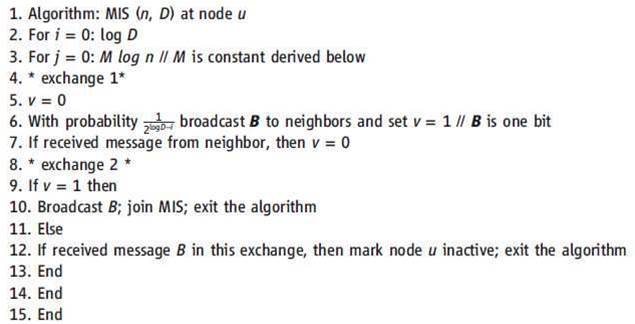
MIS selection algorithm
MIS selection algorithm by Y Afek, N Alon, O Barad, E Hornstein, N Barkai, and Z Bar-Joseph. Courtesy of Science/AAAS.

Cells that became SOPs would emit a protein that inhibited their neighbours from self-selecting later, and the probability that a cell would self-select to become an SOP appeared to increase as time progressed.

Bar-Joseph said that few cells tended to self-select initially, so there was a small chance that neighbouring cells would "collide" by simultaneously self-selecting to become SOPs.

Such collisions occurred in fruit flies less than one percent of the time, he said, noting that flies that developed with conflicting SOP signals suffered an evolutionary disadvantage.

To avoid collisions in the digital model, the researchers determined that collisions would lead to the inhibition of all future communications between the two would-be leaders.

Their resultant algorithm was found to solve the MIS problem in a quick, robust manner, although it was slightly slower than current methods for networks with a large number of components.

Bar-Joseph expected the 15-line algorithm to be easily implemented in research projects and the industry, although the researchers had not yet spoken to industry members about their findings and had no commercial plans.

"We devised a solution to a longstanding distributed computing problem," the researchers wrote in Science.

"The biological approach is efficient and more robust because it doesn't require so many assumptions," Bar-Joseph said. "This makes the solution applicable to many more applications."


Copyright © iTnews.com.au . All rights reserved.


Fruit fly brains for wireless deployments
Credit: Bbski, Wikimedia Commons


Top Stories
Photos: AusCERT 2013 day one
First day of the Queensland security conference.
 
CenITex to move from IT provider to broker
Documents reveal new strategy.
 
eHealth measures missing the point
Opinion: When will the PCEHR lead to patient outcomes?
 
 
Credit: Bbski, Wikimedia Commons
Sign up to receive iTnews email bulletins
   FOLLOW US...

Latest VideosSee all videos »

Bankwest builds continuous delivery capability
To automatically deploy test/dev sandboxes by mid-year.
Veterans' Affairs sets sights on modernisation
Data safe with Human Services, CIO says.
Citi Australia drops platform customisations
Technology chief shifts focus from building to leveraging systems.
VicRoads restructures IT team
Department moves to align with industry benchmarks.
Zurich Australia extends IT team offshore
Malaysian staff served from Australian data centres.
Leigh Berrell - Utilities CIO of the Year
Yarra Valley Water CIO Leigh Berrell accepts his Benchmark Award for Utilities CIO of the Year.
Wayne McMahon - Retail CIO of the Year
Domino's Pizza CIO Wayne McMahon accepts his Benchmark Award for Retail CIO of the Year.
Inside Perpetual's ongoing IT transformation
CIO Jenny Levy discusses how outsourcing will help the firm "simplify, refocus and grow".
Managing Complexity - Defence's Daniel McCabe
Daniel McCabe, Assistant Secretary of Australia's Department of Defence, provides the audience at the iTnews Data Centre Strategy Summit with a deep dive into the organisation's data centre consolidation program.
How Facebook designed the data centre from scratch - Marco Magarelli
The full keynote by Facebook data centre architect Marco Magarelli at the Australian Data Centre Strategy Summit. Magarelli details the design considerations behind the social network's Prineville, Oregon; North Carolina and Luleå, Sweden data centres.
Modernising Legacy Data Centres - Telstra's Jon Curry
Telstra general manager of managed data centres Jon Curry guides the audience at the iTnews Australian Data Centre Summit through the build of the telco's Clayton, Victoria data centre.
NSW Government launches NABERS data centre rating tools
Matthew Clark from the NSW Department of Environment guides facilties managers through the details of the new NABERS data centre energy rating tool at the Australian Data Centre Strategy Summit.
NABERS launch panel: Australian Data Centre Strategy Summit
Matthew Clark (NSW Dept of Environment), Greg Boorer (Canberra Data Centres), Glenn Allan (National Australia Bank), Mike Andrea (Strategic Directions) and Bob Sharon (Green Global Consulting) discuss the impact of the NABERS data centre rating.
Judges notes: Fortescue Metals [The Benchmark Awards]
iTnews' panel of judges discuss Fortescue Metals 'New World of Work" project, one of three shortlisted finalists for the Industrials category of the CIO Benchmark Awards.
Judges notes: Retail [The Benchmark Awards]
iTnews' panel of judges discuss the shortlisted finalists for the Retail category of the CIO Benchmark Awards.
Judges notes: Pacific Aluminium [The Benchmark Awards]
iTnews' panel of judges discuss Pacific Aluminium's lightning fast service desk refresh, one of three shortlisted finalists for the Industrials category of the CIO Benchmark Awards.
Judges notes: Domino's Pizza [The Benchmark Awards]
iTnews' panel of judges discuss Domino's Pizza's shift to hosted services, one of three shortlisted finalists for the Retail category of the CIO Benchmark Awards.
Judges notes: McDonald's Australia [The Benchmark Awards]
iTnews' panel of judges discuss McDonald's Australia's new self-service portal for employees, one of three shortlisted finalists for the Retail category of the CIO Benchmark Awards.
Judges notes: ING Direct [The Benchmark Awards]
iTnews' panel of judges discuss ING Direct's 'Bank in a Box', one of three shortlisted finalists for the banking and finance category of the CIO Benchmark Awards.
Judges notes: Yarra Valley Water [The Benchmark Awards]
iTnews' panel of judges discuss Yarra Valley Water's insourcing project, one of three shortlisted finalists for the Utilities category of the CIO Benchmark Awards.
Latest Comments
Polls
Do you prefer the Coalition's NBN policy?

   |   View results
Yes
  19%
 
No
  81%
TOTAL VOTES: 1691

Vote