The Federal Government has pledged $47.3m towards the development of solar and geothermal energy for radio-astronomy and supercomputing facilities in Western Australia.
Funding will be split between two renewable energy infrastructure projects to power the Pawsey High-Performance Computing Centre and Murchison Radio-astronomy Observatory.
A full-scale, hybrid solar and diesel plant will be built at Murchison, with sophisticated energy management systems to support its storage and generation capabilities.
For the Pawsey Centre in Kensington, hot sedimentary aquifers will be installed to provide water cooling and ventilation for the 10 megawatt thermal facility, which will become one of Australia's largest direct geothermal research and demonstration sites.
Construction on the projects is scheduled to commence in November 2010, be completed in August 2013, and support 62 construction jobs.
The Government expects the projects to cut annual energy costs by up to $5 million, and reduce carbon emissions 12,000 tonnes per year -- the equivalent of taking 6,000 cars off the road.
"This is one of dozens of renewable energy projects the Government is supporting across the nation, all part of the Government's continued response to climate change," Prime Minister Kevin Rudd said to the Perth Media Club yesterday.
"Each one of these investments matters because each plays a part in building a stronger economy that delivers a fairer share to working families."
Strengthening Australia's SKA bid
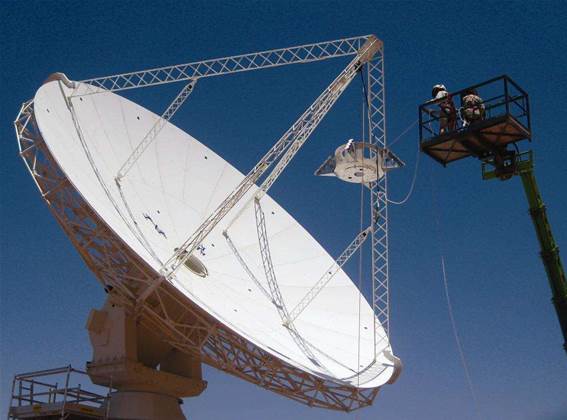
The $47.3m investment will support CSIRO's Australian Square Kilometre Array Pathfinder (ASKAP), a network of radio telescopes at the Murchison Observatory that produces terabytes of data to be processed at Pawsey each day.
ASKAP is part of the Australasian bid to host the $2.5 billion Square Kilometre Array (SKA), which involves 20 countries and will investigate galaxy evolution, dark matter, and the existence of life.
Australia and New Zealand are in competition with a Southern African SKA bid, involving South Africa, Namibia, Botswana, Mozambique, Madagascar Mauritius, Kenya and Ghana. A decision is expected to be made in 2012.
Innovation Minister Kim Carr is understood to have been in Europe this week to promote the Australasian bid, which is expected to generate both economic and scientific benefits for the host region.
According to CSIRO chief executive Megan Clark, the newly announced projects will also accelerate the Australian development of renewable energy technology for uses beyond the SKA.
"This project will also allow the practical application of research by scientists and students from all over Australia in renewable energy, as well as in astronomy, computer science, engineering, geology and environmental management," she said in a statement.
"It is a unique opportunity for many different areas of science to come together and work on something that will benefit all Australians, the development and application of renewable energy technologies."
Other Government contributions to the Australasian SKA bid include: $100 million for ASKAP, $80 million for the Pawsey supercomputing centre; and $25 million for a fibre broadband link from Perth to Geraldton.



.jpg&h=140&w=231&c=1&s=0)
.png&h=140&w=231&c=1&s=0)

.jpg&h=140&w=231&c=1&s=0)


 RIMPA Live Convention 2026
 What’s Next?
 iTnews Benchmark Security Awards 2026
 iTnews State of Security Breakfast Sydney
 iTnews Executive Retreat - Security Leaders Edition - VIC





.jpg&h=140&w=231&c=1&s=0)


.jpg&h=140&w=231&c=1&s=0)