Analysis: Car makers still lukewarm on driverless vehicles


iTnews asks: How long before cars drive themselves?

Computer scientist Albert Huang is building a robotic car that can visually navigate public roadways.
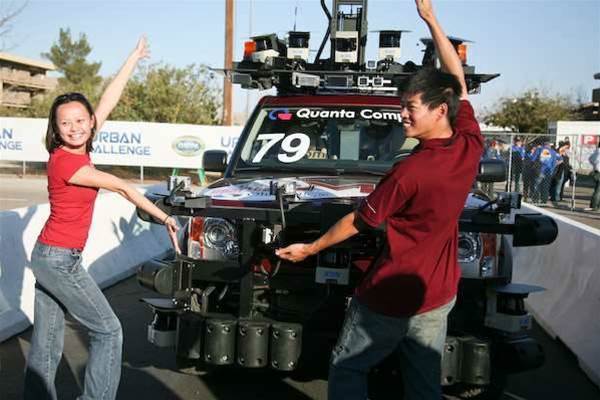
But it could take several dozen years of societal and legal progress before the US$700,000 project renders human drivers obsolete.

"Autonomous cars right now are at a stage where they can do a pretty good job getting from point A to point B without hitting big things," said Huang, who is a doctoral student at MIT.

"[However] deploying in public areas requires much more than just technological progress ... I don't expect that to happen widely for at least several dozen years after the technology is ready," he told iTnews.

MIT's autonomous car is a modified Land Rover LR3 named ‘Talos'. The project spans several departments at the university, and also involves Olin College, Draper Laboratory and BAE Systems.

In 2007, the car was one of only six vehicles to successfully navigate a 96-kilometre obstacle course in the DARPA Urban Challenge for driverless cars. Some 89 teams had initially applied to compete in the government-sponsored competition, which offered a grand prize of US$2 million.

Like the internet and so many technologies before it, it is the U.S. military that is showing the most interest in autonomous vehicles as the technology develops.

Because the vehicles have the potential to reduce manpower requirements in danger zones, the U.S. military views this as a technology that could save lives.

U.S. congress mandated in the 2001 National Defense Authorization Act that one third of operational ground combat vehicles are to be unmanned by 2015.

"Deploying robotic ground vehicles on the battlefield [means they can] perform hazardous tasks that threaten the lives of American men and women in uniform," said Johanna Jones, who is a Public Affairs Officer at the U.S. Defense Advanced Research Projects Agency (DARPA).

"Transportation, reconnaissance, surveillance and bomb detonation are just a few examples of potential near-term battlefield applications for robotic ground vehicles operating autonomously or as part of convoys."

Meanwhile, civilian car manufacturers have yet to embrace the technology. While manufacturers have demonstrated interest in autonomous fallback safety systems and vehicle-to-vehicle communication systems, a market for full automation has yet to emerge.

Huang expects a gradual introduction of robots into society, starting with controlled environments - for example, autonomous ground robots working alongside trained humans in warehouses - and progressing to more complex environments as their capabilities grow.

While he noted that his vision of robotics may not completely gel with that of the military, he expects a mutual interest in autonomous robots to encourage cooperation.

"My interest in robotics is fundamentally about letting us humans do things that we couldn't do before, either by making a previously impossible task possible, or by dramatically increasing the efficiency with which a task can be completed," he said.

"As with any new technology, there's always a way to subvert it and use it for ill gain or violent purposes, and I don't think the distinction necessarily lies at the civilian-military boundary."


Save up to 10% online when you buy a new Allianz Car insurance

Analysis: Car makers still lukewarm on driverless vehicles
""It doesn't seem too far out of reach to add inter-vehicle connectivity via say an adhoc wireless network the bus itself could communicate to all nearby cars warning them to slow down to X speed ..."
By Sams


Comments: 7
wjase
Nov 30, 2009 9:26 AM
Are these guys mad? What will all the florists do who make those nice wreaths for teenagers to lay at slightly bent powerpoles? What about the advertisers? How do you make a racy testosterone fuelled TV ad when the driver is simply pressing a button to select a destination. No, we need to defend our teenage childrens' right to die and take others with them in the biggest, meanest, nitro-sucking package we can afford. (Hopefully with baby seal-eye headlights)
Slatts
Nov 30, 2009 8:29 PM
I don't think the florists will have much to worry about in the short term wj.

I can see it now.
An autonomous SUV driving down a busy city street.
it hits a pothole, causing a hard drive head crash that kills a few subroutines.
The software goes back to its military roots and decides it's under attack.
It declares all pedestrians in the vicinity as hostile.
The florists are back in business.
MerariSchroeder
Nov 30, 2009 8:51 PM
Funny, I was just thinking of this recently. The key is to make it fun. Just like they can make super fast electric cars. Once refined enough, you could be travelling at 200Kph - because you don't have the risks of human error.

[slatts] I don't think you would have problems with a harddisk crash. You'd most likely have the software on a flash disk plus programs are fully loaded into memory.

If Russians can make missiles which can evade anti-missile missiles which move faster than the speed of sound. You'd think we could manage to design autonomous cars!
MerariSchroeder
Nov 30, 2009 8:53 PM
Plus think of the technology they use in fighter jets. They're better than the pilots. And I saw a clip of a fighter jet, where the pilot was in a spin, got out of it and landed (then found out one of the wings was missing!) the computer automatically adjusted the balance, trims etc..

Apply this to cars.
Sams
Nov 30, 2009 9:10 PM
"If Russians can make missiles which can evade anti-missile missiles which move faster than the speed of sound. You'd think we could manage to design autonomous cars!"

When an autonomous car can see a mini bus with a school logo pulled over ahead and think "hey, there may be school kids about to step out from behind that bus" and consequently slow down to allow adequate time for braking (without risking injury to the passengers of said car), then I'll be interested. Driving requires a much higher level of semantics than out-manoeuvring inanimate objects.
Desk
Dec 1, 2009 8:49 AM
"When an autonomous car can see a mini bus with a school logo pulled over ahead and think "hey, there may be school kids about to step out from behind that bus" and consequently slow down to allow adequate time for braking (without risking injury to the passengers of said car), then I'll be interested. Driving requires a much higher level of semantics than out-manoeuvring inanimate objects."

It doesn't seem too far out of reach to add inter-vehicle connectivity via say an adhoc wireless network the bus itself could communicate to all nearby cars warning them to slow down to X speed for x amount of time or until the car moves out of x range of x.y. co-ordinates (on the presumption that all the cars have GPS systems)
Sams
Dec 1, 2009 10:10 AM
"It doesn't seem too far out of reach to add inter-vehicle connectivity via say an adhoc wireless network the bus itself could communicate to all nearby cars warning them to slow down to X speed for x amount of time or until the car moves out of x range of x.y. co-ordinates (on the presumption that all the cars have GPS systems)"

You would then need all such vehicles to have this wireless notification capability. The logistics of doing that are horrendous Besides, this was just one small example of how driving requires higher reasoning. I'm not saying it will always never be possible to have autonomous vehicles, but waiting for better AI seems prudent.
Comments have been disabled for this article.


Top Stories
Vito Forte: A CIO for tough times
Fortescue Metals CIO talks vendor management and innovation.
 
Tech staff spared in ANZ's 1000 job cuts
Cost cutting hits middle management.
 
Telstra shifts BigPond email to Windows Live
All data to be migrated to Microsoft cloud.
 
Sign up to receive iTnews email bulletins
   FOLLOW US...

Latest VideosSee all videos »

Latest Comments
Polls
Would you be concerned about your business' email data being hosted offshore?

   |   View results
Yes
  83%
 
No
  17%
TOTAL VOTES: 245

Vote