iTnews
  • Home
  • News
  • Technology
  • Hardware

Scientists tout super-fast hard drives

By Liz Tay
Feb 10 2012 7:19AM
Follow google news

No magnetic field needed for new data recording method.

A new, heat-only method of writing data on hard disks could speed up information recording by a thousand times, British physicists have claimed.
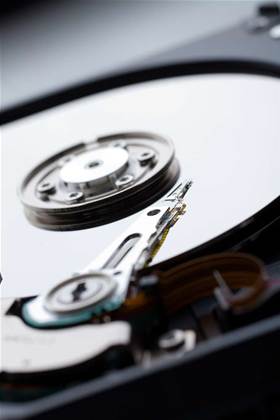
Scientists tout super-fast hard drives

The York University method builds on heat-assisted magnetic recording (HAMR) technology in development by the likes of Fujitsu and Seagate.

In traditional hard drives, data is recorded by “write-heads” that use a strong, localised magnetic field to affect the motion of electrons, and thus the magnetic state, in an area of film.

HAMR drives use film that -- unless heated -- is more difficult to magnetise, so "magnetic bits" can be packed in more tightly without being accidentally reset. Within the next three years, storage vendors expect HAMR to boost the capacity of hard drives to tens of terabytes.

York researchers proposed to improve the speed and efficiency of HAMR by doing away with the use of a magnetic field entirely – a move previously thought to be impossible.

“The use of the field was previously thought to be essential,” lead researcher Thomas Ostler told iTnews.

“Our discovery negates the need for the field ... with the added bonus that the process occurs around 1000 times faster than current methods.

“Without the field the hope would be that some of the power consumed in drives could be reduced over HAMR technology,” he added.

In a study reported in Nature Communications this week, Ostler’s team reversed the direction of magnetism in a film of Gadolinium, Iron and Cobolt using an ultrashort heat pulse.

The femtosecond (millionth of a billionth of a second) pulse heated up the film until it was unable to sustain magnetisation.

Because electrons in each of the metals cooled at a different rate, the magnetic state was reversed when the film was able to sustain magnetisation again.

Ostler said the method could record 100 gigabytes of data per second, as long as the film could physically move quickly enough to support it.

“The speed of the mechanical spinning plays an important role,” he noted. “If the engineering challenges could be overcome the potential rate of data transfer could be up to 100 GB per second.”

York University professor Roy Chantrell said the team had not estimated the cost of the new head-only method, but expected it to be cheaper than current technology, which was “difficult to manufacture”.

Hard drives that used the heat-only writing process would also be cheaper, denser and more reliable than solid state drives, he said.

The researchers said they were working with industrial partners but the technology would take “a few years” before becoming a “realistic commercial possibility”.


Add iTnews as your trusted source

Add iTnews As Your Trusted Source Add iTnews As Your Trusted Source
Got a news tip for our journalists? Share it with us anonymously here.
Copyright © iTnews.com.au . All rights reserved.
Tags:
hardwarehddscitechstorage

Related Articles

  • Microsoft teases new era of AI-driven devices Microsoft teases new era of AI-driven devices
  • PsiQuantum to build computer at Moreton Bay PsiQuantum to build computer at Moreton Bay
  • US to invest in IBM, other quantum computing firms US to invest in IBM, other quantum computing firms
  • South Korea says it will pursue all options to avoid Samsung strike South Korea says it will pursue all options to avoid Samsung strike
Join our WhatsApp Channel

Partner Content

Why resilient communications are becoming critical infrastructure for modern enterprise IT
Promoted Content Why resilient communications are becoming critical infrastructure for modern enterprise IT
The hidden economics of AI: Why token usage matters more than you think
Partner Content The hidden economics of AI: Why token usage matters more than you think
Take control of your connectivity with Telstra’s Adaptive Networks Centre
Partner Content Take control of your connectivity with Telstra’s Adaptive Networks Centre
Scalable AI solutions: secure delivery

Sponsored Whitepapers

Agile in the AI Era: why projects still fail
When Technology Becomes the Blocker: Unlocking Real Outcomes from AI and Cloud
High-volume data sources for AI-driven security analytics
How healthcare organisations can get more value from cloud
1 in 3 companies lose SaaS data. Here’s how to prevent it

Events

  • iTnews State of Security Breakfast iTnews State of Security Breakfast

  • iTnews State of Data & AI Breakfast iTnews State of Data & AI Breakfast

  • The 2026 iAwards The 2026 iAwards
  • Integrate 2026 Integrate 2026
  • Security Exhibition & Conference Security Exhibition & Conference
Share on Facebook Share on LinkedIn Share on Whatsapp Email A Friend

Most Read Articles

Google says it has cracked a quantum computing challenge

Google says it has cracked a quantum computing challenge

Microsoft teases new era of AI-driven devices

Microsoft teases new era of AI-driven devices

Australian teen leaks pictures of new iPhone parts

Australian teen leaks pictures of new iPhone parts

Federal Court orders Google to pay $55 million for anti-competitive conduct

Federal Court orders Google to pay $55 million for anti-competitive conduct

techpartner.news logo
Sydney-based AI-cloud waste startup raises $3m
Brennan uses NiCE to modernise its contact centre
Impact Awards: Tecala slashes customer response times for fintech IQumulate
Interactive introduces private cloud platform
Digital61 expands cybersecurity portfolio
All rights reserved. This material may not be published, broadcast, rewritten or redistributed in any form without prior authorisation.
Your use of this website constitutes acceptance of nextmedia's Privacy Policy and Terms & Conditions.