Graphics card vendor Nvidia has set its sights on enterprise IT with GPU-based ‘desktop supercomputers’ costing upwards of $3,000.
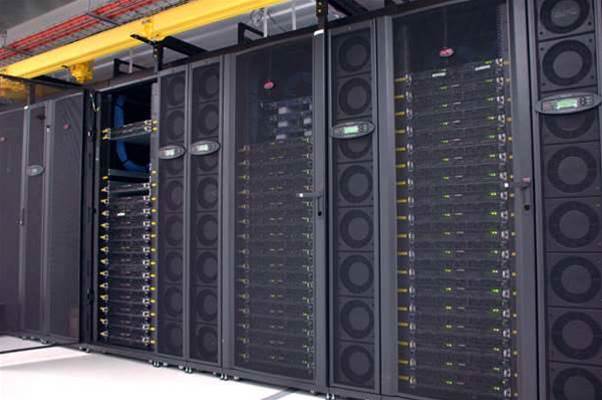
With two large-scale GPU-based high performance computers (HPC) currently in Australia, and three more expected this year, Nvidia expected demand for its Tesla HPC brand to grow.
The demand for large-scale HPCs was currently driven by research organisations like the CSIRO, which deployed a cluster containing 64 Tesla S1070 chips (256 GPUs) in November 2009.
After being upgraded with newer Tesla s2050s, the cluster ranked 145 in the Top500 supercomputers list last November, performing the Linpack benchmark at 52.55 teraflops in double precision.
Luke Domanski of CSIRO’s Advanced Scientific Computing division viewed GPUs as the “next best step in multi-core computing”, and a vital learning opportunity for CSIRO scientists.
Unlike CPUs, which operated sequentially, GPU clusters performed operations in parallel, and thus required a different approach to programming.
Domanski was one of four specialists in a newly established Computational and Simulation Science team that trained and helped scientists develop on Nvidia’s CUDA architecture.
Besides the Canberra-based GPU cluster, CSIRO also had a number of what Domanski called “desktop supercomputers” – individual, four-GPU workstations.
The teraflop workstations were estimated to require 1,100 Watts and cost between $10,000 and $15,000, depending on components.
Eventually, Domanski hoped desktop supercomputers would be as common as today's off-the-shelf laptops, allowing researchers to consider scientific problems without computational limits.
Dragan Dimitrovici, managing director of Tesla integrator Xenon, said workstations with two to three Tesla GPUs would cost between $3,000 and $4,000.
Besides CSIRO, Xenon counted the Department of Defence, Rio Tinto and Chevron among its Australian customers.
“We always see early adoption in government and academic [sectors],” Tesla general manager Andy Keane said.
“But the real market for supercomputing is industry … the heart of this [supercomputing] industry is enterprise.”
In the US, Keane said consumer goods manufacturer Proctor & Gamble used GPU-based supercomputers to model how products would behave when dropped.
Automotive companies were also known to use HPCs for crash test simulations, resulting in significant savings from the elimination of unnecessary prototypes.
Highlighting Tianhe-1A, China’s 2.57 petaflop supercomputer that topped last November’s Top500 list, Keane expected the hybrid CPU-GPU model to dominate future HPC designs.
Three of the top five supercomputers currently employed hybrid designs, including: Tianhe, which combined about 7,000 Nvidia GPUs with 14,000 Intel CPUs; Nebulae at the Chinese National Supercomputing Centre; and TSUBAME 2.0 at the Tokyo Institute of Technology.
The US Department of Energy’s Jaguar and Hopper supercomputers – both traditional Cray supercomputers – were ranked second and fifth on the Top500 list.
Besides requiring less energy to run, Keane expected advances in GPU performance to surpass that of CPUs, since developments were subsidised in part by the computer games industry’s demand for graphics processors.
In contrast, IBM’s Blue Gene technology was built specifically for HPC and “wouldn’t exist without assistance from the US government”, Keane claimed.
“We see a future in hybrid computing, where you have CPUs and GPUs working together,” he said.
“Basically for the future, this is the model: you’ll always have a sequential piece, and you’ll always have a parallel piece.”




.jpg&h=140&w=231&c=1&s=0)




 iTnews State of Security Breakfast
 iTnews State of Data & AI Breakfast
 The 2026 iAwards
.jpg&w=120&c=1&s=0) Integrate 2026
Integrate 2026
 Security Exhibition & Conference









_(1).jpg&h=140&w=231&c=1&s=0)