iTnews
  • Home
  • News
  • Technology
  • Networking

Video: Why Dell ditched the container data centre

By Brett Winterford
Nov 11 2010 4:08PM
Follow google news

Too small a market for containers.

Dell has cited a lack of customer demand as the reason behind its shift from container data centre fit-outs to a more flexible, modular approach.
Video: Why Dell ditched the container data centre

Dell has for several years provided internet giants such as Microsoft with modular data centre fitouts made up of traditional 40-foot shipping containers, but there was no shipping container to be seen in its third generation centre launched earlier this week in Adelaide.

Forrest Norrad, vice president of the server group at Dell said the container solution tried to marry objectives around high density and portability, but had to compromise on one to boost the other.

“Extreme mobility” containers represent “a small niche market”, he said.

“We realised that [the shipping container] form factor is very inflexibile and not the most efficient way to go,” he said in an interview with iTnews (see below).

“It was difficult to move and lacked the flexibility to meet different customer needs,” he said. “If one customer needed more power density, they were sort of stuck with what was designed in the container.”

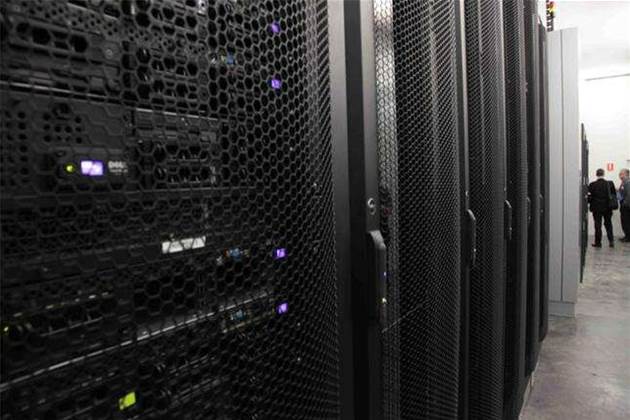
The vendor has instead opted for modular units called PACs which can be pre-configured and snapped into place in a warehouse using cranes.

“An individual customer can have the right need of power, the right level of cooling and the right level of resiliency to meet their needs rather than be constrained by the container solution we may have created for someone else,” Norrad said.

If a data centre park such as Tier 5’s Adelaide facility has the relevant physical space and power in place, Norrad estimates the fitout of a new module to take three months. “But if you have a little bit of site preparation, you can set up a data centre in a warehouse in 30 days,” he said.

Customers can also choose to have servers racked, cabled and tested before the module is dropped into place at a warehouse data centre.

“The modules are designed to be transported full,” Norrad said. “There is a very carefully engineered set of shock absorbers and isolation elements that allow us to ship fully configured racks.

"We will actually pre-build for many of our customers an IT module with thousands of servers, cable it all up, test it, provision it with software if they want, and then ship the entire unit to their location, land it on their floor, plug it into power, plug it into cooling, and literally have thousands of servers deployed in just a few days.”

Analysts were generally impressed by Dell’s approach.

Ideas International analyst Gary Burgess said that the design brought Dell into line with IBM and HP’s offerings to the corporate market, rather than focusing on massive internet customers.

Gartner analyst Matthew Boom said that modular approaches to data centres “is starting to resonate well with customers, particularly those running out of space, concerned about efficiency and data recovery.”

IBRS analyst James Turner was broadly supportive of the move, but noted that “it seems like a step back in terms of modularity” that may come with a higher price tag.

Dell was “opening up” the modular data centre market “so it is no longer self-contained,” he said.

“You can put in whatever equipment you like - but it has removed the homogeneity of it – which was one of the big advantages of the data centre in a box.”


Add iTnews as your trusted source

Add iTnews As Your Trusted Source Add iTnews As Your Trusted Source
Got a news tip for our journalists? Share it with us anonymously here.
Copyright © iTnews.com.au . All rights reserved.
Tags:
adelaidecontainerdata centredatacenterdellhardwarenetworkingstoragestrategytier

Related Articles

  • Federal Parliamentary Computer Network set for its "most significant" upgrade Federal Parliamentary Computer Network set for its "most significant" upgrade
  • Kmart Group to expand RFID tagging to more products and to Target Kmart Group to expand RFID tagging to more products and to Target
  • Home Affairs opens internal "conversation" on adopting three types of AI Home Affairs opens internal "conversation" on adopting three types of AI
  • Meta accuses Australia of breaching free trade agreement Meta accuses Australia of breaching free trade agreement
Join our WhatsApp Channel

Partner Content

Thomas Peer Solutions unveils data cloud platform and executive leadership forum for 2026
Partner Content Thomas Peer Solutions unveils data cloud platform and executive leadership forum for 2026
Why resilient communications are becoming critical infrastructure for modern enterprise IT
Promoted Content Why resilient communications are becoming critical infrastructure for modern enterprise IT
AI is delivering business value today
Partner Content AI is delivering business value today
Scalable AI solutions: secure delivery

Sponsored Whitepapers

Are Australian organisations as cyber-ready as they think?
Are New Zealand organisations as cyber-ready as they think?
From visibility to execution:  Fixing the SaaS management gap
From visibility to execution: Fixing the SaaS management gap
When cyber risk has no clear owner: A practical guide for senior Australian business leaders
Agile in the AI Era: why projects still fail

Events

  • iTnews State of Security Breakfast iTnews State of Security Breakfast

  • iTnews State of Data & AI Breakfast iTnews State of Data & AI Breakfast

  • Forrester's AI Forum Sydney Forrester's AI Forum Sydney

  • The 2026 iAwards The 2026 iAwards
  • Security Exhibition & Conference Security Exhibition & Conference
Share on Facebook Share on LinkedIn Share on Whatsapp Email A Friend

Most Read Articles

Kmart Group to expand RFID tagging to more products and to Target

Kmart Group to expand RFID tagging to more products and to Target

Federal Parliamentary Computer Network set for its "most significant" upgrade

Federal Parliamentary Computer Network set for its "most significant" upgrade

WA man jailed for at least five years for evil twin attack

WA man jailed for at least five years for evil twin attack

Optus fast-tracks network operations insourcing from Nokia

Optus fast-tracks network operations insourcing from Nokia

techpartner.news logo
Sydney-based AI-cloud waste startup raises $3m
Brennan uses NiCE to modernise its contact centre
Impact Awards: Tecala slashes customer response times for fintech IQumulate
Interactive introduces private cloud platform
Digital61 expands cybersecurity portfolio
All rights reserved. This material may not be published, broadcast, rewritten or redistributed in any form without prior authorisation.
Your use of this website constitutes acceptance of nextmedia's Privacy Policy and Terms & Conditions.