It's a rarity to log-in to any Google service from here in Australia and find it lagging in performance.
We've got used to some pretty remarkable response times, considering it was always assumed that local users were connecting to data centres located in Japan or the United States.
The response times here in Sydney are such that many technology journalists are convinced Google has a data centre in Australia, and we've long badgered Google to tell us where it is.
Today, we can reveal that we've found Google's racks. By the end of this article you'll know where they are. But far more interesting - Google barely needs them. They've bought into the network.
Hint number one
Back in October, wholesale fibre network builder Pipe Networks held an event to celebrate the launch of the PPC-1 cable from Sydney to Guam.
Among the ISPs that had signed up for the additional capacity was an unnamed customer, spelt out with multi-coloured letters.
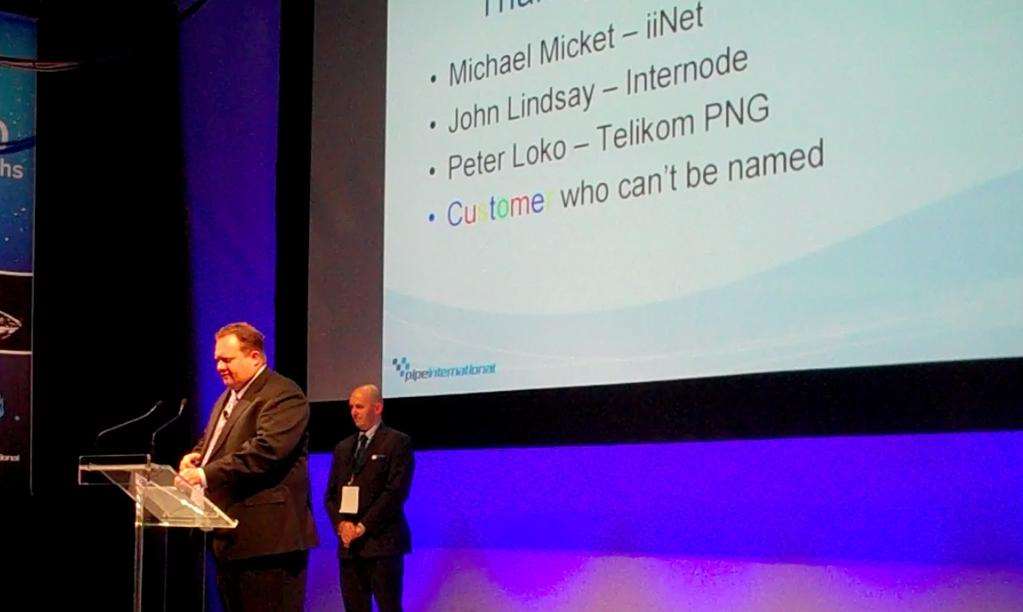
Naturally, our young reporter Ben Grubb assumed at the time that Pipe was referring to Google, but we missed the ramifications. Until now.
Google is leasing a fair chunk of PPC1's 2.56 terabit pipe - we've seen indications that it's pulling in four gigabits per second - purely to suck down Google pages from its data centre in Japan.
Why is Google investing in a network link into Australia? See hint number two.
Hint number two
If you check out Pipe's peering partners, you'll notice Google Australia is among them. Pipe runs this peering service from data centres such as Equinix, Global Switch, AAPT, Powertel and others.
This means that Pipe's customers - ISPs - can get direct access to Google content (YouTube, Gmail, Google Apps etc) at a flat, predictable rate. Cinenet is one of the latest ISPs to offer this as a business service to its customers.
That's not trivial - network managers report that Google traffic can account for 15-25 percent of total consumption on some networks, courtesy of the bandwidth-hungry YouTube videos.
Response times become of even greater consequence once we start talking about the consumption of "cloud-based" services.
Large organisations are nervous about consuming apps or compute from the cloud for a lot of reasons - but prime among them, they need to be convinced that response times to their data will be so fast, you would feel like you are connecting to the room next door.
Through its investment in PPC-1 and the peering agreement with Pipe, Google can guarantee a decent experience for its Google Apps suite, even if the data is hosted elsewhere in the region. Is Microsoft, Amazon or Salesforce doing the same? Stay tuned on that one.
Hint number three
But even if Google has a big fat pipe and a good business model in the works for using it, this still doesn't quite explain the sub-ten second response times we enjoy for the most popular YouTube videos or the front pages of Google services from here in Australia. If ALL the data was in Google's Japan data centres, it would be more like 80 to 100 milliseconds.
Somewhere on Australian soil there has to be a "cache cluster" - a few racks of Google gear, hosting the most popular and accessed content.
And by George, iTnews has found it.
Now, you were probably expecting something like this right? Massive warehouses, shipping container pods stacked a mile high?
Sorry to disappoint, but the closest thing Google has to an Australian data centre is tiny. It's a small, caged off area at a discreet computer room on Sydney's suburban Northern Beaches.
Our intrepid reporter Ry Crozier has even been there - but was directed not to photograph a caged off area - an area that we've now confirmed includes Google's kit.
Google, for the record, doesn't comment on the location of their equipment, for understandable reasons.
So what have we learned?
The sum of my rant is that while Google has racks of kit sitting here in Australia, it doesn't especially need a big data centre. By buying into the network, Google can give you high speed access to its data without hosting any of it here.




.jpg&h=140&w=231&c=1&s=0)





 iTnews State of Security Breakfast
 iTnews State of Data & AI Breakfast
 The 2026 iAwards
.jpg&w=120&c=1&s=0) Integrate 2026
Integrate 2026
 Security Exhibition & Conference








_(1).jpg&h=140&w=231&c=1&s=0)