

Canberra-based engineering firm Datapod has launched a line of modular container data centres which, from a base price of around $400,000, provide a complete data centre solution housed within a shipping container.
Container data centres have come into favour with the likes of Google and Microsoft, as they offer a highly modular and capital efficient approach to building out data centre capacity on demand.
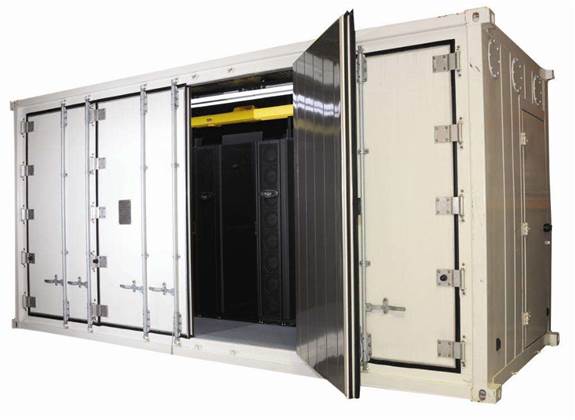
Datapod and its vendor partner APC guided iTnews through two of the company's container models - a full featured, 30 metre squared Starterpod and its 10 metre squared little brother, the Projectpod. [see photo gallery at top right of page].
The Starterpod, attached to a connection node module, is the first pod of an expandable, modular container data centre.
In this single ISO-standard shipping container, Datapod provides two back-to-back rows of APC InfrastruXure racks for the housing of servers, storage and communications equipment.
The foldable walls of the pods are made of 90mm thick polyurethane insulation and impervious to extreme temperatures or lightning. But they are also expandable and can be manipulated such that a new pod (or Expanderpod) can be snapped onto the Starterpod in modular fashion when more capacity is required.
The pod itself is connected to a node that aggregates the electricity, data communications and chilled water required to feed it.
The other model on display at Datapod's launch was a Projectpod - a smaller, 10 square metre self-contained pod with a single row of InfrastruXure racks - the hot air this time being contained between the exhaust of the racks and a glass panel.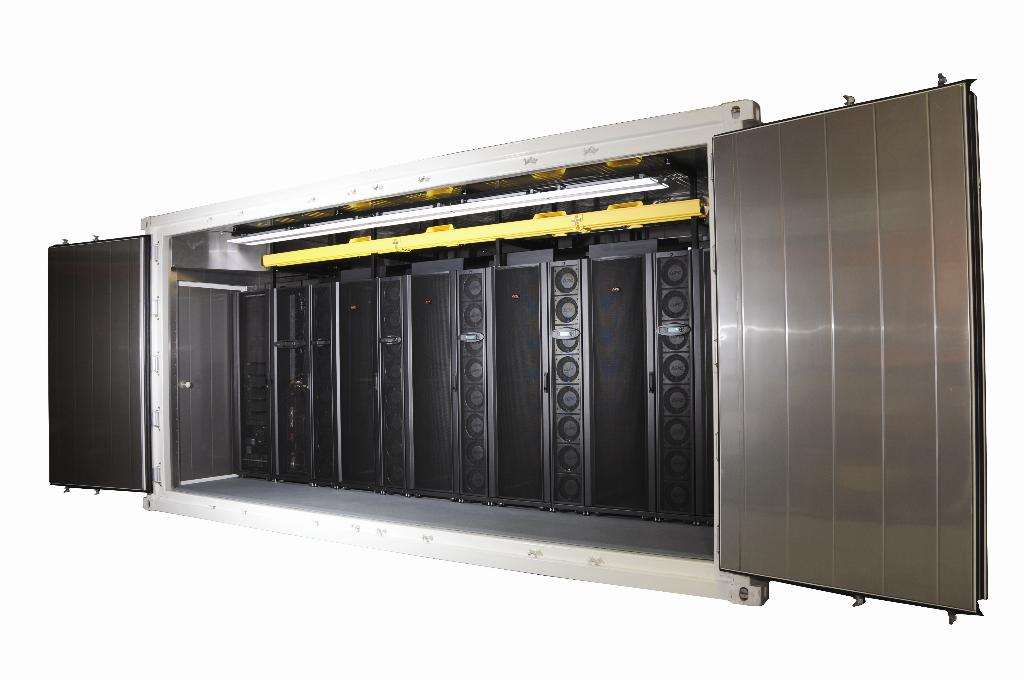
The Projectpod was intended to be deployed in short-term scenarios such as mining exploration projects or in Defence operations.
Uses
Datapod's container data centres have been designed to be shipped on the back of a truck anywhere they are required - or at least, anywhere a carrier can terminate its fibre network and where three-phase power and water is available.
Datapod director Scott Carr told iTnews that after designing and building data centres for the likes of Defence and the Australian National University (ANU) in Canberra, he realised that infrastructure providers were not able to roll out new facilities "in the timeframes IT and business required.
"So we started to build on the idea of very small modules within the footprint of an ISO shipping container," he said.
"We put together a solution in a Lego-based approach. If you want extra redundancy, put some extra modules beside each other. If you want scalability for growth in capacity, deploy them as you need them."
The Datapod solution, he said, was well suited to any implementation that was short term or project-based, or for use as a disaster recovery site.
It could also be used for the augmentation of an existing data centre when an organisations' computing needs stretched beyond their floor space or power capacity, he said.
Carr said that the solution was far more capital efficient than building or retrofitting an existing data centre within a physical building.
"Building or retrofitting can be a $10 million or $30 million investment," he said. "Spend $10 million and you could get it wrong - run out of space and you have a problem. Spend $30 million and you have capacity tied up and not utilised until toward the end of its life.
"The entry level Datapod, by contrast, starts at around $400,000 - and that's for us to come in and design, build and deploy."
Carr said the Datapod solution trumps the 'first generation' container data centre models offered by the likes of Sun and Dell because it was completely vendor neutral from a server, storage and communications perspective. (The user, however, is locked into the APC cooling and power infrastructure.)
"The first generation solutions don't address the entire site infrastructure," Carr said. "We're from an engineering background, we provide a turnkey solution. Simply putting servers in a container doesn't solve any problems for my clients - the issue was how to cool it and get power to it."
Read on for more on how in-row cooling and hot aisle containment works in the Datapod.
Advanced cooling techniques
The APC racks housed within the Datapod were designed to address the increasing requirement for higher density computing - whilst cutting down on cooling requirements and thus power costs.
APC country manager Gordon Makryllos said traditional data centre configurations were built on a raised floor, with cracks in between the racks where hot and cold air mix. Many of these configurations, he said, were only capable of running two to three kilowatts per rack.
The APC solution in the Datapod used in-row cooling to bring the cold air closer to the load, enabling the data centre operator to run at six to eight kilowatts per rack.
Further, the exhausts of the two racks of equipment faced each other in an aisle only just wide enough to service the equipment. This aisle could be closed off to the rest of the room using two sliding doors.
This 'hot aisle containment' allowed data centre operators to run at up to 30 kilowatts per rack, Makryllos said.
"The smaller the area you are trying to cool, the more energy efficient it is," he said. "We can go into most data centres and offer 50 percent savings in energy."
Makyrllos said there were twenty data centres in Canberra alone using this cooling system.
"What we're finding is, a lot of customers want to deploy this, but their building can't take it," he said. "They don't have the room, the power, the cooling, the chilled water, or can't get approvals from landlords or the council.
"So what we're saying to them is, rather than take two years to build a data centre, buy a Datapod and put it out somewhere in a warehouse or anywhere that you have cheap real estate.
"All you need is fibre, power and water, and you have a data centre on demand. If a customer is constrained by their building, they now have another option."




.jpg&h=140&w=231&c=1&s=0)




 iTnews State of Security Breakfast
 iTnews State of Data & AI Breakfast
 The 2026 iAwards
.jpg&w=120&c=1&s=0) Integrate 2026
Integrate 2026
 Security Exhibition & Conference








_(1).jpg&h=140&w=231&c=1&s=0)
