iTnews
  • Home
  • News
  • Technology
  • Hardware

Robots deemed less intelligent than humans, still

By Liz Tay
Jul 15 2008 4:55PM
Follow google news

Despite improvements in artificial intelligence and robotics, humans prefer human interactions to those with machines, a study has found.

Robots deemed less intelligent than humans, still
Researchers measured the brain activity of 20 survey participants, who each played a simple game against four opponents of varying degrees of human-likeness.

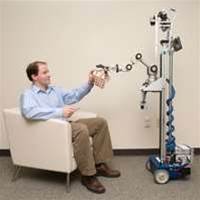
Opponents were: a regular computer notebook, a functionally designed Lego-robot, the anthropomorphic robot named BARTHOC Jr., and a human.

Although all opponents were instructed to play in a similar manner, participants reported experiencing the most enjoyment when interacting with a more human-like opponent.

The researchers expect participants’ perceptions to reflect a tendency to attribute rational decision-making abilities and strategy to human-like opponents.

“This is intriguing as intuitively one would never claim that machines find real own decisions,” said Sören Krach, a psychologist at the RWTH Aachen University.

“From a rather philosophical point of view, I would argue that humans always tend to search for explanations,” he said. “Participants were unknowingly confronted with random sequences of response decisions but intuitively searched for a logical strategy.”

“This was, as we believe, partly triggered by the anthropomorphic [human-like] design of the game partners and the abstract social interaction. Treating game partners as non-human would rather induce a feeling of dissonance,” he said.

When also asked to estimate the intelligence of their opponents, participants demonstrated a greater regard for more human-like opponents.

Krach described intelligence as a property of the mind that encompasses the capacities to reason, to plan, to solve problems, to think abstractly, to comprehend ideas, to use language, and to learn.

Movement and facial attributes also were identified as physical traits that are commonly perceived to be human-like.

The researchers suggest that robots performing social roles, such as nurse or caretaker, to be designed with human-like features to be most successful.

“Recent research proves that the more social a situation is the more human-like features are demanded by the subjects,” Krach said.

“If the robot works within a factory where there is has no direct contact to human beings the shape does not matter. However, if the robot takes over the role of a nurse or a caretaker it would matter,” he said.


Add iTnews as your trusted source

Add iTnews As Your Trusted Source Add iTnews As Your Trusted Source
Got a news tip for our journalists? Share it with us anonymously here.
Tags:
deemedhardwarehumansintelligentlessrobotsstillthan

Related Articles

  • Kmart Group to expand RFID tagging to more products and to Target Kmart Group to expand RFID tagging to more products and to Target
  • Microsoft teases new era of AI-driven devices Microsoft teases new era of AI-driven devices
  • PsiQuantum to build computer at Moreton Bay PsiQuantum to build computer at Moreton Bay
  • US to invest in IBM, other quantum computing firms US to invest in IBM, other quantum computing firms
Join our WhatsApp Channel

Partner Content

Why resilient communications are becoming critical infrastructure for modern enterprise IT
Promoted Content Why resilient communications are becoming critical infrastructure for modern enterprise IT
Take control of your connectivity with Telstra’s Adaptive Networks Centre
Partner Content Take control of your connectivity with Telstra’s Adaptive Networks Centre
Scalable AI solutions: secure delivery
From test case to control tower: How DXC and ServiceNow are governing enterprise AI at scale
Promoted Content From test case to control tower: How DXC and ServiceNow are governing enterprise AI at scale

Sponsored Whitepapers

Are Australian organisations as cyber-ready as they think?
Are New Zealand organisations as cyber-ready as they think?
From visibility to execution:  Fixing the SaaS management gap
From visibility to execution: Fixing the SaaS management gap
When cyber risk has no clear owner: A practical guide for senior Australian business leaders
Agile in the AI Era: why projects still fail

Events

  • iTnews State of Security Breakfast iTnews State of Security Breakfast

  • iTnews State of Data & AI Breakfast iTnews State of Data & AI Breakfast

  • Forrester's AI Forum Sydney Forrester's AI Forum Sydney

  • The 2026 iAwards The 2026 iAwards
  • Security Exhibition & Conference Security Exhibition & Conference
Share on Facebook Share on LinkedIn Share on Whatsapp Email A Friend

Most Read Articles

Google says it has cracked a quantum computing challenge

Google says it has cracked a quantum computing challenge

Kmart Group to expand RFID tagging to more products and to Target

Kmart Group to expand RFID tagging to more products and to Target

Microsoft teases new era of AI-driven devices

Microsoft teases new era of AI-driven devices

How technologists can move from reactive to innovative: Cisco AppDynamics Agents of Transformation 2022 report

How technologists can move from reactive to innovative: Cisco AppDynamics Agents of Transformation 2022 report

techpartner.news logo
Sydney-based AI-cloud waste startup raises $3m
Brennan uses NiCE to modernise its contact centre
Impact Awards: Tecala slashes customer response times for fintech IQumulate
Interactive introduces private cloud platform
Digital61 expands cybersecurity portfolio
All rights reserved. This material may not be published, broadcast, rewritten or redistributed in any form without prior authorisation.
Your use of this website constitutes acceptance of nextmedia's Privacy Policy and Terms & Conditions.